Where to eat in Tbilisi
4 h route3 stopsBest: The main meal is at midday and it runs longUpdated July 2026
Eating in Georgia surprises almost everyone, because it’s a cuisine that resembles neither Turkish nor Russian nor Persian despite sitting between all three. It uses enormous quantities of walnut, fistfuls of fresh herbs, pomegranate, and a local spice mix, ajika, that genuinely burns.
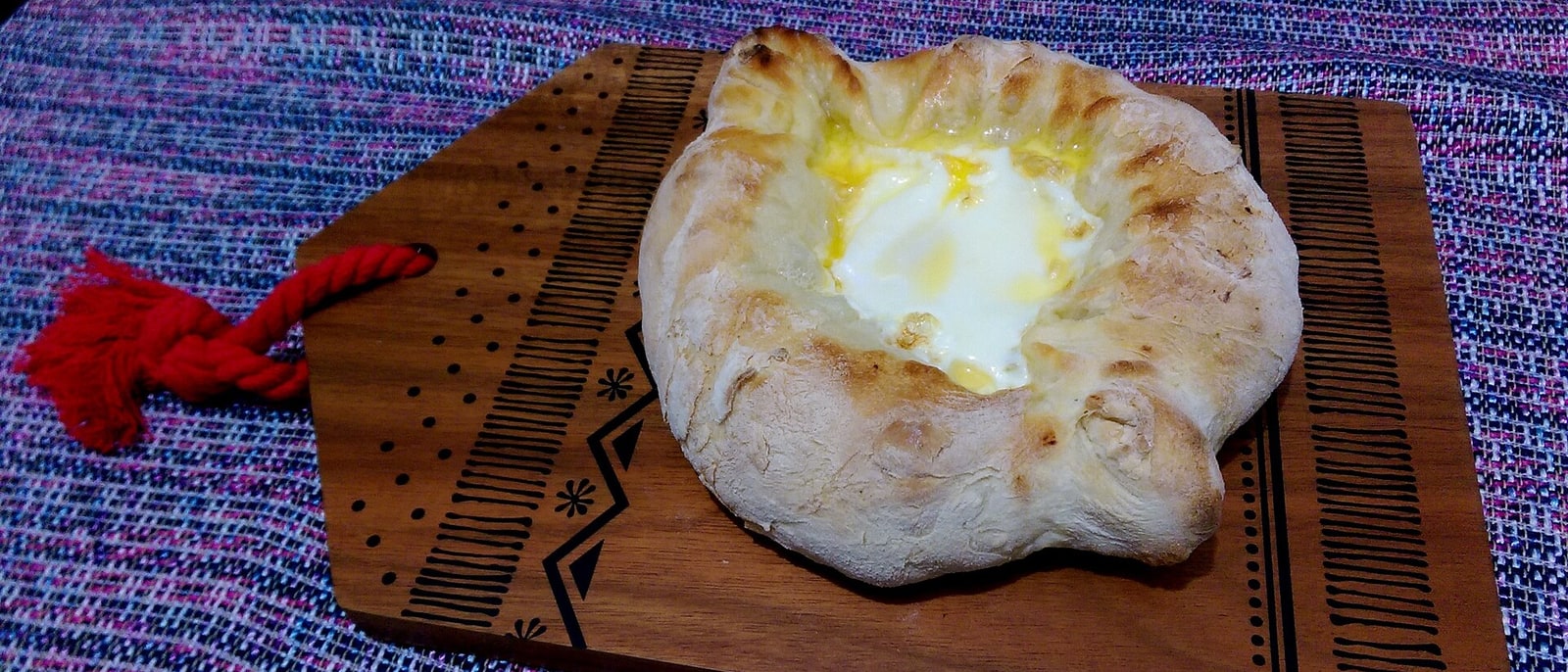
Two dishes hold the fame and both have a technique: khachapuri, which is bread with cheese, and khinkali, which are broth dumplings. The second is eaten a particular way and getting it wrong is very visible.
The route, stop by stop
3 STOPS- 01
Khachapuri
Bread stuffed with cheese, and every region has its own: imeruli is round with the cheese inside, megruli adds melted cheese on top, and adjaruli, the famous one, is shaped like an open boat with the cheese bubbling inside and a raw egg and a knob of butter dropped in at the end.
Adjaruli is eaten with your hands and with method: stir the egg and butter into the hot cheese until it sets, then tear pieces off the rim of the boat to dip in the middle.
And the boat shape isn’t decorative: it comes from the Black Sea coast and represents one, with the egg as the sun.
- 02
Khinkali
Large, hand-pleated, filled with spiced meat and broth. The technique matters more than the recipe: pick one up by the knot on top, take a small bite from the side, sip the broth before it spills, then eat the rest. The knot, which stays tough, isn’t eaten: you leave it on the plate. Traditionally it’s how you count them, and at a Georgian table the pile of knots in front of each person is the scoreboard. Ordering fewer than five each counts as a snack.
- 03
Walnuts, pomegranate and the market
Nearly the whole vegetable repertoire runs through the walnut. Badrijani nigvzit proves it better than anything: rolls of fried aubergine filled with walnut paste and garlic, pomegranate scattered on top. And pkhali, balls of chopped vegetable (spinach, beetroot, leek) bound with ground walnut.
For dessert, churchkhela: strings of walnuts threaded and dipped many times in thickened grape must, hung to dry and looking like coloured candles.
You see them hanging in every market and at roadside stalls. It is, literally, grape and nut, and it keeps for months.
Frequently asked
Is Georgia good for vegetarians?
Surprisingly good. Much of the traditional repertoire is plant-based for religious reasons: the Orthodox church has many fasting days without animal products, and that’s where dishes like pkhali, bean lobio and badrijani come from. Any menu has meat-free options.