OZU /SWITZERLAND /ZURICH /GUIDE
Zurich in a day: the old town
8 h route6 stopsBest: Any day but Sunday: the shops shutUpdated July 2026
Zurich has a reputation as a bankers’ city where nothing happens, and that reputation does it no favours: the old town takes twenty minutes to cross on foot, and inside it are the church where the Swiss Reformation began, five Chagall windows, and the alley where in 1916 Lenin and the inventors of Dada lived a hundred metres apart without knowing it.
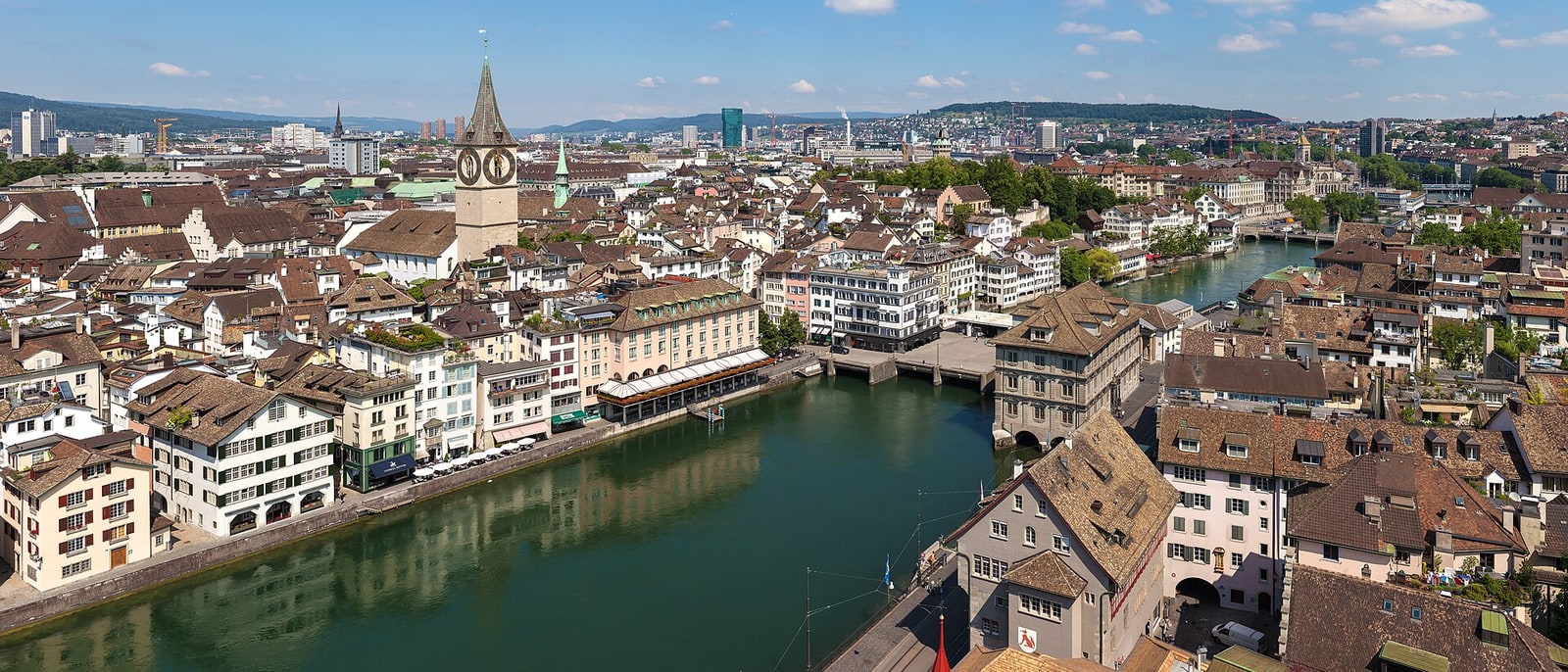
It’s a day on foot with no transport, on both banks of the Limmat. The only thing to plan is your wallet: Zurich competes every year for the title of most expensive city in the world, and that shows at lunchtime more than anywhere else.
The route, stop by stop
6 STOPS- 01
Lindenhof
Start at the top, to understand the shape of the place: the Lindenhof is the hill above the Limmat where the Romans put a customs post called Turicum, the origin of the name Zurich, and where a Carolingian palace stood later. None of that survives: it’s a square with lime trees, giant chess and the best view of the old town. The story told here is from 1292: with the Habsburgs besieging the city and the men away, the women of Zurich dressed as soldiers and paraded on the Lindenhof to fake a garrison. The siege was lifted. Legend or not, the city has been telling it for seven hundred years.
- 02
Fraumünster: the Chagall windows
From outside it promises nothing: a sober church with a green spire. Inside are the five stained glass windows Marc Chagall designed for the choir in 1970, aged 83, and they’re the reason to go in: five towering windows of pure colour (red, blue, green, yellow) that change the whole nave as the sun moves.
In the north transept there’s also a window by Augusto Giacometti from 1945. It’s the stop most people in Zurich skip and the one everybody remembers afterwards.
Photography is banned inside, so you’ll have to just look at them, which is exactly the right thing to do.
- 03
St. Peter and its clock
A five-minute stop with a fact that sticks: St. Peter’s tower has the largest clock face in Europe, 8.64 metres across. For scale, the minute hand is nearly four metres long. It isn’t a whim: this was the city’s public clock and it had to be legible from a distance, in an age without wristwatches. From the Lindenhof it’s perfectly framed, and you won’t be able to stop noticing it.
- 04
Grossmünster
The twin towers in every photo of Zurich, on the far bank. It’s the city’s heaviest building historically. Huldrych Zwingli began preaching here in 1519 and the Swiss Protestant Reformation came out of it: one reason the interior is so austere, since the reformers stripped the churches of images. That contrast explains Zurich better than anything: the bare Grossmünster on one bank and the Chagall-filled Fraumünster on the other. You can climb the Karlsturm by a narrow stair. The view over the roofs and the lake is worth the legs.
- 05
Niederdorf and the Spiegelgasse
The pedestrian quarter of the old town, all narrow alleys, is where Zurich loosens up: bars, small shops, people. And it hides the best coincidence of the 20th century, on a single street, the Spiegelgasse.
At number 1, in February 1916, the Cabaret Voltaire opened, where a group of artists who had fled the First World War invented Dada. At number 14, a hundred metres away, a Russian exile called Lenin was living at the time. In April 1917 he took a train to Petrograd.
The art that would blow up the century and the politics that would blow it up too, on the same alley, at the same moment.
- 06
Bahnhofstrasse and Paradeplatz
The street running from the station to the lake is one of the most expensive places on earth to rent a shop, and it shows: watches, jewellery and banks. The fun part is what’s underneath: the Bahnhofstrasse was laid out in 1864 on the city’s medieval moat, which was filled in to make it. It was called the Fröschengraben: the frogs’ moat.
Halfway down is Paradeplatz, the heart of Swiss banking, and on it Confiserie Sprüngli, on that corner since 1859. You don’t need to buy a thing on the whole street: it’s a twenty-minute walk that ends at the lake.
Frequently asked
Can you see Zurich in a day?
Yes, comfortably: the old town takes twenty minutes to cross on foot. One day covers the Lindenhof, the Chagall windows in the Fraumünster, the Grossmünster, the Niederdorf and the Bahnhofstrasse down to the lake, all walking.
What are the Chagall windows in the Fraumünster?
Five stained glass windows Marc Chagall designed for the church’s choir in 1970, when he was 83. They’re the best thing in Zurich and the stop most people skip. Photography inside isn’t allowed.
What’s Lenin’s connection to Zurich?
He lived in exile at Spiegelgasse 14, in the old town, from 1916 until April 1917, when he left for Russia. At number 1 on that same street, the Cabaret Voltaire, the birthplace of Dada, had opened in 1916: they were neighbours without knowing it.