Hanoi in a day
9 h route4 stopsBest: October and November: dry, cool and without the summer humidityUpdated July 2026
The thirty-six streets of the old quarter aren’t a metaphor: each street grouped a guild and carries its name. Hàng Bạc is silver, Hàng Mã is paper, Hàng Thiếc is tin. In several of them the same work still goes on, and that’s the best plan for a first day: walk and look into doorways.
The city is walkable because everything is packed together, but be aware the motorbike traffic is constant and never fully stops. Crossing has a technique and we explain it in the practical tips, because it’s what intimidates most in the first hours.
The route, stop by stop
4 STOPS- 01
Hoan Kiem lake and Ngoc Son temple
Hoan Kiem means “returned sword” and comes from the legend of king Le Loi, given a magic sword by a divine turtle to drive out the Chinese in the fifteenth century and who returned it here when he was done.
What’s interesting is that giant turtles of an extremely rare species really did live in the lake. The last died in 2016 and is preserved in the temple.
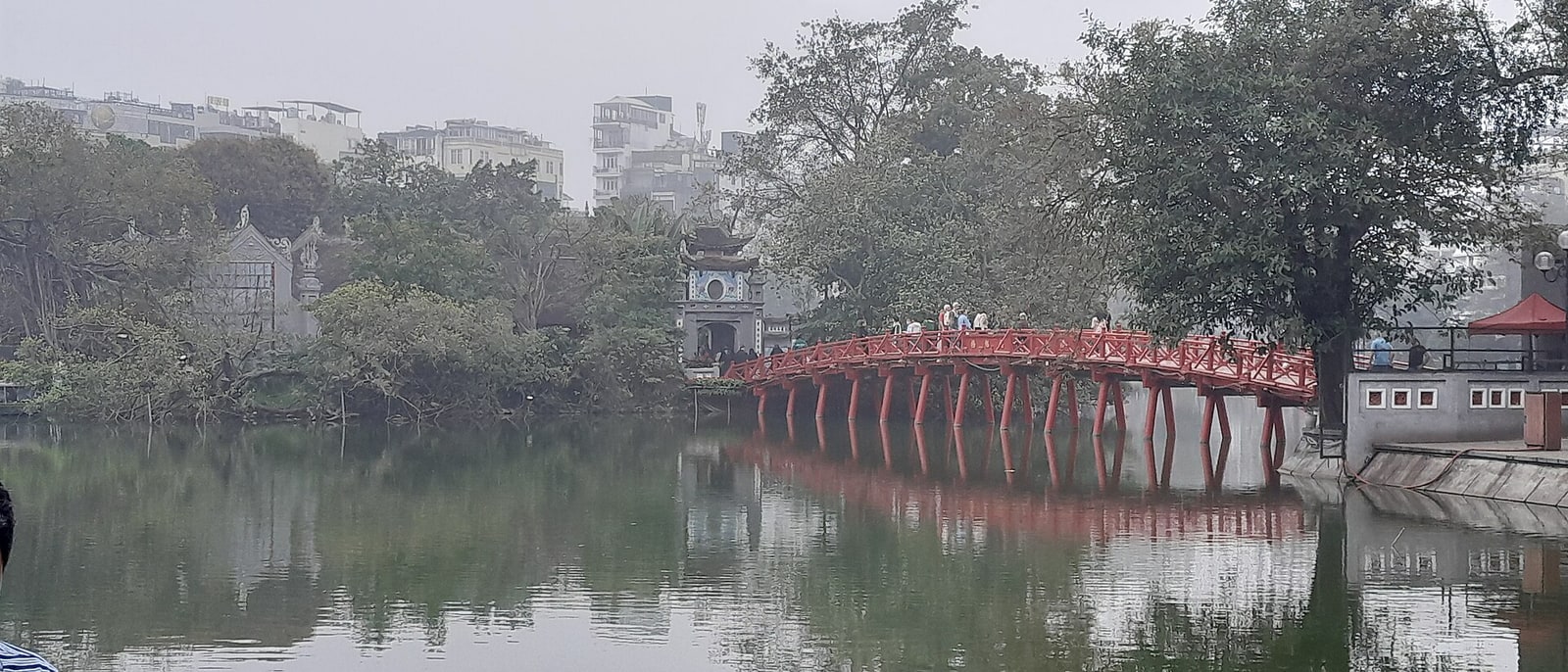
Ngoc Son temple is reached over The Huc, a wooden bridge painted deep red whose name means “where the morning sunlight alights”. The walk around the lake is the city’s living room: at six in the morning it’s full of people doing tai chi, and at weekends it closes to traffic.
- 02
The 36 streets
The quarter dates from the thirteenth century and was organised by guilds of craftsmen who came from the delta villages, grouping by trade and by street. The prefix Hàng means merchandise, so each street name says what was sold: Hàng Bạc (silver), Hàng Gai (silk), Hàng Mã (funeral paper and decorations), Hàng Thiếc (tin).
Look at the shape of the houses: extremely narrow and extremely deep, sometimes two metres of frontage and sixty of depth. They’re called “tube houses” and they’re like that because tax was calculated on metres of street frontage, so everyone built inwards.
A textbook case of a tax ending up drawing a city.
- 03
The Temple of Literature
Founded in 1070 as a Confucian temple and six years later turned into the country’s first university, the Imperial Academy, where mandarins were trained. It ran for over seven hundred years. It’s five successive courtyards, each more private than the last, with ponds and wooden pavilions.
What to see are the eighty-two stone stelae mounted on turtles: they carry the names of graduates of the imperial examinations between 1442 and 1779, with their home villages. They’re on UNESCO’s Memory of the World register.
Students come to touch them before exams, though it’s now prohibited to preserve them.
- 04
Egg coffee and a stool on the pavement
Cà phê trứng carries a cream of egg yolk whipped with condensed milk on top of the coffee, and it tastes like warm tiramisu. A waiter at the Metropole hotel invented it in 1946: fresh milk was scarce during the war and he replaced whipped cream with beaten yolk. It stuck, and today it’s the most Hanoi thing you can drink.
What matters isn’t only the coffee but where you drink it: on a twenty-centimetre plastic stool on the pavement, the national furniture. That’s where the city’s life happens: breakfast, games, arguments, and watching the traffic go by.
Sitting there for an hour is, without exaggeration, the best activity in Hanoi.
Frequently asked
Can you visit Hanoi’s “train street”?
Access is restricted and changes frequently: there are manned barriers, group tours have been banned since 2025 and in 2026 the frequency of trains through it was cut. Check the situation right before going and don’t build it into your plan as a certainty.
How many days do you need in Hanoi?
Two for the city and one or two more if you’re going to Ha Long bay or Ninh Binh, which is the usual plan. Many people use Hanoi as their northern base, and the night train to Sapa also leaves from here.