Tirana in a day
8 h route6 stopsBest: Spring and autumn. July and August are an ovenUpdated July 2026
Tirana looks like no other European capital, and the reason is that until 1991 it was closed to the world. Albania was the most isolated country in Europe: it broke with Yugoslavia, then the USSR, then China, and ended up alone, with a dictator convinced invasion was imminent. That left physical marks you can now visit.
The day fits inside the centre and works on foot: the main square, a nuclear bunker turned museum under your feet, the house where the secret police listened to the country, the pyramid the dictator’s daughter designed for her father, and the district where the regime’s elite lived and where the nightlife now is. It isn’t a beautiful city: it’s an interesting one, which is better.
The route, stop by stop
6 STOPS- 01
Skanderbeg Square
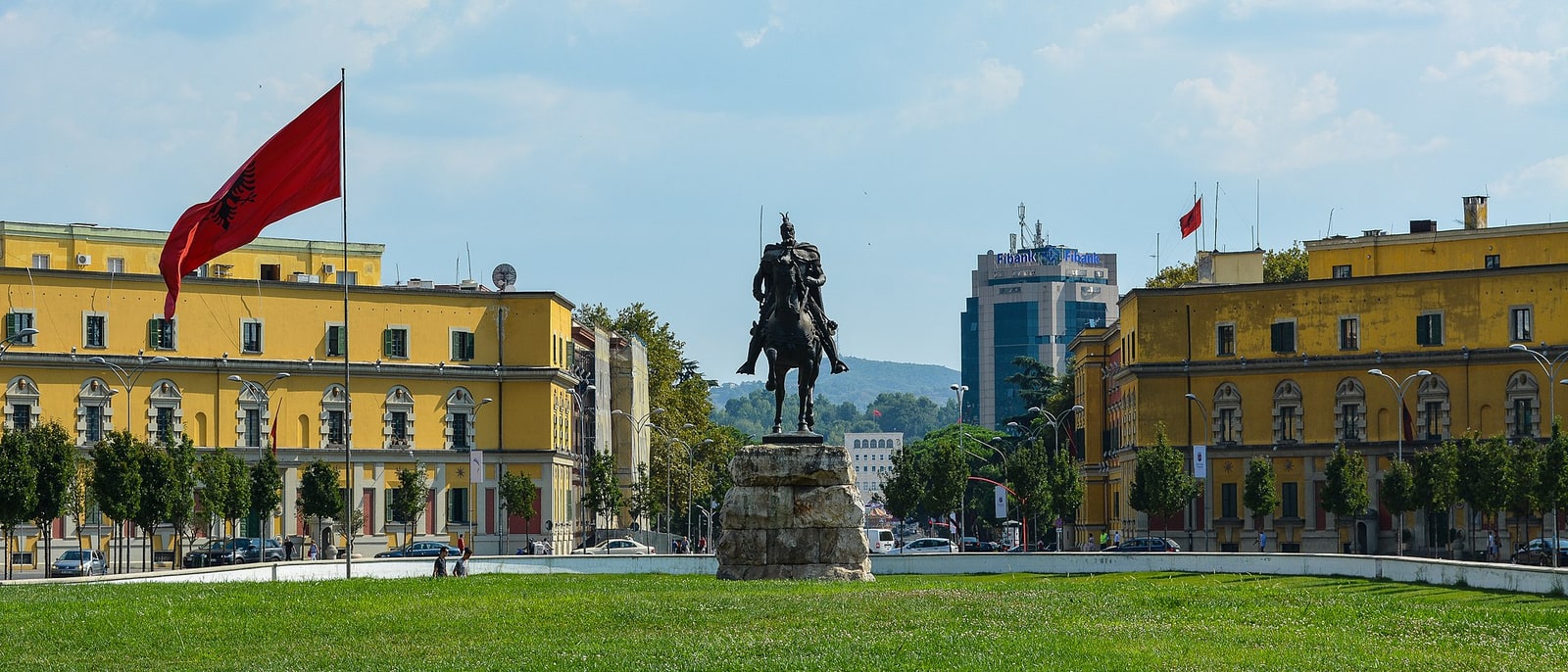
The centre of everything and the best place to start. It’s a giant car-free pedestrian expanse, rebuilt in 2017 with a good idea behind it: paved with stones brought from every corner of the country, so crossing it means walking on the whole of Albania. It won architecture prizes and you can tell it works, because it’s full of people at all hours.
In the middle, the equestrian statue of Skanderbeg, the national hero: a 15th-century nobleman who held off the Ottomans for twenty-five years. When he died in 1468, Albania fell within a few years. You grasp it quickly here: in a country that spent centuries occupied, the hero is the one who resisted.
- 02
The Et’hem Bey Mosque
The building with the strongest story on the square. In 1967 Albania declared itself the world’s first officially atheist state: it banned religion entirely, closed mosques and churches and turned them into warehouses or gyms. This mosque was spared for its artistic value and left shut.
In January 1991, with the regime dying, some ten thousand people walked into it without permission, and the police didn’t dare stop them. It was one of the moments that marked the end.
Inside, look at the frescoes: there are trees, waterfalls and bridges, landscapes. Highly unusual in a mosque. Next door is the 1822 clock tower, which you can climb.
- 03
Bunk’Art 2
The entrance already counts as half the museum: a concrete bunker dome poking out of a city-centre pavement, and you go down through it. Inside is a real Interior Ministry shelter, corridors and rooms intact, dedicated to what the Sigurimi, the secret police, did.
It’s hard going and well made: room by room it walks through the surveillance, the purges, the labour camps and the executed. It gives the context that makes everything else in the city make sense.
If you enter one museum in Tirana, make it this or the House of Leaves.
- 04
The House of Leaves
A discreet house covered in ivy, hence the name, that was first a clinic and then the secret police’s wiretapping headquarters. The museum is in the original building, with the microphones, hidden cameras and devices that were actually used, displayed where they were used. What lands isn’t the technology, which is crude: it’s the scale. An entire country listening to itself, with neighbours informing on neighbours. It’s small, it takes an hour, and it doesn’t leave you.
- 05
The Pyramid
The strangest building in the Balkans and an entire parable. It was raised in 1988 as a museum to the glory of Enver Hoxha, the dictator, designed by his own daughter. Three years later the regime fell and the thing lost its purpose: it became a conference centre, a NATO base during the Kosovo war, a television studio, and finally a concrete ruin that Tirana’s kids ran up the sloping walls of.
It was going to be demolished and the city decided against it. The MVRDV studio renovated it and it reopened in 2023 with real stairs, businesses inside and a technology centre for young people. Now you climb it legally and there’s a view.
A mausoleum turned into a school for teenagers: it’s the best metaphor this city has, and it’s been built.
- 06
Blloku, the forbidden district
Until 1991 this district was cordoned off: the Party elite lived here, Hoxha included, and an ordinary Albanian could not cross the street. There were guards. It was, literally, a forbidden block inside their own capital. It opened to the public in 1991 and today it’s Tirana’s bar, restaurant and shopping quarter: where the city goes out. Hoxha’s villa is still there and you can walk past it. That the most exclusive, most guarded place in the country is now where everyone has a beer says plenty about what’s happened here in thirty years.
Frequently asked
Is Tirana worth visiting?
Very much, if 20th-century history interests you. It isn’t a conventionally pretty capital: it’s the capital of a country closed to the world until 1991, with nuclear bunkers turned into museums, the secret police’s listening house and the forbidden quarter where the regime lived. It’s a day on foot.
What is the Pyramid of Tirana?
A 1988 building conceived as a museum to the dictator Enver Hoxha and designed by his daughter. After the regime fell it was a conference centre, a NATO base and a ruin, until the MVRDV studio renovated it and reopened it in 2023 as a technology centre for young people. You can climb it, and there’s a view.
What is Tirana’s Blloku?
The district where the Party elite lived, Hoxha included, guarded and off-limits to ordinary Albanians until 1991. Today it’s the city’s bar and restaurant quarter, and Hoxha’s villa is still standing.