OZU /SAUDI ARABIA /JEDDAH /GUIDE
Jeddah in a day
8 h route4 stopsBest: November to March, and late in the afternoon: the humid heat here is seriousUpdated July 2026
Jeddah makes more sense once you know it isn’t a desert city but a port. For thirteen hundred years it was where pilgrims coming across the Red Sea entered on their way to Mecca, and a city half the world passes through every year ends up resembling its hinterland very little.
The day splits into two natural halves: the morning in Al-Balad, the historic quarter listed by UNESCO in 2014, and the afternoon on the Corniche, thirty kilometres of seafront. In between comes the heat, which here isn’t negotiable: you spend it indoors.
The route, stop by stop
4 STOPS- 01
Al-Balad
The houses of Al-Balad went up in coral blocks quarried out of the Red Sea, a light, porous material that insulates against heat, bound with mortar and timber. Across the fronts run the rawashin: carved, pierced wooden oriels that let air and light through but not eyes, and they are the city’s visual signature.
Many are restored and others are still half falling, propped with beams. The best known is Nassif House, from the late nineteenth century, with the internal ramp camels once climbed and the big tree at the door, for decades the only one in the district.
Beside it is the Al-Alawi souq, the market as it has always been.
- 02
The Corniche sculpture museum
Through the 1970s and 80s, Jeddah’s municipality commissioned and bought work by some of the twentieth century’s major sculptors and planted it around the city and along the seafront, in the open air. There are pieces by Henry Moore, Joan Miró, Alexander Calder and Victor Vasarely, among many more.
It’s one of the most remarkable collections of public sculpture anywhere and remains little known outside the country. A good part of it was gathered and restored along one stretch of the Corniche.
You see it on foot, free, and late in the afternoon with the sea behind it is when it’s best.
- 03
King Fahd’s Fountain
It throws water over two hundred and fifty metres into the air, making it the tallest fountain in the world, and it’s visible from almost anywhere along Jeddah’s coast. It runs on Red Sea water, not fresh, pumped from the bay itself. It’s lit at night and it’s the city’s gathering point as the sun goes down, when the Corniche fills with families, cars and people picnicking. Seeing the Corniche at that hour tells you more about how life works here than any monument.
- 04
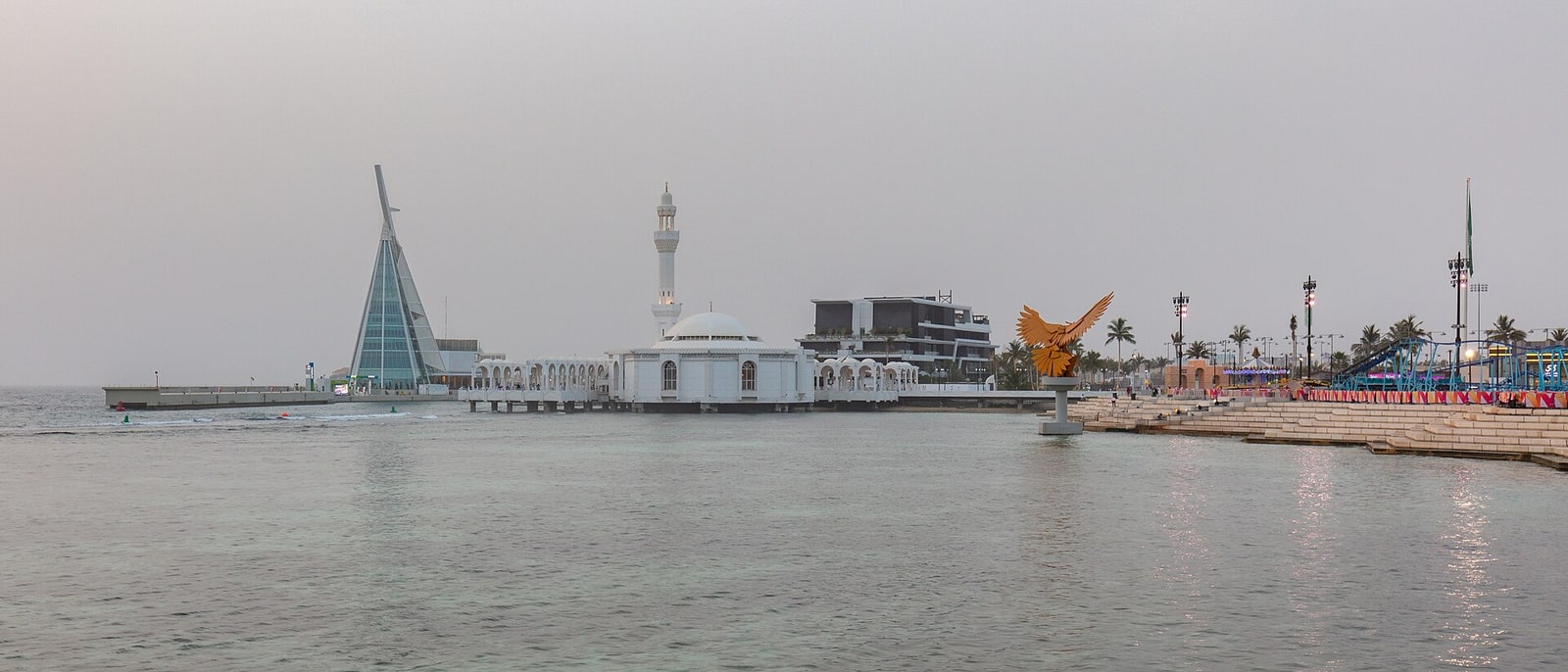
The floating mosque
Al-Rahmah mosque stands on piles out in the sea, a few metres from the shore, so that when the tide comes up the water surrounds it completely and it appears to float. It dates from the late 1980s, white, with a turquoise dome. It’s one of the most photographed places in the city, especially at sunset. As at any mosque, visit outside prayer times and in clothing that covers arms and legs. Women also cover their hair.
Frequently asked
Can you visit Mecca from Jeddah?
Only if you are Muslim. Mecca and Medina are reserved for Muslim visitors and there are checkpoints on the approaches, including on the train. It is an access rule, not a recommendation, and it’s worth being clear on before buying a Haramain ticket to those cities.
What should you wear in Jeddah?
Modest clothing: shoulders and knees covered for everyone. Since 2019 foreign women are not required to wear an abaya, though many do for convenience, and hair is covered only to enter mosques. Jeddah is more relaxed than the interior of the country.