Modern Valencia: science, sea and fire
6 h route4 stopsBest: The City of Arts at dusk: it lights up and reflectsUpdated July 2026
If the old town is Valencia in stone, this is the other one: the city built in the empty riverbed from the 1990s on, and now its global image. Santiago Calatrava’s complex, Europe’s largest aquarium, a zoo with no bars, and the museum housing the only things the Fallas never burn.
All of it sits outside the old town and is reached by bike along the riverbed or by metro. It’s a full day if you go into the Oceanogràfic. Half if you settle for the buildings from outside, which is already worth it.
The route, stop by stop
4 STOPS- 01
The City of Arts and Sciences
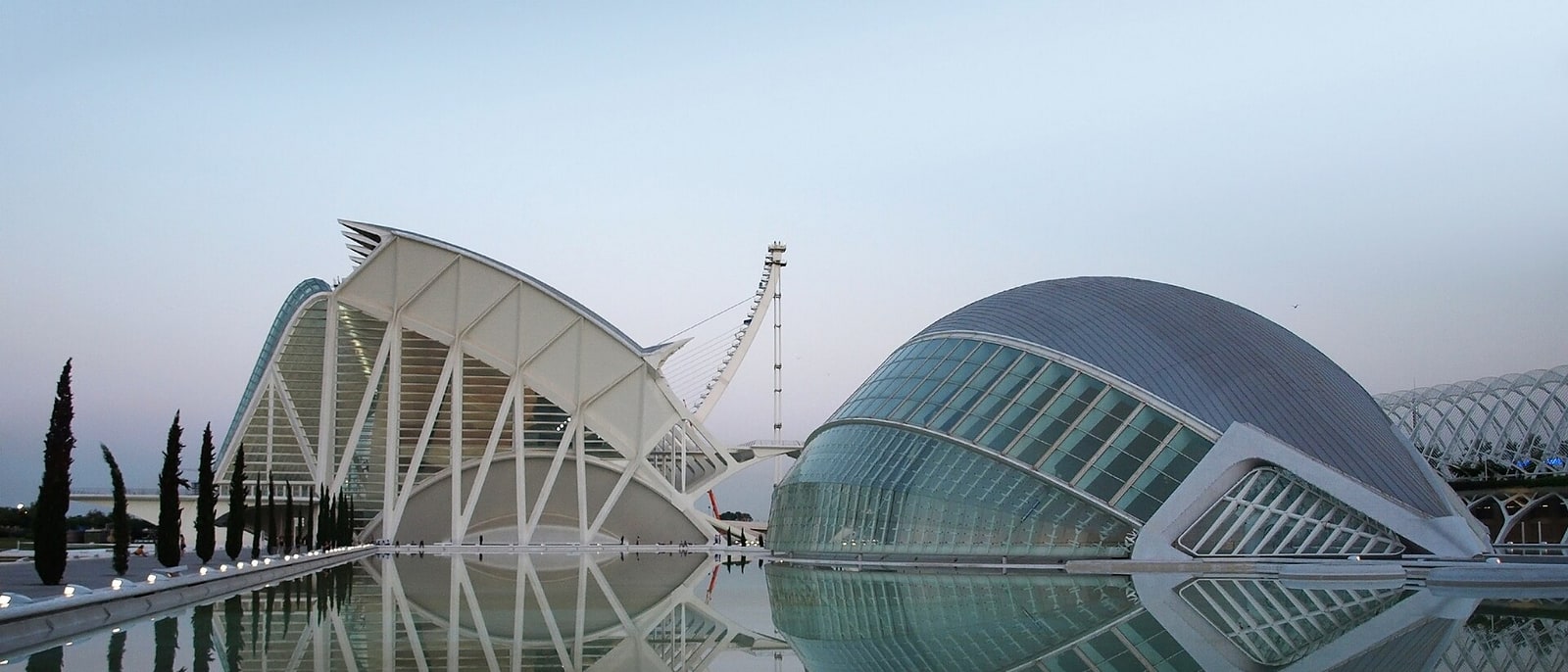
The ensemble Santiago Calatrava and Félix Candela raised at the far end of the riverbed: the Hemisfèric shaped like an eye that opens, the Science Museum like a whale skeleton, the Palau de les Arts and the Àgora. All white concrete mirrored on sheets of blue water.
It’s the city’s great controversy for what it cost and how late it ran, but also its face to the world. Go at dusk: when they light up and reflect in the water is when it finally makes sense.
Walking among them costs nothing.
- 02
Oceanogràfic
Europe’s largest aquarium, with around 45,000 animals of 500 species spread across buildings that recreate the planet’s ecosystems: the Arctic with belugas and walruses, the tropics, the Mediterranean and a dolphinarium.
The star is the underwater tunnel crossing the shark tank.
It’s expensive and needs a long half-day, so it’s the day’s plan if you have kids or love the sea. Book online.
- 03
Bioparc
An immersion zoo at the western end of the riverbed: no visible bars, the animals separated from visitors by moats, rocks and level changes, so it feels like being inside the habitat.
It recreates the savannah, Madagascar and the African equatorial forest.
It’s the opposite of the classic zoo and works very well with children. It sits next to the Parque de Cabecera, so it links to the riverbed walk at its other end.
- 04
Museu Faller
Every year at the Fallas, every monument burns except one: the ninot indultat, the figure the public votes to save. This museum keeps every pardoned figure since 1934, one per year.
It’s the best way to understand the festival if you don’t come in March: you see the craft evolve, from papier-mâché to today’s materials, and the satire of each era.
Small, cheap and surprisingly good.
Frequently asked
Is Valencia’s Oceanogràfic worth it?
It’s the largest aquarium in Europe, with around 500 species and a tunnel under the shark tank. It needs a long half-day and it’s expensive, so it pays off above all with kids or if you care about marine life.
Can you see the City of Arts without paying?
Yes: walking among the buildings and the water pools is free, and it’s the most spectacular part, especially at dusk. You only pay to enter the Oceanogràfic, the museum or the Hemisfèric.
What is a ninot indultat?
It’s the falla figure the public votes to save from the fire each year. Every other monument burns in the cremà. The pardoned one goes to the Museu Faller, which keeps one per year since 1934.