The river that isn’t there
3 h route4 stopsBest: At dawn or dusk, by bike. Midday sun is fierceUpdated July 2026
In 1957 a flood of the Turia left hundreds dead in Valencia, and the city made a strange, luminous decision: instead of channelling the river, it diverted it around the outskirts and turned the empty bed into a nine-kilometre park running right through the centre. Today it’s the best way to see the city: by bike, below street level, passing under the old bridges.
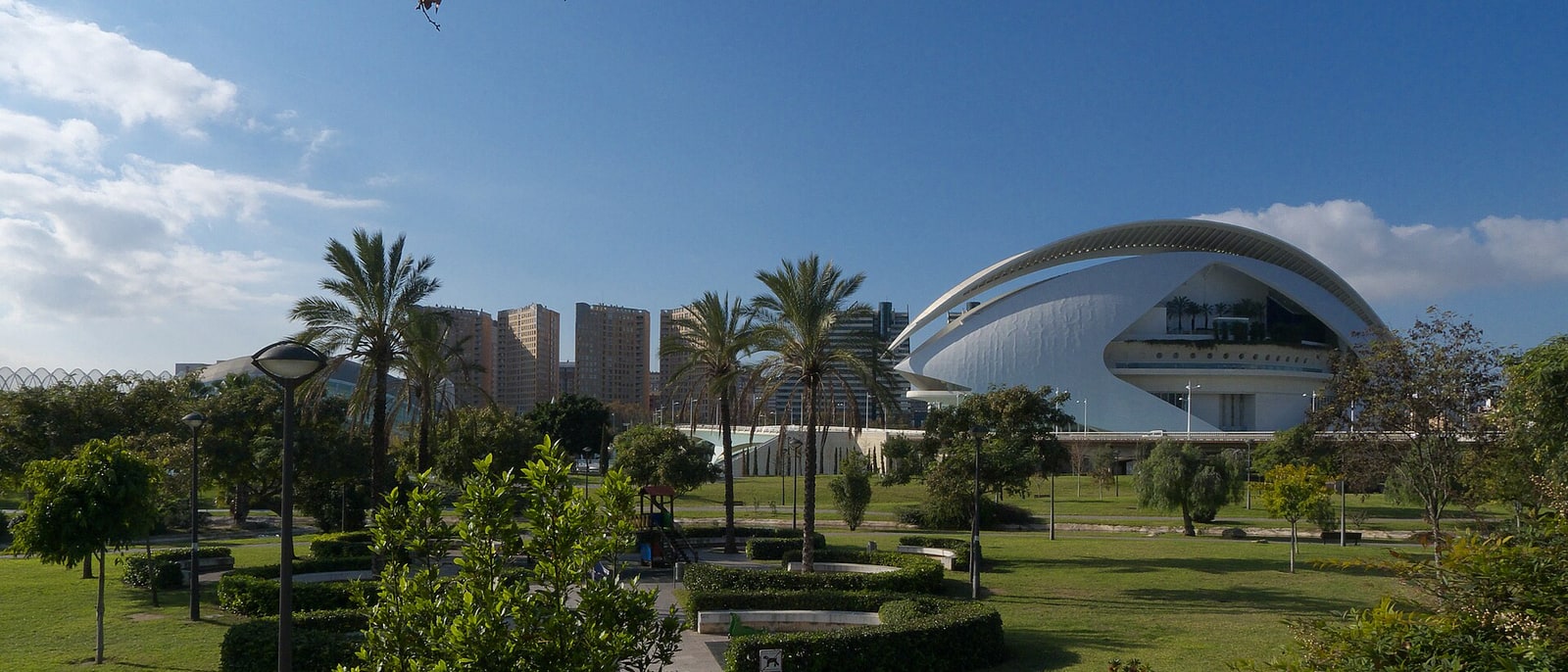
The Turia Garden connects almost everything on this list, from the Parque de Cabecera in the west to the City of Arts and Sciences in the east. Hire a bike and ride it end to end: it’s flat, shaded by trees, and doesn’t cross a single traffic light.
The route, stop by stop
4 STOPS- 01
The Turia Gardens
The dry riverbed, landscaped in the 1980s by the architect Ricardo Bofill: nine kilometres of pines, orange trees, fountains and sports pitches, with a cycle path from end to end. The historic stone bridges are still in place, now crossing grass instead of water.
It’s Valencia’s lung and axis, and where the city lives: people run, stroll and play here.
Take it as the backbone of your day and step out of the bed towards the places on this route.
- 02
The City of Arts and Sciences
The futuristic complex by Santiago Calatrava and Félix Candela at the far end of the bed: a science museum shaped like a skeleton, an IMAX cinema like an eye, an aquarium and an arts palace, all white concrete mirrored in sheets of blue water.
It’s Valencia’s modern image and its great controversy, for what it cost and how late it ran.
Even without going into the buildings, walking among them at dusk, when they light up and reflect, is free and spectacular.
- 03
Cabecera Park
The western end of the bed, where the garden opens into a boating lake, a riverside wood and a hill with views over the whole city. It’s far quieter than the Arts end and almost only locals use it.
It sits next to the Bioparc, the immersion zoo with no visible bars.
If you’re cycling the bed, it’s the natural starting point: from here you roll towards the centre with the wind behind you.
- 04
The Flower Bridge
One of the modern bridges crossing the bed, covered in flowerbeds all year round: more than 27,000 plants the city swaps by season. It’s the easy photo of the route and a good point to leave the garden for the historic centre. From here, climbing up out of the bed, a short walk reaches the cathedral and the market. It marks the moment to drop the bike and move into stone-built Valencia.
Frequently asked
Why doesn’t Valencia have a river?
It does, but diverted. After the great flood of 1957, the city rerouted the Turia around the outskirts and turned the bed that crossed the centre into a nine-kilometre park, the Turia Garden.
Can you cycle the Turia Garden?
Yes, it’s the best way: a flat cycle path from end to end, nine kilometres with no traffic lights, and bike hire all over the city. It links the Parque de Cabecera with the City of Arts and Sciences.
Is the City of Arts and Sciences worth seeing from outside?
Very: Calatrava’s cluster of white buildings mirrored in the water is free to walk and spectacular at dusk. Tickets for the aquarium, the museum or the IMAX are paid separately.