OZU /SWITZERLAND /GENEVA /GUIDE
Geneva’s neighbourhoods
4 h route5 stopsBest: Carouge, Saturday morning, with its marketUpdated July 2026
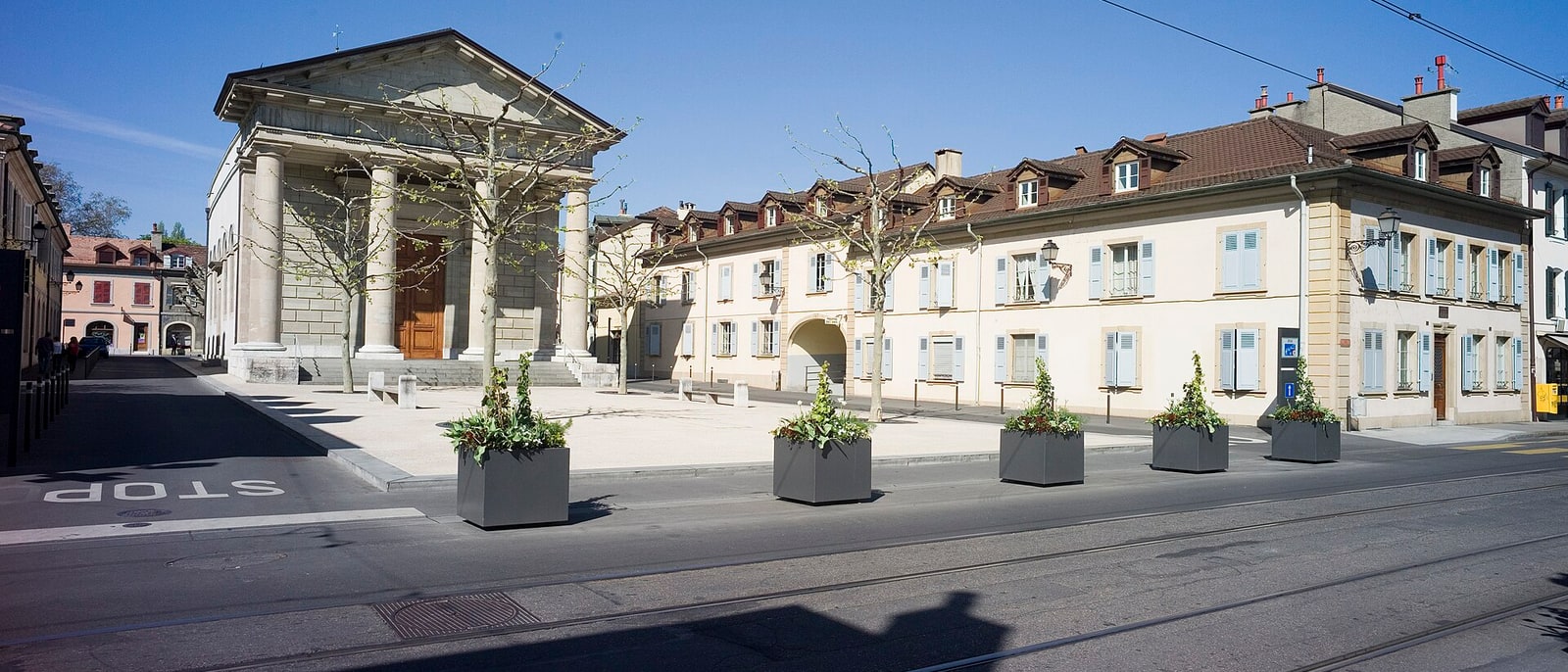
Geneva looks uniform (expensive, orderly, international) until you cross a bridge or a river. Then an Italian district of low houses that wasn’t Swiss until 1816 appears, and a working quarter where you eat half the world ten minutes from the banks, and the largest old town in the country.
The city is small and everything is a walk or a tram away. Here are the five districts and why each one is the way it is.
The route, stop by stop
5 STOPS- 01
Carouge
The district with the best story in the city. In the 18th century Geneva was an austere, closed Calvinist republic, and across the river Arve ruled the King of Sardinia. So he decided to build, directly opposite, a town that would be everything Geneva was not: Catholic, tolerant of Jews and Protestants, with taverns, theatres and no moral restrictions. An urban antidote.
Piedmontese architects laid it out on a grid with low courtyard houses, which is why Carouge looks like an Italian village and not a Swiss city. It was annexed to Geneva in 1816.
Today it’s the district of artisans, terraces and bars, with a market on Saturdays. It’s the most pleasant part of Geneva.
- 02
Pâquis
Ten minutes from the banks and a step from the lake: Geneva’s most mixed district, with people from everywhere and, as a result, the best and cheapest food in the city. It’s also a bar area with a red-light element, with what that brings. It’s safe and it’s alive at all hours.
The Bains des Pâquis are here, the public baths on the lake that are the city’s best-loved institution.
That the most democratic place in Geneva sits in its most working-class district is no accident.
- 03
La Vieille Ville
The largest old town in Switzerland, on top of the hill: cobbled streets, antique dealers, galleries and St Pierre Cathedral above it all. This is where Calvin’s Geneva was, the one that drew reformers from half of Europe. The Place du Bourg-de-Four was the Roman forum, then the market, and today it’s the square for sitting on a terrace. It’s the most charming area and also the priciest: here you walk and look, but for eating you go back down.
- 04
Eaux-Vives
Following the lake from the Jet d’Eau: a pleasant residential district with Geneva’s great public parks, the Parc La Grange, with an enormous rose garden, and the Parc des Eaux-Vives, both looking over the water. The new thing is that Geneva built itself a public beach here, which in a city with so much lake and so little free access to it had been a long-standing demand. It’s the Sunday walk, and from here Mont Blanc is straight ahead on clear days.
- 05
Plainpalais
The plaine de Plainpalais opens a giant diamond-shaped space in the middle of the city, and there Geneva does everything: a flea market several days a week, a produce market, the circus when it comes, fairs, and a skatepark that’s always full.
Around it are the university quarter and MAMCO, the contemporary art museum, in a former factory. This is young, untidy Geneva, and the flea market is one of the few places in this city where something costs little.
Frequently asked
Why does Carouge look like an Italian village?
Because it is, by origin: the King of Sardinia built it in the 18th century with Piedmontese architects as a rival town to Calvinist Geneva. Catholic, tolerant and with taverns. It wasn’t Swiss until 1816.
Where do you eat cheaply in Geneva?
In Pâquis, between the station and the lake: it’s the city’s most mixed district with the most varied, affordable food, ten minutes from the centre. Carouge and the university area around Plainpalais are the other two answers.
What’s the nicest neighbourhood in Geneva?
The Vieille Ville is the most monumental (Switzerland’s largest old town, with Calvin’s cathedral) but Carouge is the nicest for an afternoon: low Italian houses, courtyards and terraces, ten minutes away by tram.