OZU /SWITZERLAND /GENEVA /GUIDE
Geneva in a day
8 h route6 stopsBest: The Jet d’Eau doesn’t run year-round: it stops in deep winterUpdated July 2026
Geneva has an image problem: it’s associated with the UN, the banks and the watches, and it sounds like a city of meetings. But underneath that is a Protestant city-state that for two centuries was the Rome of Calvinism, with Switzerland’s largest old town on top of a hill.
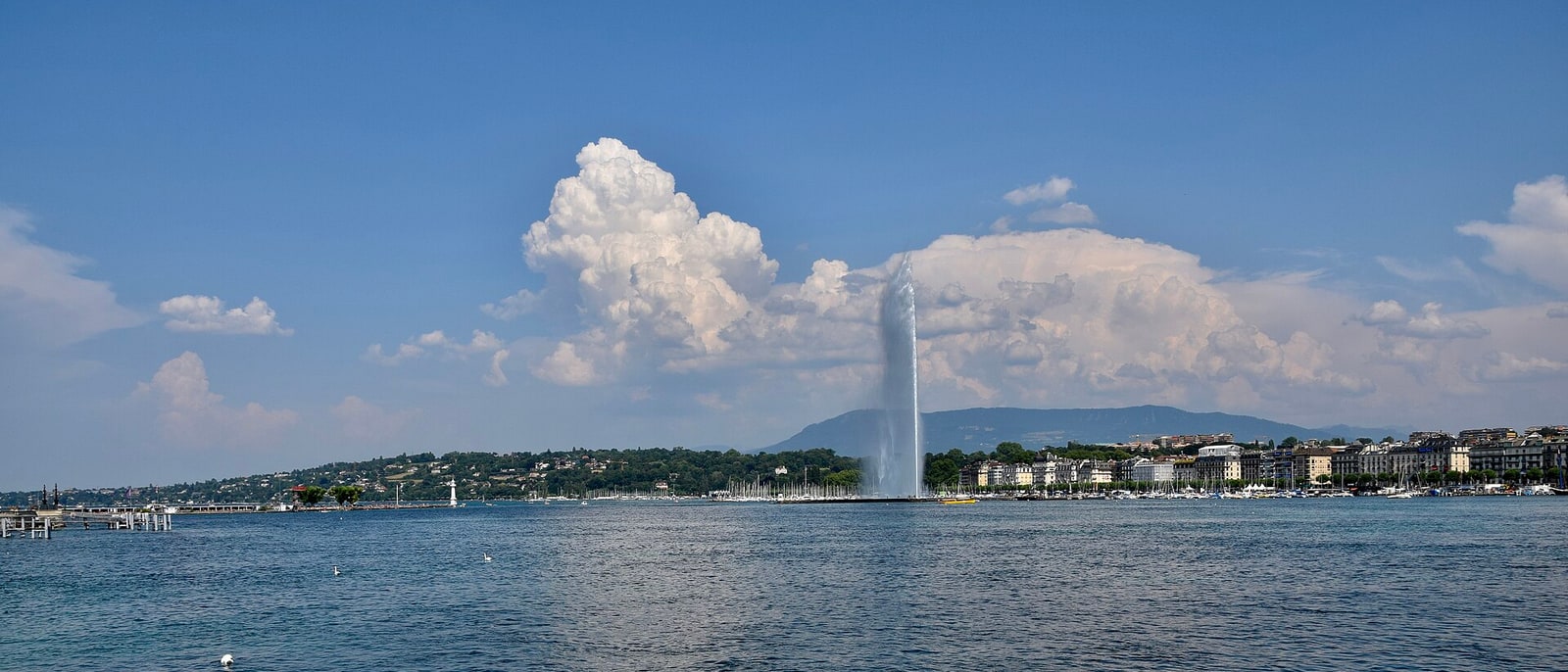
The whole thing is a day on foot, and there’s one thing worth knowing before you come: the Jet d’Eau, the 140-metre plume that is the city’s symbol, doesn’t run all year. In deep winter they switch it off. Don’t plan the entire trip around one photo.
The route, stop by stop
6 STOPS- 01
The Jet d’Eau
Geneva’s symbol and, by some distance, the city’s best story: it wasn’t designed as a monument. In 1886 the hydraulic plant powering the workshops had a problem (when the craftsmen shut everything at the end of the day, the pressure had nowhere to go) so they fitted a relief valve that vented the excess into the air.
Genevans liked the accidental jet, so in 1891 they moved it to the harbour mouth and made it an attraction. Today it climbs 140 metres and throws around 500 litres a second at roughly 200 km/h: you can see it from the plane as you land.
Walk the jetty to its base if you don’t mind getting soaked, which will be decided by the wind and not by you.
- 02
The Flower Clock
Five minutes from the Jet d’Eau, in the Jardin Anglais: a working clock several metres across made of thousands of plants, replanted several times a year with the seasons. It’s been there since 1955 and it’s the city’s nod to what made it rich before banking: watches. It claims the longest second hand in the world. It’s a two-minute stop and a photo, but it’s on the way to the old town and it says something about the place: here even the flowerbed tells the time.
- 03
St. Peter’s Cathedral
The church from which John Calvin preached between 1536 and 1564, and from which Geneva became the Rome of Protestantism, with reformers arriving from half of Europe. Calvin’s chair is still inside, and the interior is bare: the reformers emptied the building of images, and that bareness is the message.
Look at the facade before you go in: it’s an 18th-century neoclassical portico of columns, grafted onto a Romanesque and Gothic church. It doesn’t fit at all, and that’s the charm. Beneath it is one of the most extensive urban archaeological sites in Europe, with the earlier churches excavated. And above are the towers, which you climb for the best view of Geneva.
- 04
The Vieille Ville and the Maison Tavel
Geneva’s old town, the largest in Switzerland, contradicts what you expect from this city: cobbled slopes, small squares, antique dealers and not an international organisation in sight. The Place du Bourg-de-Four, which was the Roman forum and later the market, is the place to sit down. The Maison Tavel is the oldest private house in the city, from the 14th century, and today it’s a free museum of urban history. It holds an enormous model of Geneva as it was before the walls came down in 1850, which explains at a glance why the city has the shape it has.
- 05
The Reformation Wall
In the Parc des Bastions, against the old rampart: a hundred-metre wall with four five-metre statues (Farel, Calvin, Bèze and Knox) raised in 1909 for the 400th anniversary of Calvin’s birth. It’s solemn, it’s enormous and it’s very much of this place: instead of a king on a horse, four men with books. The park is also where Geneva spends the afternoon: there are giant chessboards set into the ground and there’s always a game on. It’s a twenty-minute stop that becomes an hour without you noticing.
- 06
The Bains des Pâquis, at sunset
Geneva’s best-loved institution and the proof that the city isn’t only diplomats: public baths built out on a jetty into the lake, open since 1932, where everyone swims and where there’s no trace of expensive Geneva.
In summer you swim looking at the Jet d’Eau and Mont Blanc on a clear day. In winter it doesn’t close: it becomes a sauna and hammam, and they serve fondue. It was nearly demolished in the 1980s and the city voted to save it, which explains everything.
It’s the best sunset in Geneva and it costs little.
Frequently asked
Can you see Geneva in a day?
Yes: the Jet d’Eau, the Flower Clock, St Pierre Cathedral, the Vieille Ville, the Reformation Wall and the Bains des Pâquis are a day on foot. International Geneva (the UN, the Red Cross, CERN) needs another day.
Why does Geneva’s Jet d’Eau exist?
By accident. In 1886 it was a safety valve on the hydraulic plant: when the workshops shut at once, the excess pressure was vented into the air. People liked it so much that in 1891 it was moved to the harbour as an attraction. Today it rises 140 metres.
Does the Jet d’Eau run all year?
No: it’s switched off in deep winter, and also in strong wind or frost, for safety. If your trip depends on that photo, check first: it isn’t a fixed monument, it’s an installation that gets turned off.