What to see in Prague
12 h route4 stopsBest: All year. Winter brings fog and fewer peopleUpdated July 2026
The first thing to understand about Prague is why it’s still standing. Dresden, two hours away by car, was flattened in 1945. Warsaw was demolished on purpose. Prague came out with comparatively minor damage, and the result is that here Gothic is Gothic and Baroque is Baroque, not a well-executed postwar reconstruction.
The second thing is that this city has a habit of throwing people out of windows when it gets angry. It has happened twice with historical consequences, and the second time it started a thirty-year war.
The route, stop by stop
4 STOPS- 01
Old Town Square
Besides the orloj and the black spires of Týn, twenty-seven white crosses are set into the pavement in front of the town hall.
They mark where, in 1621, twenty-seven Czech nobles and burghers were executed after the Protestant defeat at White Mountain. Twelve of their heads hung for ten years on the bridge tower.
The square also has an odd gap at one corner: an entire wing of the town hall is missing, burned by German forces in May 1945, in the last days of the war, during the Prague uprising. It was never rebuilt and today it’s a small garden.
- 02
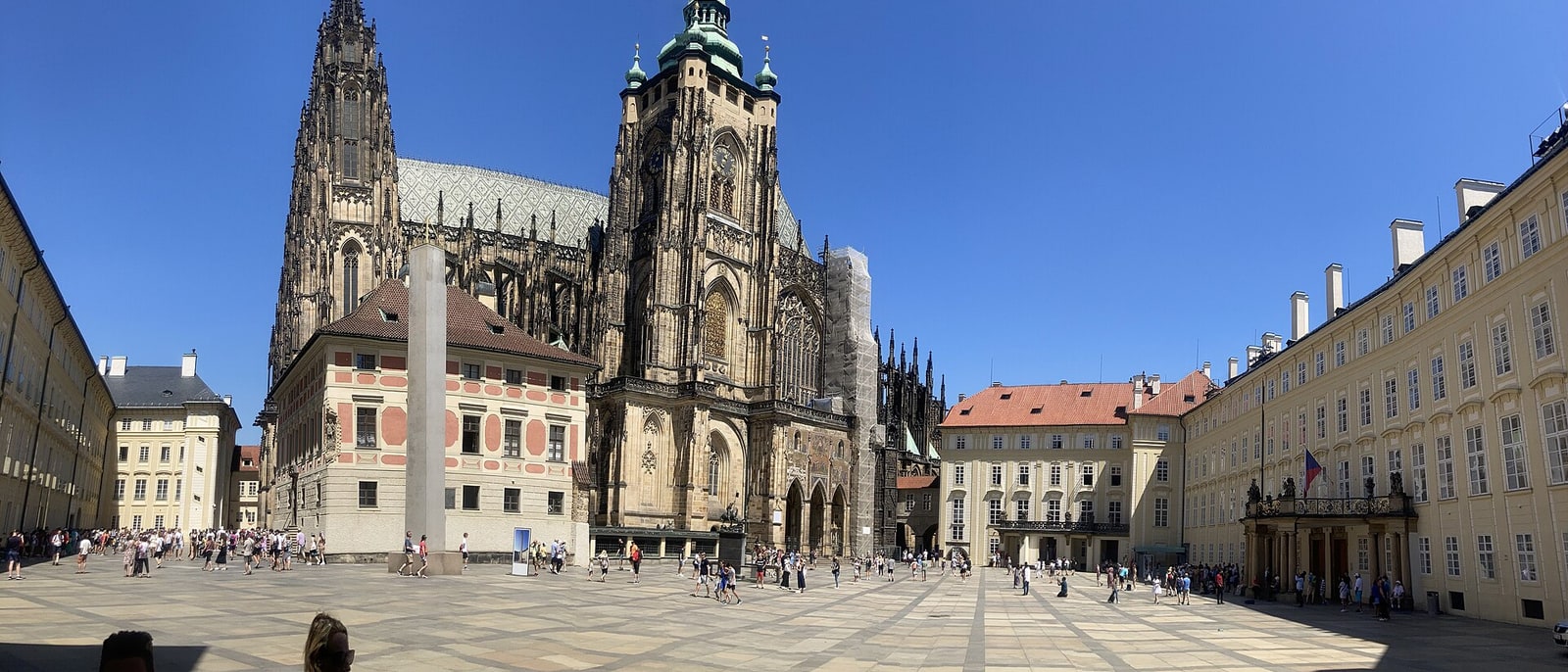
The castle and St Vitus
In the Old Royal Palace, inside the compound, is the window from which two imperial governors and their secretary were thrown in 1618. They fell some seventeen metres and all three survived: Catholics said an angel had saved them, Protestants said a dung heap had. That lit the Thirty Years’ War, which took much of central Europe with it.
The cathedral keeps the Bohemian crown jewels behind a door with seven locks, whose keys are held by seven different people. They go on display very rarely.
- 03
Wenceslas Square
It’s seven hundred metres long by sixty wide: a medieval horse market, and it still has the shape of one, with the National Museum closing it at the top. Hundreds of thousands gathered here in November 1989 shaking keys in the air, and within weeks the regime was gone without a shot. Hence the Velvet Revolution.
In front of the museum there’s a bronze cross set in the ground, buckled out of shape. It marks where Jan Palach, a twenty-year-old student, set himself on fire in January 1969 in protest at the Soviet invasion of the year before.
He died three days later.
- 04
Vyšehrad
Two kilometres upriver stands a second castle almost nobody mentions, on a crag, with Baroque walls and grass. Legend puts the city’s origin here, and it holds the national cemetery: Dvořák, Smetana, Mucha, Čapek. Entry is free and you walk with nobody in front of you. The views of the Vltava from the ramparts are the best in Prague and never make the postcards, which prefer the castle. It’s where locals go on a Sunday.
Frequently asked
Why is Prague so well preserved?
Because it wasn’t flattened in the Second World War like Dresden or Warsaw. It took damage, a mistaken Allied bombing in 1945 and the burning of the town hall during the uprising, but the historic fabric survived, which is why what you see is original rather than rebuilt.
Is Prague Castle worth going inside?
The grounds are free to walk and part of the cathedral is accessible without a ticket. The paid ticket covers the Old Royal Palace, where the defenestration window is, St George’s Basilica and the Golden Lane. If Czech history interests you, yes. If you came for the view, the climb is enough.