Prague in a day
9 h route5 stopsBest: April to June and September to October. July and August are crowdsUpdated July 2026
A day in Prague is literally uphill: you start low, in the old town, cross the river and finish at the top of the castle. That order is practical, not poetic: Charles Bridge at nine in the morning and Charles Bridge at midday are two different places, and only one of them can be crossed without shuffling in single file.
The whole thing is a walk of a bit over an hour if you don’t stop. What eats the day is the queues, the castle has a security check, and the hills, which here are real hills.
The route, stop by stop
5 STOPS- 01
The astronomical clock, at nine
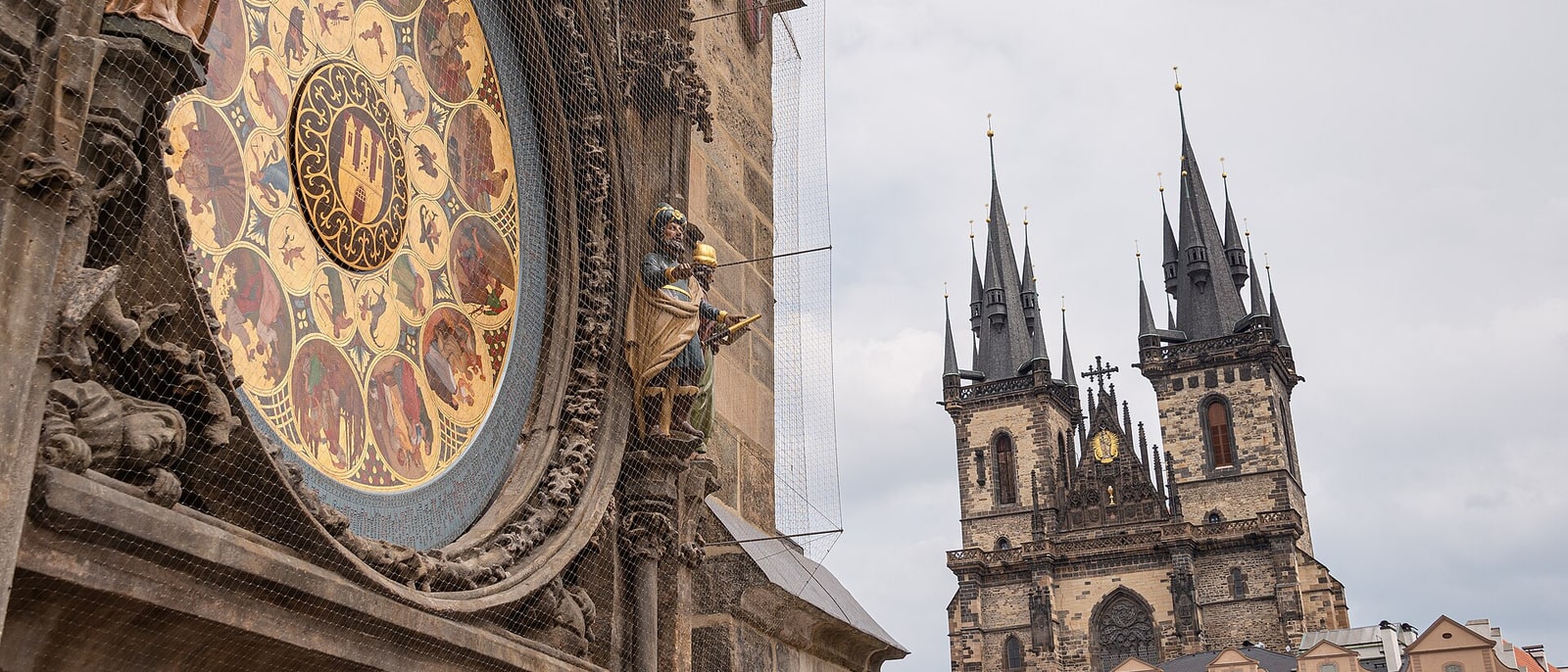
The orloj went up in 1410 on the south wall of the town hall and has been telling the time for six centuries, which is what makes it singular: there are showier astronomical clocks, but none this old and still running. On the hour two small windows open and the twelve apostles file past while a skeleton pulls a rope.
The show lasts under a minute and tends to disappoint anyone expecting more. What rewards attention is the lower dial. The calendar face, with its twelve months painted by Josef Mánes, is a copy: the 1866 original is kept in the city museum because sun and rain were wearing it away.
At nine in the morning you can still cross the square. By midday you’re watching from three rows back, with someone’s elbow at your neck.
- 02
The Jewish quarter, Josefov
The old cemetery doesn’t leave you. For more than three centuries it was the only ground where Prague’s Jewish community was allowed to bury its dead, and since it couldn’t be widened, it was buried upwards: layer on layer of soil, up to twelve deep in places. That’s why the twelve thousand visible headstones lean and crowd against each other, shoved by the rising ground.
The Pinkas synagogue next door carries the names of nearly eighty thousand Jews of Bohemia and Moravia murdered in the Holocaust, written by hand on the walls, surname by surname. They were painted over under the communist regime on the pretext of damp, and written again in the nineties.
Tickets to the circuit are sold together and are worth booking: it’s one of the few things in Prague that sells out.
- 03
Charles Bridge
Charles IV laid the first stone in 1357, replacing a Romanesque bridge a flood had taken away. This one held where the other hadn’t, and today it’s pedestrian: sixteen arches, two towers and thirty Baroque statues added from 1683 onwards. Almost all the ones you see are copies. The originals are in the Lapidarium, out of the pollution.
The statue people rub until it shines is St John of Nepomuk, thrown into the river from this very bridge on Wenceslas IV’s orders. Touching the plaque for a wish is a twentieth-century habit, not a medieval one: the guides invented it.
Early on there are painters setting up easels and mist coming off the water. From eleven it’s a slow flood of people in both directions.
- 04
Malá Strana
Across the bridge begins the Lesser Town, which isn’t especially lesser: Baroque palaces built by nobles who wanted to be near the castle, with courtyards you can walk through and gardens terraced up the slope. St Nicholas church, with its green dome, is among the most excessive things central European Baroque ever did.
The Lennon Wall is here too, a stretch of wall that filled with graffiti after the Beatle’s murder in 1980 and that the communist police painted over again and again, getting nowhere.
People still paint on it, so you never see it the same twice.
- 05
The castle, and the six-hundred-year cathedral
The word castle falls short for seven hectares of palaces, churches, gardens and a whole street of tiny houses. It’s still the seat of the Czech presidency, so there are guards and security checks at the gates, and that’s what the queue is.
Inside stands St Vitus Cathedral, begun in 1344 and finished in 1929. Nearly six hundred years, with entire centuries of nothing happening: the west front and towers are nineteenth and twentieth century, and you can see it in the stone, paler and smoother. Inside is Mucha’s window, Art Nouveau from 1931 in a Gothic building, and it jars far less than it ought to.
If you’ve any energy left, the Golden Lane is a row of miniature houses built against the wall where guards and goldsmiths lived, and where Kafka wrote through one winter at number 22.
Frequently asked
Can you see Prague in a day?
The historic centre yes, because it’s compact and walkable: old town, Jewish quarter, Charles Bridge and castle fit into one long day. What doesn’t fit is going inside things unhurried. With one day you pick one, and it’s usually either the Jewish circuit or the castle.
What time should you cross Charles Bridge?
Before nine in the morning or after nine at night. Between eleven and six it’s a continuous mass in both directions and you can’t even see the river. At dawn there’s mist on the water and you cross almost alone.