Antalya in a day: Kaleiçi
8 h route6 stopsBest: Start at 9am. From 1pm to 4pm in summer you can’t walkUpdated July 2026
Kaleiçi, the old town, is a walled Roman harbour with wooden Ottoman houses inside it, and you can walk the whole thing in a day. Hardly anyone does: people arrive in Antalya for the beach, stay in a resort twenty kilometres out, and that’s that. It’s a mistake.
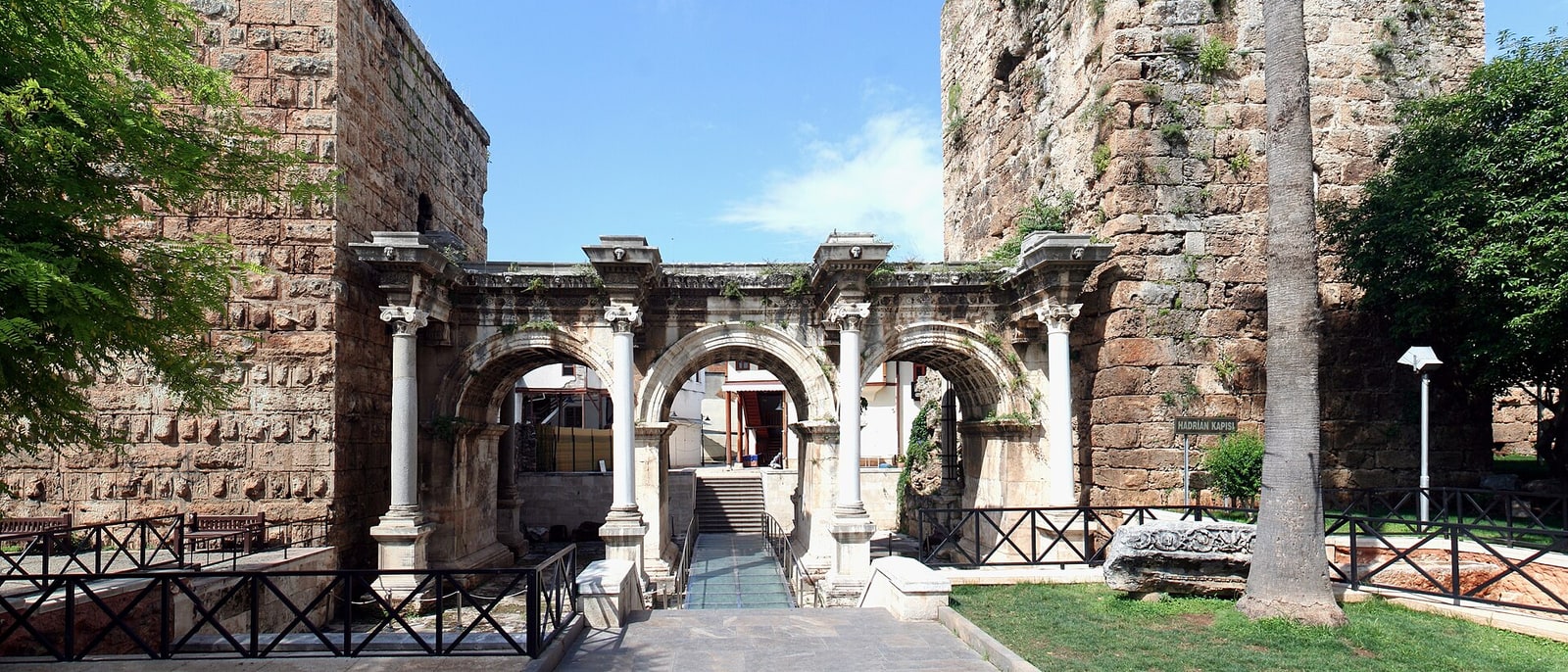
The plan fits in one square kilometre: the gate Rome raised for an emperor, the minaret the Seljuks left as a signature, a two-thousand-year-old harbour turned marina, and the archaeological museum where the statues from the Roman cities nearby ended up. Start early: in July and August, midday is uninhabitable.
The route, stop by stop
6 STOPS- 01
Hadrian’s Gate (Hadriyanüs Kapısı)
The monumental entrance to Kaleiçi and the oldest thing you’ll see standing: three white marble arches built in the year 130 to receive Emperor Hadrian, then touring his provinces.
It survives so well because for centuries it was walled up inside the city defences, and that saved it.
Look at the ground under the arches: those grooves were cut by Roman cart wheels and they’re still there. It’s one of the few pieces of an ancient city you can walk on without anyone stopping you.
- 02
The Fluted Minaret (Yivli Minare)
Antalya’s emblem and the thing on every postcard: a red brick minaret some 38 metres tall, its shaft split into eight vertical half-round flutes, hence the name, raised by the Seljuks in the 13th century under Sultan Alaeddin Keykubad I.
It stands by Kalekapısı, the city gate, where the clock tower is too. From here the descent to the harbour begins through alleys of Ottoman houses: this is the moment to get lost, which in Kaleiçi happens fast and costs nothing.
- 03
The Truncated Minaret (Kesik Minare)
One building with the city’s entire history stacked on it: it began as a Roman temple, the Byzantines made it a church, the Ottomans a mosque, and a fire in the late 19th century took the top of the minaret and left it cut off. Hence the name. It isn’t big or spectacular, and that’s exactly why it earns the stop: it sits mid-neighbourhood, among lived-in houses, and explains in thirty seconds why Antalya isn’t a city from a single era.
- 04
The old harbour (Yat Limanı)
The reason Antalya exists: a sheltered inlet at the foot of the cliff that served as the city’s commercial port from Roman times well into the 20th century. Today it’s a marina of wooden boats beneath the walls, and the sea trips to the Düden waterfalls leave from here. The way down is steep and so is the way back: stairs and ramps between the houses. This is where you eat fish with a view, with the usual caveat: here you pay for the view.
- 05
The Antalya Museum
If you go inside only one roofed building in Antalya, make it this one, and do it in the heat of the day. It’s one of the country’s great archaeological museums, filled with what came out of the Roman cities nearby, above all Perge: the hall of gods and the hall of emperors are a row of first-rate marbles. The piece with the best story is the Weary Herakles. For decades the bottom half was here and the top half was in the Museum of Fine Arts in Boston, until in 2011 the torso came back to Turkey and the statue was made whole again. It’s displayed that way, with the join visible.
- 06
The Hıdırlık Tower, at sunset
At the southern tip of Kaleiçi, where the wall leans out over the sea, stands a 2nd-century Roman tower with a square base and a round body. Nobody knows for certain what it was: mausoleum, lighthouse and watchtower have all been proposed, and the argument is still open.
What isn’t in dispute is that it has the best sunset in the city, with the Bey mountains cut out against the sky, and that Karaalioğlu park begins right here if you want to keep walking.
Save it for the end of the day.
Frequently asked
Is the centre of Antalya worth it, or just the beach?
Very much so. Kaleiçi is a walled Roman harbour with Ottoman houses inside it, with Hadrian’s Gate from the year 130 and the 13th-century Seljuk minaret, and it’s a day on foot. Most people staying in the resorts never set foot in it.
How long does Kaleiçi take?
The old town itself takes three or four hours, because it fits in a square kilometre. Add the Antalya Museum, three kilometres west and worth two hours, and you have a full day.
What is the Weary Herakles in the Antalya Museum?
A Roman statue that spent decades split between two museums: the lower half in Antalya and the torso in Boston’s Museum of Fine Arts. In 2011 the upper part was returned to Turkey and the figure was whole again. It’s displayed reassembled.