What to see in Berlin
14 h route4 stopsBest: May to September. The museums rescue winterUpdated July 2026
The wall fell on 9 November 1989 almost by accident. An East German government spokesman, Günter Schabowski, read out at a press conference a draft of travel rules he hadn’t prepared, and when a journalist asked when it took effect, he searched the paper and answered the first thing he saw: “immediately, without delay”. That night thousands turned up at the crossings and the guards, with no orders, ended up opening them.
Berlin is visited by understanding that: what matters here isn’t always a handsome building, but the place where something happened. And a good many of those places are marked with very little ceremony.
The route, stop by stop
4 STOPS- 01
Museum Island, and what’s open
The island in the Spree filled with museums between 1830 and 1930 to display what Prussia had gathered, and has been UNESCO-listed since 1999. Today you need the fact updated: the Pergamon, with the Hellenistic altar and the Ishtar Gate, has been closed since October 2023. The north wing and central building reopen on 4 June 2027. The south wing in 2037.
Fourteen years of work in all.
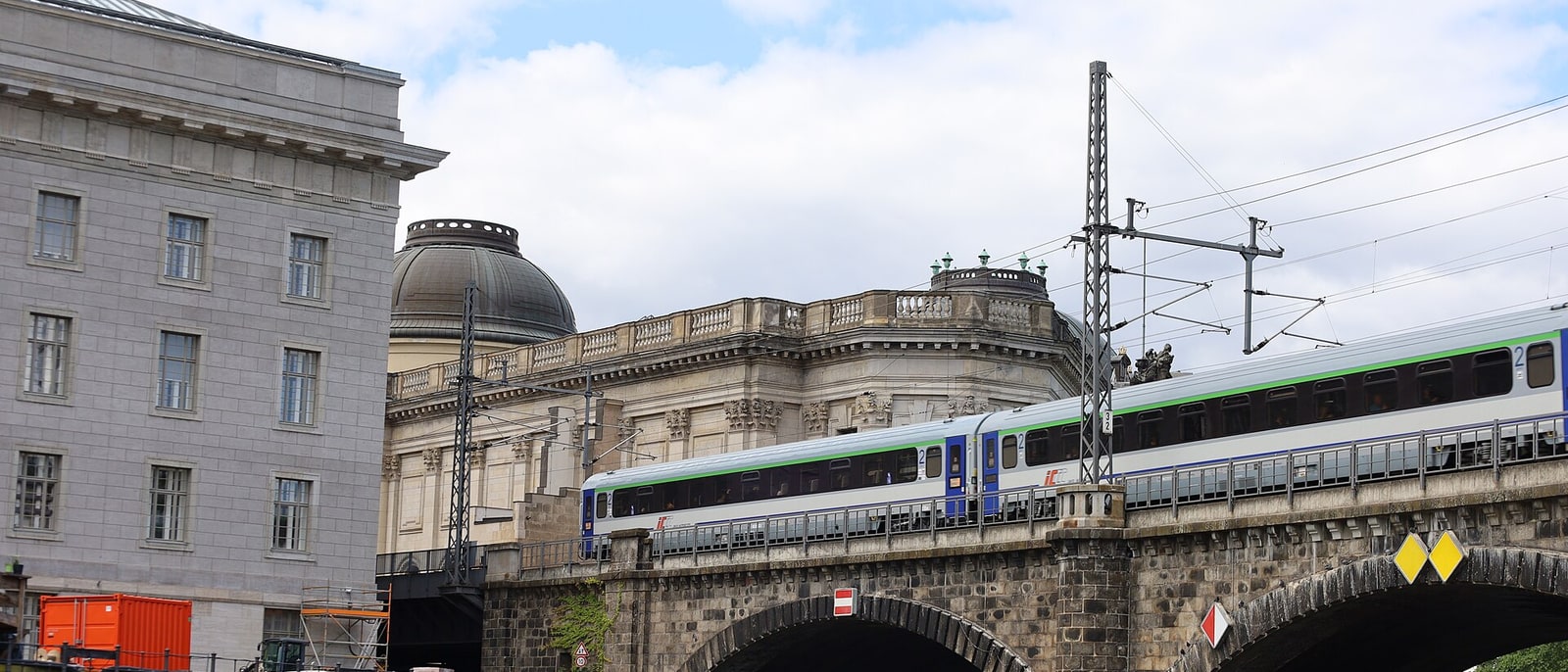
What is open repays the trip: the Neues Museum holds the bust of Nefertiti, some three thousand three hundred years old, found at Amarna in 1912 and displayed in a room of its own. The Alte Nationalgalerie has nineteenth-century German painting, and the Bode sculpture and coins, in the domed building at the island’s tip.
- 02
Checkpoint Charlie and the Topography of Terror
Foreigners and diplomats crossed at Checkpoint Charlie, and in 1961 Soviet and American tanks faced each other there for sixteen hours, gun barrel to gun barrel. What stands today is a replica hut with costumed actors and souvenir shops around it: it’s among the most touristy and least interesting things in Berlin, and worth knowing before you cross the city for it.
Five minutes’ walk away is the Topography of Terror, which is the opposite: the plot where the Gestapo and SS headquarters stood, demolished after the war. Nothing has been rebuilt. There’s an open-air exhibition and a centre, both free, documenting who administered the terror from that exact spot. It’s among the hardest and most necessary visits in the city.
- 03
Alexanderplatz and the television tower
The Fernsehturm rises 368 metres, and no building in Germany beats it. The GDR raised it in 1969 to demonstrate technical capacity and to be seen from West Berlin. The joke wrote itself: when the sun strikes it, the steel sphere reflects a luminous cross, and Berliners called it “the Pope’s revenge”.
The regime tried to get rid of it and couldn’t.
Around it is Alexanderplatz, the great socialist square, with the world clock and sixties blocks. It isn’t beautiful in the conventional sense, but it’s the most honest photograph of what East Berlin was, and it remains the transport hub for half the city.
- 04
The Humboldt Forum and the palace that comes and goes
On this plot stood the Prussian royal palace, damaged in the war and dynamited by the GDR in 1950 as a symbol of imperialism. In its place they built the Palace of the Republic, the East German parliament’s seat, with a bowling alley and concert halls, much loved by many. After reunification it was closed for asbestos and dismantled between 2006 and 2008.
And on top of that the Prussian palace has been rebuilt, finished in 2020, with three copied Baroque façades and a fourth modern one. Inside is the Humboldt Forum, holding ethnological collections whose colonial provenance is now openly debated, including the Benin bronzes, whose ownership Germany has transferred to Nigeria.
Few buildings tell this city’s layers so well.
Frequently asked
Is Checkpoint Charlie worth it?
Not much, honestly. What’s there is a replica hut with costumed actors and shops around it. If you must choose, five minutes away is the Topography of Terror, free and on the Gestapo’s actual site, and at Bernauer Straße you see what the wall really was.
Where is the bust of Nefertiti?
In the Neues Museum, on Museum Island, in a room of its own. It isn’t in the Pergamon, which has been closed since October 2023 and won’t fully reopen until 2037. It’s the commonest confusion when planning the visit.