OZU /GERMANY /FRANKFURT /GUIDE
A weekend in Frankfurt
16 h route5 stopsBest: Outside trade-fair dates, when the hotel costs what it shouldUpdated July 2026
Two days in Frankfurt are more than enough for the city, and that’s exactly the charm: you can spend the second one somewhere else. Cologne is an hour away by train, Heidelberg fifty minutes, the Rhine half an hour, and the main station is a funnel everything runs out of. Few European cities work this well as a base camp.
The other quirk is Sunday. German shops shut on Sundays by law and here you notice it, with two exceptions that rescue the day: whatever is inside the main station and inside the airport opens anyway. So Saturday is the day for streets and markets, and Sunday is the day for a museum, a park, or a train.
The route, stop by stop
5 STOPS- 01
Saturday morning: the Kleinmarkthalle
The covered market is two streets from the Römerberg and it’s where Frankfurt stops being a set and starts eating. There are a hundred-odd stalls over two floors: butchers, cheese, vegetables, Turkish spices, an Italian counter that’s had a queue since about 1970. Saturday is the big day and there are twice as many people.
The local ritual is eating standing up mid-morning: a sausage, a Handkäs, a glass of wine on the upper floor looking down. Don’t look for a table, there isn’t one.
And get on with it: it shuts around midday and doesn’t open on Sundays, so if you save it for day two it no longer exists.
- 02
Saturday afternoon: the Museumsufer
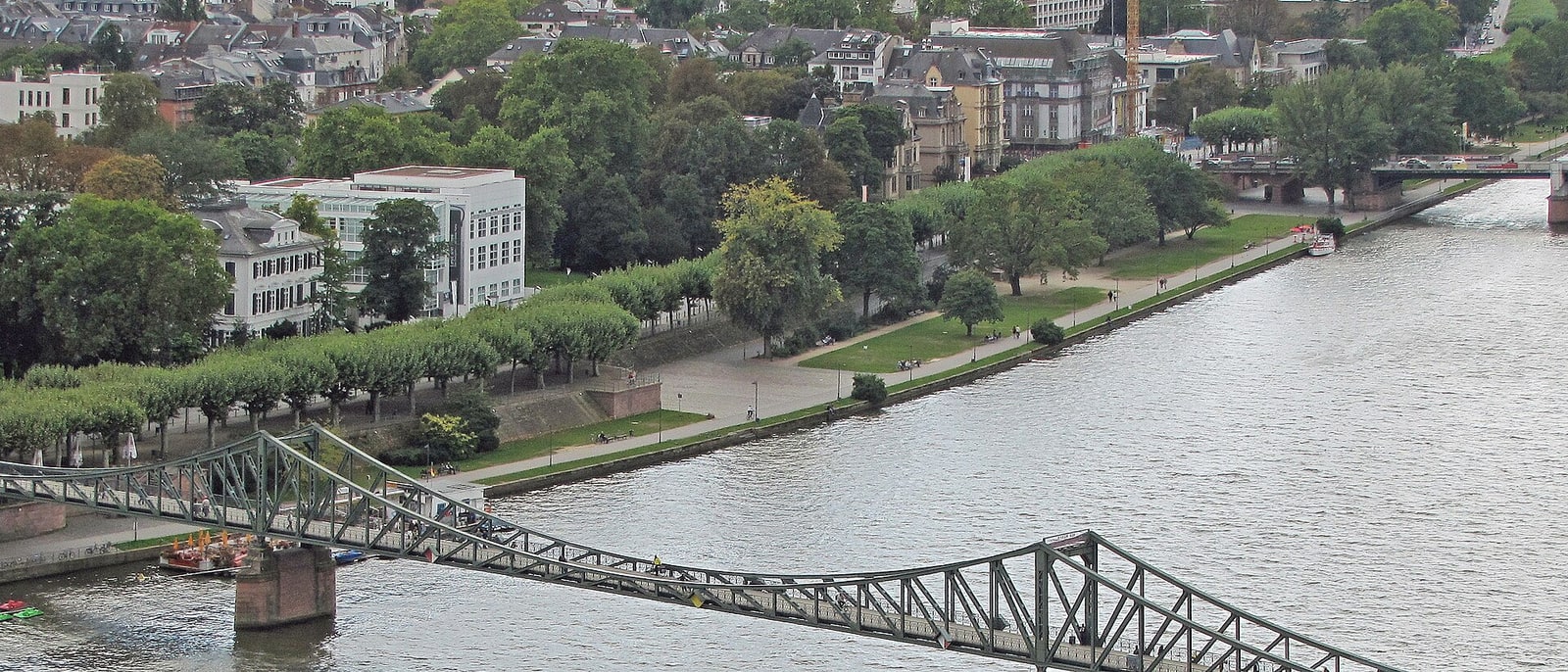
The south bank has a dozen museums lined up one after another along the river, and that concentration says something about the city: no prince founded these museums, because there never was one. Merchants founded them with their own money, which is a fundamental difference from the rest of Germany.
The exemplary case is the Städel, which exists because a banker called Johann Friedrich Städel left his entire collection and fortune to the city in 1815, on condition that it belong to the citizens. Two hundred years on it still does, and it’s one of the best picture galleries in the country.
Next door are the film, architecture, applied-arts and ethnographic museums. With one afternoon, pick two.
- 03
Saturday night: the Bahnhofsviertel
The station quarter shows the most honest thing in Frankfurt, the thing no guidebook dares print: four blocks where the red-light district, an open and visible drug scene, and the best restaurants in the city all live wall to wall with the bank towers. In a hundred metres you go from an investment bank to someone using on the pavement.
The city has spent decades living with this rather than sweeping it away, under a public-health policy that’s known well beyond Germany. You eat superbly (Korean, Ethiopian, Japanese, Portuguese) and you walk the main streets without trouble. What you do is not wander the side alleys at night and not walk along staring at your phone.
Head screwed on, as at any big station.
- 04
Sunday: the Paulskirche and Goethe’s house
In the Paulskirche, a plain round church, in 1848 the first German parliament elected by vote sat down to write a constitution with fundamental rights. It failed within a year and the kings took the place back, but that text is the direct grandfather of today’s basic law. There’s no worship inside now: there’s an empty building that Germany treats as its founding site.
Five minutes away is the house where Goethe was born in 1749, which also went up in 1944 and was also rebuilt: this time with the original furniture, which had been moved out in time.
Both open on Sundays, which is exactly why they’re here: it’s the day the city shuts the shops and only this kind of thing is left.
- 05
Sunday afternoon: the train to anywhere
The second afternoon shows what Frankfurt is actually for. The main station is a funnel of nearly thirty platforms that half the country leaves from: Cologne an hour away by ICE, Heidelberg fifty minutes, Mainz thirty, the Rhine valley a little more. No other German city puts that much within reach.
And there’s a trick almost nobody uses: if your flight is in the evening, you don’t need to come back into town. The airport’s long-distance station has direct ICEs, so you can spend Sunday in Cologne, come back to the Fernbahnhof and check in without setting foot in Frankfurt again.
That’s where the free day comes from.
Frequently asked
What is there to do in Frankfurt on a Sunday?
Museums, parks, or a train out. Shops shut by law on Sundays across Germany, with two practical exceptions: whatever is inside the Hauptbahnhof and inside the airport opens anyway. The Museumsufer, the Paulskirche and the Goethe House all run.
Is Frankfurt’s Bahnhofsviertel dangerous?
It looks worse than it acts: there’s a red-light district and an open drug scene right next to the bank towers, and also the best restaurants in the city. The main streets are fine to walk. The sensible thing is to stay out of the side alleys at night, as at any big station.
What can you visit in a day from Frankfurt?
Cologne is an hour by ICE, Heidelberg about fifty minutes, Mainz half an hour and the Rhine valley a little more. If your flight leaves in the evening you can come straight back to the airport’s long-distance station without going through the centre.