OZU /GERMANY /FRANKFURT /GUIDE
What to see in Frankfurt
6 stopsUpdated July 2026
On the night of 22 March 1944 the largest ensemble of timber-framed houses in Europe ceased to exist. What there is to see here is within walking distance and makes sense through one question: what do you do when you no longer have a city. and the answer here was first modern and then retrospective, in that order, with forty years in between.
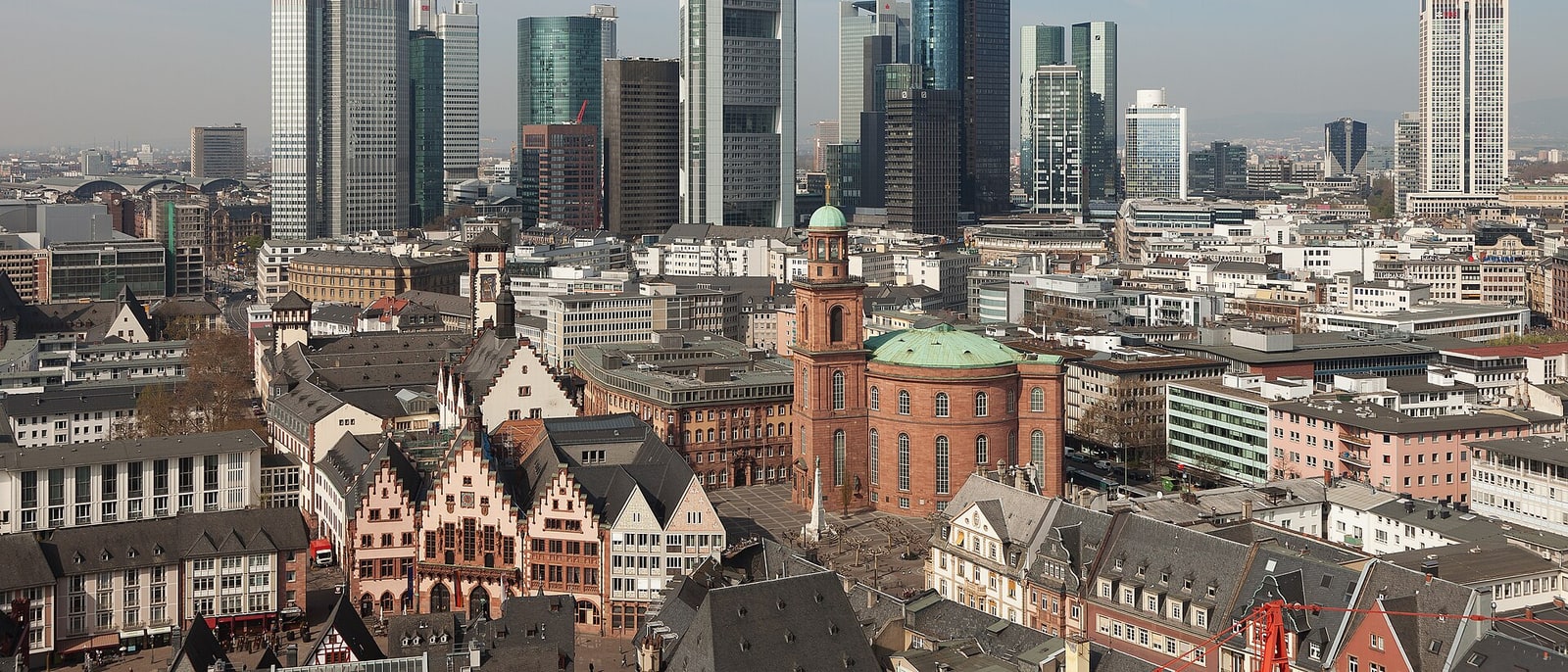
Which is why things that don’t match sit side by side: bank towers, a medieval square completed in 2018, the church where German democracy was born, and a row of museums paid for by merchants. It isn’t a beautiful city the way Heidelberg is, and it doesn’t try to be. It’s a legible one, which is a different thing and sometimes a better one.
The route, stop by stop
6 STOPS- 01
The Neue Altstadt, and the argument that took twenty years
Between the cathedral and the Römer there stood, for decades, a concrete building from the seventies, aggressively ugly, which the city eventually pulled down. What to do with the gap was argued over for twenty years: some wanted contemporary architecture, others wanted the old quarter back, and the second lot won narrowly.
What went up between 2012 and 2018 is thirty-five buildings: fifteen reconstructed from the originals’ plans and photographs, down to the carvings, and twenty new-builds that copy nothing but respect the scale.
It’s worth walking knowing which is which, because the exercise is more interesting than the result: it’s a city deciding, in 2018, how much past it wants to have.
- 02
The Kaiserdom
The red sandstone tower crowns the old town and survives as the oldest thing still standing, though it too burned and it too was redone. What matters is what happened inside: the Golden Bull of 1356 fixed that the Holy Roman Emperor be elected here, and from 1562 crowned here as well. Ten times in a row, up to 1792.
The conclave chapel, where the seven electors shut themselves in, is a small room you cross in twenty seconds today and out of which came the most powerful man in central Europe. It has never had a bishop, so “cathedral” is a courtesy title.
You can climb the tower: three hundred and twenty-eight steps and no mercy on the knees.
- 03
The Paulskirche
In May 1848 five hundred-odd deputies elected by vote, the first in German history, sat down here to write a constitution with fundamental rights for a country that didn’t yet exist. They lasted a year: the princes took power back and the project collapsed. The text, though, is the direct ancestor of the 1949 basic law.
The church was rebuilt at speed in 1948, on the centenary, while the city was still in ruins, and it was the first large building to go up: that says a fair amount about priorities. Inside it’s bare and there’s no worship. You go in, you look at a round empty room, you leave in ten minutes.
It’s worth it for what it means, not for what’s there.
- 04
The Goethe House
Goethe was born here in 1749, in a large house belonging to a comfortable family, and wrote his first things inside it, Werther included. The building went up in 1944 with everything else and was rebuilt stone by stone in the fifties, in an argument that even then set the same two camps against each other that would fight over the old town sixty years later.
The difference from the rest of the city is that here the interior is genuine: the furniture, the paintings and the library had been moved out of Frankfurt before the bombing, so the house is fake and the contents aren’t.
It takes an hour and works even if you don’t care about Goethe, because it shows in real detail how an eighteenth-century German bourgeois family lived.
- 05
The Städel
Frankfurt never had a court, or a prince, or a royal collection to inherit, and that vacuum explains its museums: merchants paid for them. The Städel exists because Johann Friedrich Städel, a banker, left his entire collection and his money to the city in 1815 on one condition: that it belong to the citizens and not the state. It still does.
Inside are seven hundred years of European painting, from Cranach and Vermeer to Monet and Picasso, and a 2012 underground extension for contemporary art with round skylights that surface in the lawn above, one of the best things built in this city this century.
If you go into one museum in Frankfurt, go into this one.
- 06
The towers, and why they’re here
No other German city has skyscrapers and this one has them for a specific reason: when the country was split in two after the war, the money settled here instead of Berlin, and never moved again. Today it holds the European Central Bank, the Bundesbank, the stock exchange and a couple of hundred banks, in a city of barely seven hundred thousand people.
Of all the towers, only the Main Tower lets the public up: two hundred metres and a platform with no glass. And one thing you see better from up there than from any book: the towers aren’t spread out, they’re packed into a handful of blocks beside the station, with the old town at their feet and countryside around.
It’s a skyline the size of a neighbourhood.
Frequently asked
What must you see in Frankfurt?
The Römerberg and the rebuilt old town, the Kaiserdom where emperors were crowned, the Paulskirche of the first German parliament, the Städel, and the Main Tower deck. It’s all within walking distance and makes a long day.
Why does Frankfurt have skyscrapers and the rest of Germany doesn’t?
Because when the country was divided after the war, the money settled here rather than in Berlin. Today it has the European Central Bank, the Bundesbank, the stock exchange and a couple of hundred banks, in a city of about seven hundred thousand. Hence Mainhattan and Bankfurt.
Can you go up a skyscraper in Frankfurt?
The Main Tower, the only one with a deck open to the public: two hundred metres and an open-air platform with no glass. It closes in bad weather because it’s exposed. Best time is late afternoon, when the offices light up.