OZU /GERMANY /FRANKFURT /GUIDE
Frankfurt in a day
8 h route5 stopsBest: Any day but Sunday, when the shops are shut by lawUpdated July 2026
Frankfurt fits into a day because it really is small: the old town, the cathedral, the river and a tower to look at it all from sit inside a mile-square. What surprises you is inside that square, and it’s that almost nothing that looks old is. The old town burned to the ground in March 1944 and what you walk on today opened in 2018.
The day shapes itself: morning on the Römerberg and at the cathedral, midday crossing the Main on the iron footbridge, afternoon on the Museumsufer or two hundred metres above it on the Main Tower, and evening in Sachsenhausen with a stoneware jug on the table. All on foot. This is the German city where you least need to look at a metro map.
The route, stop by stop
5 STOPS- 01
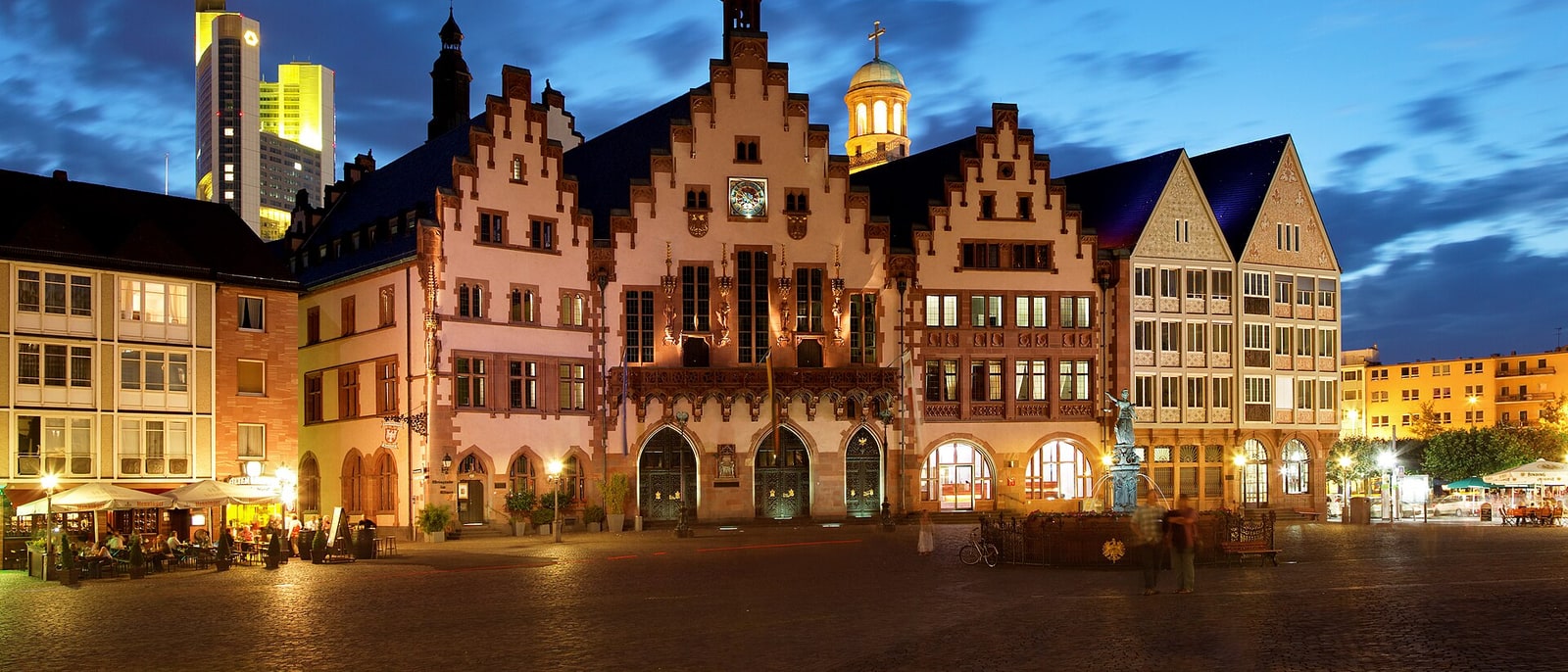
The Römerberg, and what you’re actually looking at
The Römer has been Frankfurt’s city hall since 1405 and that part is true: the city bought the house off a merchant family and has been doing the same thing in it for six centuries.
What surrounds it is another story. On the night of 22 March 1944 Allied bombing flattened what was then the largest ensemble of timber-framed houses in Europe, and nothing on the square was left standing.
What you see now was built twice: a handful of houses in the fifties, and the whole quarter between 2012 and 2018: thirty-five buildings, of which fifteen are exact reconstructions of the originals and twenty are new work imitating them. It isn’t a stage set and it isn’t a fraud: it’s a decision the city argued over for decades. Knowing it doesn’t take the merit away, it moves it somewhere else.
- 02
The cathedral that never had a bishop
The Kaiserdom, the imperial cathedral, has never had a bishop, so technically it has never been a cathedral: it’s a parish church with an enormous CV. From the Golden Bull of 1356, the seven prince-electors of the Holy Roman Empire shut themselves in here, in the conclave chapel, to choose an emperor. And from 1562 they crowned him inside too. Ten coronations in a row, up to 1792.
Which is to say: for four and a half centuries the most powerful person in central Europe came out of this building elected, in a town that then had a few thousand inhabitants. The chapel where the voting happened is still there and it’s the size of a living room.
If your legs are up to it, the tower is three hundred and twenty-eight steps and gives the best short view down over the old town.
- 03
The Eiserner Steg and the line from the Odyssey
The iron footbridge has crossed the Main since 1868 and the citizens paid for it, tired of waiting for the council to make its mind up. It’s how you get to the other side and it’s where you take the photograph that sums the city up: bank towers on one side, cathedral spire on the other, river in between.
Look at the top of the arch, which almost nobody does: there’s a line from the Odyssey written in Greek. “sailing on the wine-dark sea to men of strange speech”. In a city that lives off money coming and going, and where more than half the population has roots outside Germany, the choice of sentence isn’t an accident.
The padlocks on the railing are much newer and much less interesting.
- 04
The Main Tower, the skyline’s only viewing deck
No other German city has genuine skyscrapers, and the reason is boring and decisive: the European Central Bank, the Bundesbank and the stock exchange are here, and a couple of hundred banks with them. Hence the nicknames, Mainhattan and Bankfurt, which in Germany get said with a certain edge.
Of all those towers, the Main Tower is the only one with a deck open to the public: two hundred metres and an open-air platform, no glass, where you can hear the city.
Go up late in the day: you watch the sun drop behind the Taunus hills and the offices light up one by one, which is the honest picture of what this place is. It shuts in bad weather, because it’s out in the open.
- 05
Sachsenhausen and the ribbed glass
Sachsenhausen takes up the south bank and drinks Apfelwein: the apple cider that in dialect is Ebbelwoi and that is this city’s drink, not beer. You order it by the jug: the Bembel is grey stoneware with a blue pattern and it comes with a glass called a Geripptes, cut with diamonds on the outside.
The ribbing isn’t decoration. With hands greasy from eating with your fingers a smooth glass slips and a ribbed one doesn’t: that’s the whole story, and it’s why the glass has looked like that for generations.
The cider is sour and almost nobody likes it first time. Have it neat before you cut it with water or lemonade, which is what the person next to you will do. And plenty of the old taverns still take cash only.
Frequently asked
Is Frankfurt worth a day?
Yes, and a day is enough: the old town, the cathedral, the river and the Main Tower deck fit into a square you can cross on foot in twenty minutes. It’s Germany’s most practical layover city, because the airport has a direct train into the centre and a high-speed station of its own.
Is Frankfurt’s old town old?
The Römer, the city hall, yes: it’s been there since 1405. The rest of the square, no. The bombing of 22 March 1944 flattened the largest timber-framed ensemble in Europe, and the quarter you see was rebuilt between 2012 and 2018: thirty-five buildings, fifteen exact copies and twenty new-builds.
What is Frankfurt’s Apfelwein?
The apple cider that is the city’s drink, Ebbelwoi in dialect. It’s served in a stoneware jug called a Bembel and drunk from a diamond-cut glass, the Geripptes, whose pattern exists so it won’t slip out of greasy fingers. The quarter is Sachsenhausen.