Amman in a day
8 h route4 stopsBest: Spring or autumn, on Friday mornings the city moves slowlyUpdated July 2026
Amman covers in a day because everything genuinely ancient is concentrated on two adjoining downtown hills, the Citadel and the theatre, visible from one another. The rest of the city is twentieth-century and doesn’t ask to be visited so much as walked.
Accept from the start that you go up and down constantly here. Between the historic centre, down in the valley, and the districts of Jabal Amman there’s a serious drop, with public staircases of dozens of steps that are the normal way to get around.
The route, stop by stop
4 STOPS- 01
The Citadel (Jabal al-Qala)
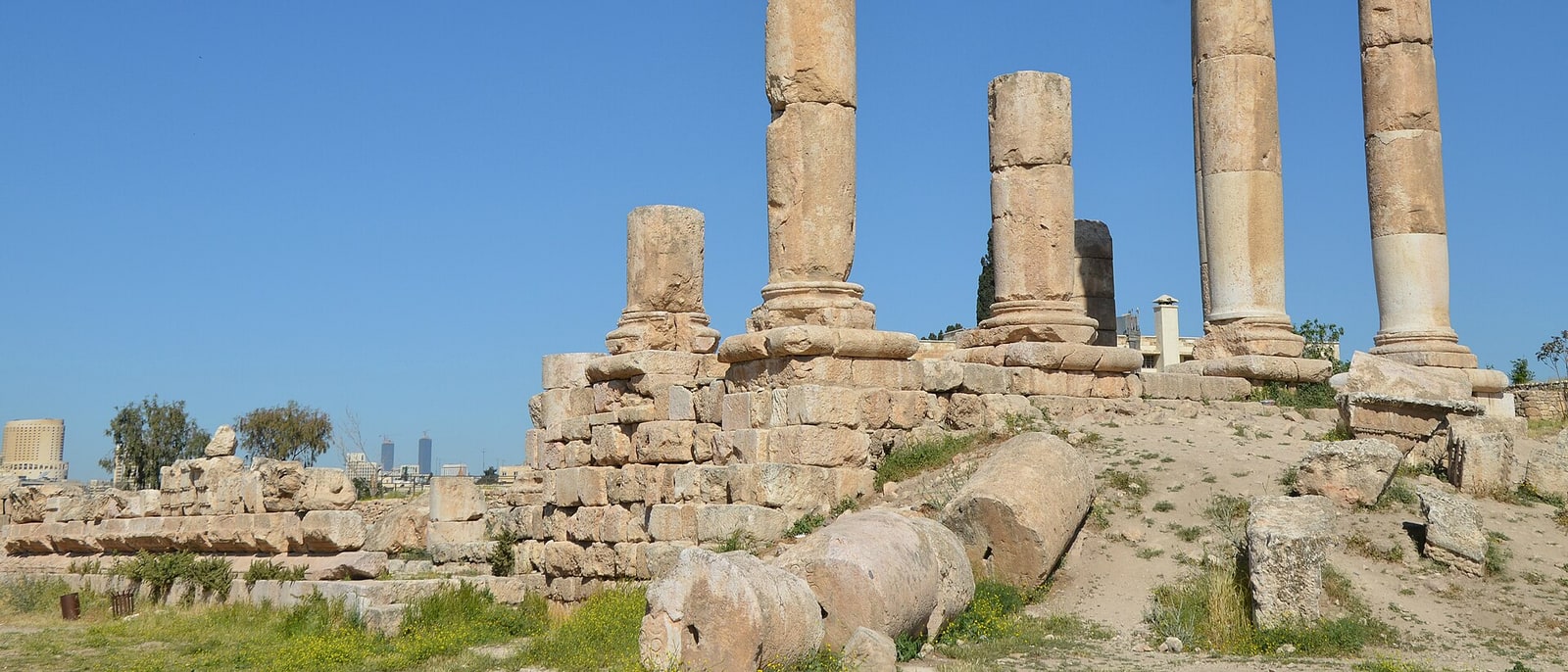
The hill dominating downtown has been occupied since the Neolithic and holds the city’s oldest remains. On top, the columns of the second-century Temple of Hercules stand alongside the remains of a Byzantine church and the eighth-century Umayyad palace, whose audience hall survives with a reconstructed dome.
The site museum holds the Ain Ghazal statues, among the oldest large-scale human figures known: about nine thousand years old, made of plaster over a reed armature.
Seeing that and then stepping to the edge of the hill, with the white city spilling over the hills opposite, is the best moment of the day.
- 02
The Roman theatre
Built in the second century, when the city was called Philadelphia and belonged to the Roman Decapolis. It’s cut into the north slope so the sun wouldn’t be in the audience’s eyes, seats around six thousand, and still hosts concerts and festivals. The acoustics are the thing to test: from the top row you clearly hear someone speaking at the centre of the orchestra. On either side are two small museums of folklore and costume, included in the ticket and covered in twenty minutes.
- 03
El-Balad, the old downtown
El-Balad fills the bottom of the valley as the historic commercial centre: streets of spice, nut, gold and clothing stalls, with constant street life. The King Hussein mosque, in the heart of the souk, stands on the site of an earlier seventh-century one.
This is where to try knafeh: melted cheese under a layer of orange-tinted semolina threads and orange-blossom syrup, served in portions on paper and eaten standing.
It’s the Palestinian-Jordanian national dessert, and in El-Balad there are places that have made only that for generations.
- 04
Rainbow Street and the staircases
Jabal Amman grew as the residential hill of the early twentieth century, with white limestone houses, and Rainbow Street is its spine: cafés, terraces, bookshops and the lookout over downtown. It’s where the city sits to watch and to smoke shisha. The good way up is by the public staircases linking valley and hill, decorated with murals and part of Amman’s urban landscape. Take them slowly: they’re many and steep, but every landing gives a different view of the centre.
Frequently asked
How do addresses work in Amman?
By numbered roundabouts. Zahran Street crosses the city linking eight circles, the First by downtown and the Eighth to the west, and everyone locates themselves by them: “near the Fourth” is a perfectly valid address. Street names exist but are little used.
How many days do you need in Amman?
One or two for the city. The usual approach is to use it as a base: Jerash, the Dead Sea and Madaba are all day trips from here, and Petra is about three hours away. Many people give it a single day and the rest to excursions.