OZU /MOROCCO /MARRAKECH /GUIDE
Gardens and palaces: the other Marrakech
6 h route4 stopsBest: First thing: Majorelle fills up and the queue has no shadeUpdated July 2026
Marrakech has a reputation for chaos, but it was built on the opposite: the Almohads brought water down from the Atlas through underground channels a thousand years ago, and out of that came the gardens and reservoirs that make a city on the desert’s edge liveable.
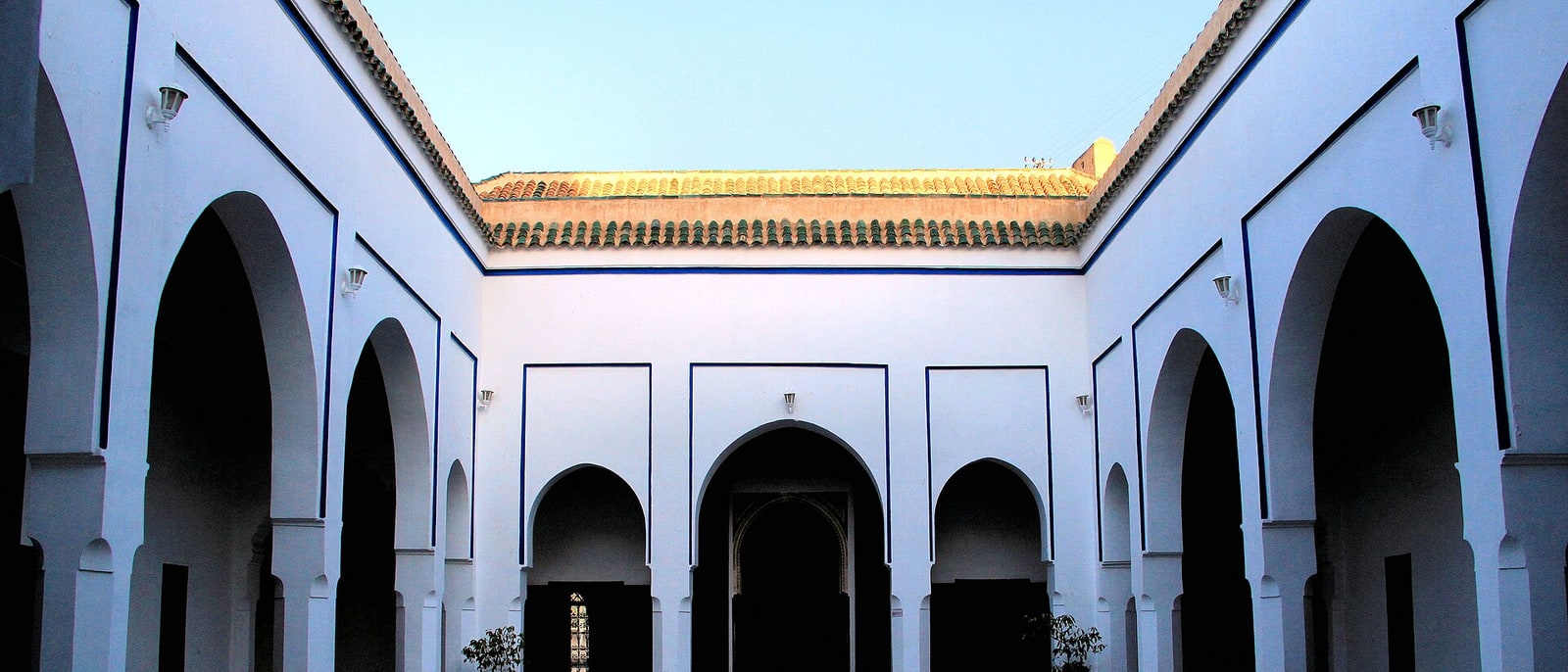
This route is the souk’s counterweight: four places with shade, water and silence, spread between the medina and the new town. They make a calm day, or they split up as breathers between medina days.
The route, stop by stop
4 STOPS- 01
The Majorelle Garden and the YSL museum
The French painter Jacques Majorelle planted this garden in the 1920s and painted it an ultramarine so distinctive it bears his name: bleu Majorelle. Bamboo, cactus, water lilies and yellow pots against that blue.
Yves Saint Laurent and Pierre Bergé bought it in 1980 to save it from a developer, and YSL’s ashes are in the rose garden. Next door is his museum, with the dresses, worth its separate ticket if fashion interests you.
Book online: the queue is in full sun.
- 02
The Ben Youssef Madrasa
The largest Quranic school in North Africa, 14th-century and enlarged in the 16th: a marble courtyard with a reflecting pool, ringed by zellige mosaic, carved stucco and cedar.
It’s the masterpiece of Moroccan craft and it was in use until 1960.
Upstairs are the 130 cells where students slept, tiny, with little windows onto the courtyard. It reopened recently after years of restoration and it remains the most impressive interior in the city.
- 03
The Menara Gardens
A vast olive grove with a 12th-century reservoir in the middle and a Saadian pavilion at its edge: the classic image is the pavilion reflected with the snowy peaks of the Atlas behind, genuinely white in winter and spring.
The reservoir is part of the Almohad hydraulic system that brings water from the Atlas through underground channels, and it still irrigates the olive grove a thousand years on.
The park is free to enter and it’s where locals go to walk at sunset.
- 04
El Badi Palace
"The Incomparable": the Saadian sultan Ahmed al-Mansour raised it in the 16th century with Sudanese gold, Italian marble and onyx, and it was the most lavish palace of its age. It lasted a century: Moulay Ismail stripped it to carry the materials to Meknes.
What remains are red earth walls, sunken courtyards and orange trees, with storks nesting on top.
Climb the terraces: you see the Atlas and the whole medina, and it’s the best lesson that here power was also erased on purpose.
Frequently asked
Is the Majorelle Garden worth it?
Yes, although it’s small, pricey and packed: the cobalt blue and the planting are unique, and it’s the perfect counterpoint to the intensity of the souk. Book online, because the queue has no shade.
What is the Ben Youssef Madrasa?
The largest Quranic school in North Africa, 14th-century, with a marble courtyard ringed by zellige mosaic, carved stucco and cedar, and 130 student cells upstairs. It’s the most impressive interior in Marrakech.
Can you see the snowy Atlas from Marrakech?
Yes, in winter and spring the peaks show white from the city, and the classic view is from the Menara Gardens, with the pavilion and reservoir in front. In summer the haze usually hides them.