OZU /MOROCCO /MARRAKECH /GUIDE
Eating in Marrakech: tagine, stalls and rooftops
3 h route4 stopsBest: The Jemaa el-Fna stalls assemble at duskUpdated July 2026
Moroccan cooking is one of the world’s great cuisines, and in Marrakech you eat well in three distinct registers: the smoking stalls of Jemaa el-Fna, the medina rooftops and the tables of the new town. All three work, and they’re different experiences.
One thing that throws everyone: the tagine isn’t a dish, it’s the conical clay pot it’s cooked in. And what your country calls couscous is a Friday dish here, the day of prayer, not an everyday one.
The route, stop by stop
4 STOPS- 01
The Jemaa el-Fna stalls
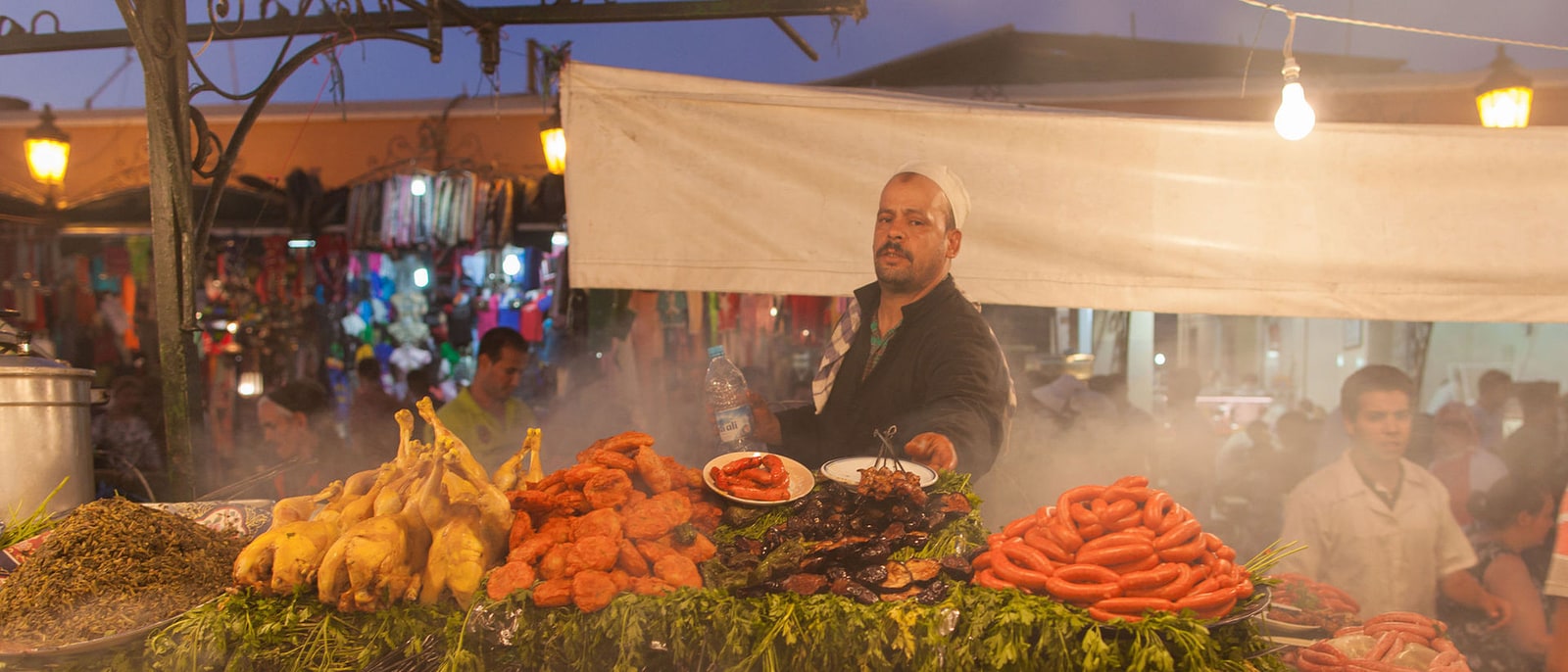
At dusk an entire food market assembles in the square: numbered stalls with bench seating, smoke, and waiters competing to seat you. It sounds like a trap and it isn’t: they’re regulated, they cook in plain sight and Moroccans eat there. The rule for choosing: the one full of locals, not the one shouting loudest. Order brochettes, tagine, harira soup or, if you’re game, snails and sheep’s head, the square’s classics. Confirm the price before anything extra arrives "as a gift".
- 02
The tagine, and what to order
Inside that clay pot with the conical lid, food stews slowly for hours and the steam falls back onto it, so it comes out tender with barely any water. The classics: chicken with preserved lemon and olives, or lamb with prunes and almonds. Other essentials: harira (a tomato, lentil and chickpea soup used to break the fast), pastilla (a pigeon or chicken pie with cinnamon and sugar on top, which sounds strange and is superb) and mint tea, served at all hours and very sweet.
- 03
The medina rooftops
The medina reads as a labyrinth at street level and as an entire city at roof level: almost every riad and café has a terrace, and that’s where you eat well, with the Koutoubia lit and the call to prayer behind it. Many riads open their restaurant to non-guests, and it’s usually the best food in the city: home-style, unhurried and in a courtyard. Book, because they have few tables.
- 04
Guéliz, the new town
Guéliz was built by the French during the protectorate, with straight avenues and low buildings: this is where the bistros are, along with modern Moroccan cooking and the places that serve alcohol, which is scarce in the medina. It’s the useful counterpoint if you’re three days into tagine, or if you want dinner without negotiating anything. And the Majorelle Garden is on the way, so it pairs with that morning.
Frequently asked
Is it safe to eat at the Jemaa el-Fna stalls?
Yes: the stalls are numbered and regulated, they cook in plain sight and Moroccans eat there themselves. The rule is to pick the one full of locals and confirm the price before extras arrive "as a gift".
What is a tagine?
It’s the clay pot with the conical lid the food is cooked in, not the dish itself. Inside, it stews slowly for hours: the classics are chicken with preserved lemon and olives, or lamb with prunes and almonds.
Can you drink alcohol in Marrakech?
Yes, but supply is limited: it’s scarce in the medina and many places don’t serve it. In Guéliz, the new town, and in licensed hotels and riads you’ll find it. Morocco is a Muslim country and alcohol isn’t part of everyday life.