OZU /MOROCCO /MARRAKECH /GUIDE
Marrakech in a weekend
48 h route4 stopsBest: March-May and October-November. July tops 45°CUpdated July 2026
The two days split themselves: Saturday for the medina, which is intense and exhausting, and Sunday for the gardens and the new town, which is the antidote. Cramming both into one day means leaving with a grudge against the souk.
The city is an assault on all five senses and that’s wonderful for eight hours. By the ninth you’ll want a shaded courtyard. That’s why day two is Majorelle, hammam and a terrace. If you have time to spare, the Atlas is ninety minutes away.
The route, stop by stop
4 STOPS- 01
Friday: landing, and a rooftop
Sleep in a riad inside the medina: traditional houses built around an inner courtyard, and the difference from a new-town hotel is the whole trip. Careful: the taxi won’t reach the door, cars don’t enter the medina, so the last stretch is on foot with your case. Don’t plan the first evening: go up to a café terrace on the west side of Jemaa el-Fna and watch the square assemble itself. Eat below, in the smoke of the stalls.
- 02
Saturday: the whole medina
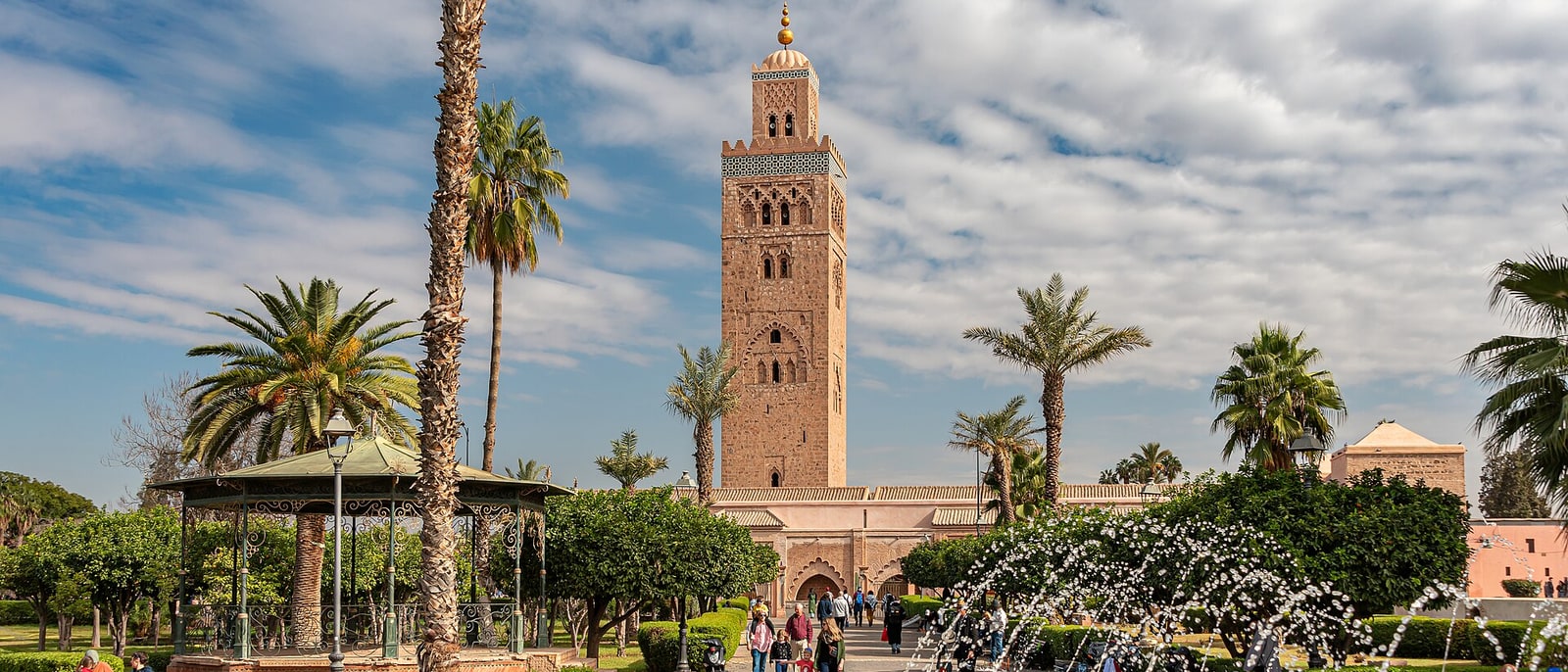
The big day, all inside the walls and on foot: the Koutoubia as your compass, the Bahia Palace, the Saadian Tombs and then the souk until you tire or get lost, whichever comes first. Eat on a souk terrace at midday, when the heat bites, and don’t try to be efficient: efficiency doesn’t exist here. End again at Jemaa el-Fna at sunset, which is never the same two days running.
- 03
Sunday: Majorelle and the gardens
The Majorelle Garden, in the new town, was painted that cobalt blue by the painter Jacques Majorelle in the 1920s and saved from demolition by Yves Saint Laurent in the 1980s, who lived next door and has his memorial here.
It’s small, pricey and packed, but the contrast with the medina is exactly what you need on day two: bamboo, cactus, water and silence.
Book online to avoid queueing in the sun.
- 04
Sunday afternoon: hammam, then a rooftop
The hammam, a public steam bath, works as a social institution: they scrub you with black soap and a coarse mitt until you’re new. There are neighbourhood ones, dirt cheap and uncompromising, and tourist ones with a massage and tea. Both work. Choose by nerve. Then, a rooftop. Marrakech is lived upwards: almost every riad and café has a terrace, and at dusk, with the call to prayer echoing across the medina, it’s the best possible close to the weekend.
Frequently asked
How many days do you need for Marrakech?
Two full days: one for the medina (Koutoubia, palaces, souks and Jemaa el-Fna) and one for the gardens, the hammam and the new town. With three, you can add a trip to the Atlas or Essaouira.
Is it worth staying in a riad?
Very: they’re traditional houses built around an inner courtyard inside the medina, and they change the trip compared with a new-town hotel. The one drawback is that cars don’t enter the medina, so the last stretch is on foot with your case.
What is a hammam and should you go?
It’s a public steam bath, a Moroccan social institution where you’re scrubbed with black soap and a coarse mitt. There are neighbourhood ones, very cheap and uncompromising, and tourist ones with a massage. It’s one of the most authentic experiences of the trip.