OZU /NETHERLANDS /AMSTERDAM /GUIDE
Day trips from Amsterdam
8 h route4 stopsBest: The tulips, late March to mid-May. No laterUpdated July 2026
The story you’ll be told about the tulips is this: that in 1637 the whole country went mad speculating on bulbs, that a single tulip came to be worth a house, that the bubble burst and ruined Holland, and that people threw themselves into the canals. It’s a great story and it’s largely a myth. The historians who have gone and looked at the archives have been pointing this out for years: the speculation existed, but it affected a small group of merchants, it didn’t sink the Dutch economy, which carried on as prosperous as before, and there’s no record of suicides.
The catastrophist telling was built afterwards, above all in the nineteenth century, with a moralising purpose: it served to illustrate the dangers of greed. And it has been repeated so often that today it’s the first thing anyone tells you about this country. It’s worth knowing before going to see the fields, because the tulip here isn’t a bubble anecdote: it’s an enormous and very serious industry still standing four hundred years later.
The route, stop by stop
4 STOPS- 01
The tulips
First, the calendar, which here rules over everything else: the season runs from late March to mid-May, and outside those weeks there’s nothing to see. A tulip field in June is a field of earth. If you come in summer expecting this, you’re late.
Within the window, there are two different things and it pays to know which you want. The Keukenhof garden is an enormous park with millions of bulbs planted by design, with paths, glasshouses and ponds. It’s spectacular and it’s packed. And then there are the real growing fields, the ones from the aerial photos: strips of pure colour to the horizon, which aren’t a garden but industrial bulb production. They’re all around, they’re free and you cross them by bike.
And one thing to respect: you don’t walk into the fields or tread on the flowers for a photo. They’re a crop, someone lives off it, and there are signs asking for a reason.
- 02
The windmills
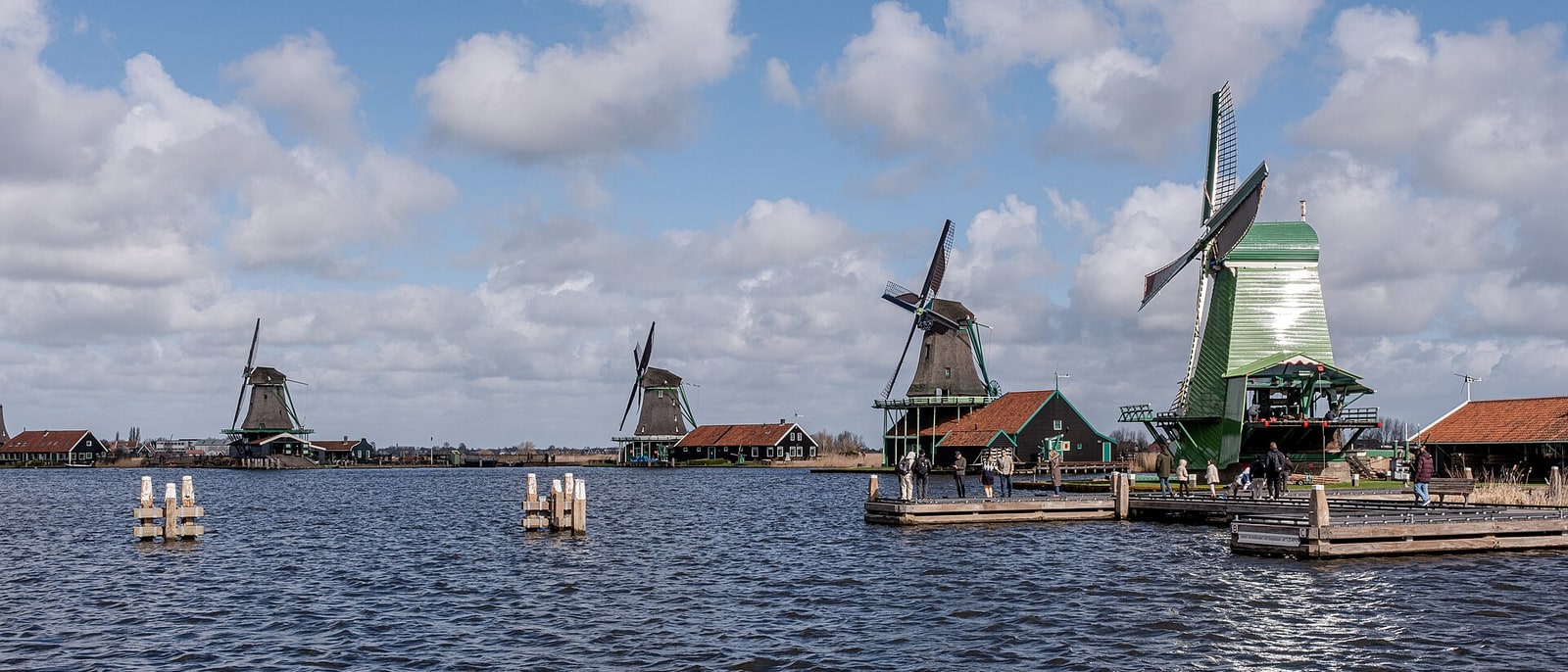
Twenty minutes by train take you to Zaanse Schans, a row of green windmills beside a river, with wooden houses. It’s a much-visited place and fairly staged, and it’s still worth it for what it explains.
The windmills aren’t rural postcards: they were industrial machinery. With them this country did two things. The first, drainage: pumping water out of the low lands to turn marshes and lakes into farmland, and so literally manufacturing the country’s ground, a significant part of which is below sea level.
The second, and this is the surprising one: production. The mills in this area sawed timber, ground pigments, pressed oil and made paper, and there were hundreds running at once, concentrated within a few kilometres. It was a wind-powered industrial zone, a good century before the steam engine existed. When you see one, don’t think of the countryside: think of a factory.
- 03
The village with no roads
A couple of hours northeast there’s a village with no cars, and not because of an ordinance: because there are no streets they could use. It’s called Giethoorn and it’s built on islets joined by wooden footbridges, with canals instead of roads. Everything moves by boat: the shopping, the furniture, the rubbish.
The reason is industrial and hardly romantic: the area was a peat bog, and for centuries peat was dug out to burn. Emptying the ground left ditches and holes that filled with water and ended up forming this network of canals, and people built their houses on the mounds left in between. It’s a landscape made by accident, by taking fuel out of the ground.
The obvious needs saying: it’s heavily visited and in season the canals run full of boats. Go outside August and first thing, hire a silent electric boat and steer it yourself, which is how it’s done.
- 04
Rotterdam, which is the opposite
The city that decided the opposite of Amsterdam sits forty minutes away by train, and seeing them on the same weekend is the best planning lesson you can get in Europe.
In May 1940, German aircraft bombed Rotterdam and flattened the entire centre in a few hours: the historic core vanished, with its canals and its seventeenth-century houses. And when the time came to rebuild, this city made a decision very rare in Europe: not to recreate what had been there.
Instead of remaking a copy of what was lost, a new, modern city was built, with contemporary architecture, skyscrapers and experiments like the cube houses or the arch-shaped market.
It’s ugly to some and fascinating to others, and it’s honest: it doesn’t pretend 1940 didn’t happen. Amsterdam kept the seventeenth century because it wasn’t bombed. Rotterdam couldn’t, and chose to look forward. Both are forty minutes away.
Frequently asked
Is the tulip bubble story true?
Largely, no. Bulb speculation did happen in 1637, but it affected a small group of merchants, it didn’t sink the Dutch economy, which carried on as prosperous as before, and there’s no record of people throwing themselves into the canals. The catastrophist telling was built afterwards, above all in the nineteenth century, with a moralising purpose about the dangers of greed, and it has been repeated so often that today it’s taken as fact.
When should you go to see the tulips?
Late March to mid-May, and outside those weeks there’s nothing to see: a tulip field in June is a field of earth. Keukenhof is an enormous designed garden, spectacular and packed. The fields from the aerial photos are industrial bulb production, they’re all around, they’re free and you cross them by bike. Don’t walk into the fields or tread on the flowers: it’s a crop someone lives off.