OZU /SOUTH KOREA /SEOUL /GUIDE
Where to stay in Seoul
4 stopsUpdated July 2026
Seoul is split in two by the Han, and the two sides are half a century apart. North, Gangbuk, is the historic city: the palaces, the hanok quarter, the markets, the mountains. South, Gangnam, is what in 1970 was rice paddy and today is the most expensive district in the country, on a grid drawn over nothing.
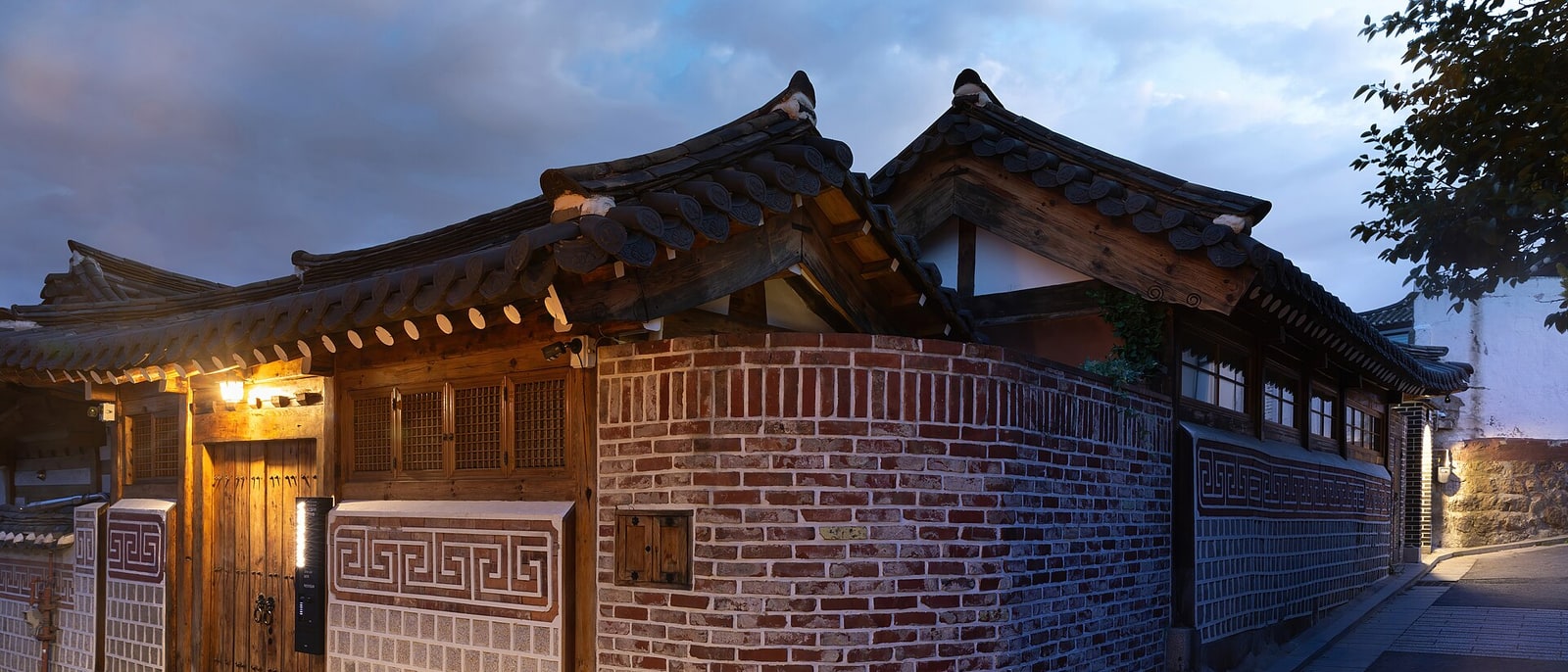
For a short trip, the answer is almost always north: that’s where what you came to see is and where you can walk from. Gangnam is interesting as a phenomenon, not as a base. And what takes the sting out of the whole decision is the subway: it’s one of the best in the world, it’s signed in English at every station and it reaches everything, so picking the wrong neighbourhood here costs you twenty minutes, not a holiday.
The route, stop by stop
4 STOPS- 01
Myeongdong
Most people end up staying here, and with reason: it’s the geographic centre, it has two subway lines, the palaces are a twenty-minute walk and it’s where the 6015 airport coach stops, dropping you at your hotel door with your suitcase.
What to know: by day it’s a packed shopping street, mostly cosmetics and tourism, with people handing out samples. At night it fills with street food stalls down the middle of the road, which are fine but are for visitors.
It isn’t the neighbourhood with the most character in Seoul, not remotely. It’s the most convenient, and for three nights that counts for more than it seems.
- 02
Bukchon and Seochon
Between the two big palaces, on the hillside, is where the traditional houses are. You can sleep in a hanok converted into a small hotel: heated floor (ondol, underfloor heating that has existed in Korea for two thousand years) courtyard, paper doors and a silence rare in this city.
And there’s a distinction that saves you grief. Bukchon, east of the palace, is the famous one, the one in the photographs, and it’s so saturated that there are hours when it closes to tourism, and wardens.
Seochon, to the west, is the same kind of neighbourhood and almost nobody goes: hanok, alleys, workshops, local cafés and people living without being photographed through the window. If you want to sleep in traditional Seoul, sleep in Seochon.
- 03
Hongdae
Around Hongik University, which is the art school, and that’s why the neighbourhood is what it is: live music, murals, record shops, people in their twenties and a nightlife that never ends. It’s the young, untidy part of a city that is otherwise very tidy.
And it has a logistical advantage almost nobody calculates: the AREX, the airport train, stops here. The all-stop service, the non-express one, calls at Hongdae, so if you sleep in this neighbourhood you save yourself reaching Seoul Station and doubling back. For a lot of travellers this is more convenient than Myeongdong and it’s cheaper too.
The trade-off is obvious: there’s street noise until four in the morning, and that isn’t an exaggeration.
- 04
Gangnam
South of the river, with ten-lane avenues, office towers, cosmetic surgery clinics and the expensive shops. It’s Korea’s most aspirational district and it works very well for what it is: if you’re here on business, it’s here, and if you’re here to shop, likewise.
As a tourist base, no. The palaces are on the other side of the river, which is a long half-hour by subway, and there’s nothing here of the Korea you came to see: it’s a seventies grid over what was rice paddy. The scale doesn’t help either: the blocks are enormous and crossing an avenue takes five minutes.
Go for a while, look at the phenomenon, eat well, and you do eat very well here, and go back north to sleep.
Frequently asked
Where should you stay in Seoul?
North of the river, almost always: that’s where the palaces and what you came to see are. Myeongdong is the practical one, with the subway and the airport coach at the door. Seochon if you want to sleep in a hanok without Bukchon’s saturation. Hongdae if you’re young and want noise, and the airport train stops there too.
Is it worth staying in Gangnam?
Only if you’re here for work or shopping. It’s south of the river, a long half-hour from the palaces, and it has nothing of historic Korea: it’s a seventies grid over what was rice paddy. You do eat very well there. Go for a while and come back north to sleep.