OZU /SOUTH KOREA /SEOUL /GUIDE
Seoul in a day
10 h route5 stopsBest: October or April. Summer is a humid oven and it rainsUpdated July 2026
Wear a hanbok, the traditional Korean dress, and you get into the royal palaces free. It isn’t a seasonal promotion or a campaign: it’s been the rule since 2013, and it works so well that there are hourly rental shops at every palace gate and half of Seoul walks around dressed Joseon-dynasty on an ordinary Tuesday. The government did it to get young people re-attached to their own clothes, and it worked.
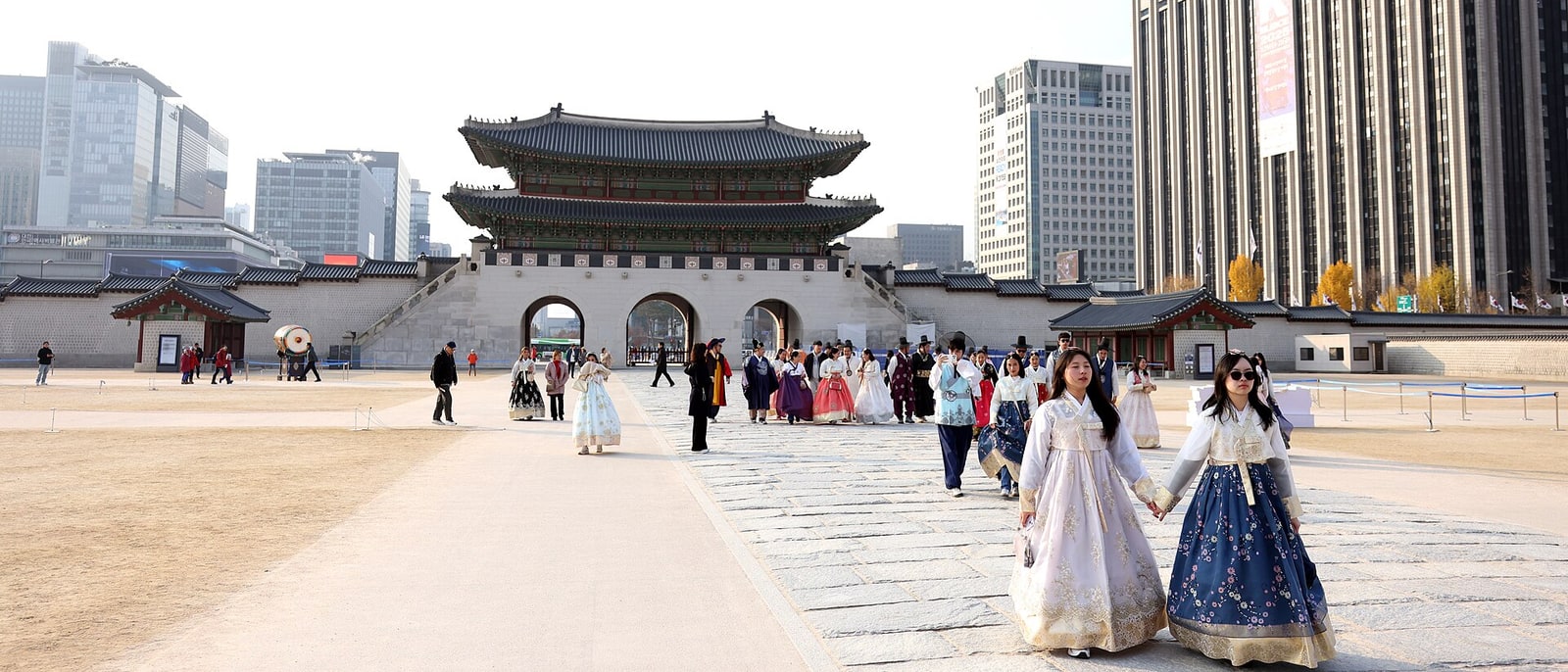
That detail explains how this city runs: Seoul is pragmatic to the bone and solves things with incentives. You’ll see it all day. The river was uncovered by tearing out a motorway. The palaces were rebuilt after being destroyed twice. And everything closes genuinely late, because here dinner at midnight is a Tuesday.
The route, stop by stop
5 STOPS- 01
Gyeongbokgung
The main palace, from 1395, and its story is the whole of Korea compressed. The Japanese levelled it in the 1592 invasion and it lay in ruins for two hundred and seventy-three years, until it was rebuilt in 1867. And then it happened again: during the Japanese occupation, between 1910 and 1945, most of its buildings were systematically demolished (of around three hundred and thirty, about ten were left) and the Government-General building was raised directly in front of it, blocking it from the street.
That building was demolished in 1995, in a televised public act, and since then reconstruction has gone bit by bit: around forty per cent has been recovered and work continues, with timelines running into the 2040s. So what you see is new and they don’t hide it: there are signs saying which year each pavilion was remade. The changing of the guard happens several times a day and is also a recreation, from 1996.
None of this diminishes it: it’s a country rebuilding by hand what was erased from it.
- 02
Bukchon, which is a neighbourhood
Between the two big palaces there’s a hillside with nine hundred traditional houses, hanok, with curved roofs and courtyards. It’s the largest concentration left in Seoul and it’s in every photograph. And here’s the important part, which almost no guide says: it isn’t a museum. People live there. Families, with children, who leave for work in the morning.
It got so many visitors that residents started leaving: people were walking into courtyards, looking through windows and making noise at eleven at night. The district ended up imposing hours, there are windows when the neighbourhood closes to tourism, hiring wardens and filling the streets with signs asking for quiet.
Go, look, take your photograph, and lower your voice: you’re on somebody’s landing. If you want to go inside a real hanok, several are open as museums or workshops two streets away.
- 03
The Cheonggyecheon stream
Under central Seoul there was a stream. In the fifties and sixties it was covered with concrete to make an avenue, and above the avenue a four-lane elevated motorway was built, which was then the symbol of progress. In 2003 the mayor decided to tear it down, and in two years he removed the motorway, lifted the concrete and brought the stream back into daylight. It cost close to nine hundred million dollars and became the world’s most cited case of urban motorway removal.
Today it’s eleven kilometres of sunken walkway below street level, with water, bridges and people eating lunch. And the honest part, which is argued about here and not told abroad: the original stream was practically dry, so the water you see is pumped from the Han river and from wells, at a permanent electricity cost.
It’s a park shaped like a river more than a river. Even so, the city’s temperature dropped, the fish came back and nobody wants the motorway again.
- 04
Gwangjang market
Korea’s oldest permanent market, from 1905, and its food alley is one of the best things in this city: rows of stalls with a woman in command of a griddle, plastic stools and people eating shoulder to shoulder. Most have no translated menu and don’t need one: you point.
What to order is bindaetteok, a thick pancake of stone-ground mung bean, there’s a mill turning at every stall, fried in a lot of oil, eaten fresh and scalding. And the small local gimbap, dipped in mustard. It goes with soju or with makgeolli, the cloudy rice wine served in a bowl. It’s cheap, it’s loud and it’s where Seoul eats, not where anyone is taught to eat.
- 05
The night, which starts late
Seoul runs late in a way that throws any European: at one in the morning on a Wednesday there are full restaurants, open cafés and people shopping in the supermarket. It isn’t a party district: it’s the normal schedule of a city where people work a lot and eat afterwards.
And there are institutions that only make sense here. The noraebang is a private karaoke room rented by the hour, you and yours, no audience: you don’t have to sing in front of strangers, which is the frightening part of Western karaoke. The jjimjilbang is a bathhouse open twenty-four hours where you can sleep on the heated floor for less than a hostel costs, and people use it when they miss the last train. And the PC bang is a gaming computer hall, with hundreds of stations, also open all night.
None of the three is tourism: it’s how this city lives.
Frequently asked
Is it true a hanbok gets you into Seoul’s palaces free?
Yes, it’s been the rule since 2013 and it isn’t a promotion: if you’re wearing hanbok, the traditional dress, entry to the royal palaces is free. There are hourly rental shops at every palace gate. The government did it to reconnect young people with their own clothes and it worked.
Can you visit Bukchon Hanok Village?
Yes, but it’s a neighbourhood where people live, not a museum: there were so many visitors that residents started leaving and the district imposed hours when it closes to tourism, plus wardens and signs asking for quiet. Go, take your photograph and lower your voice. To go inside a hanok, several are open as museums two streets away.
What is the Cheonggyecheon?
A stream that lay covered under an avenue and an elevated motorway until in 2003 the mayor tore them out and brought it back to daylight: eleven kilometres of sunken walkway, the world’s most cited case of urban motorway removal. The honest part: the stream was dry and the water is pumped from the Han river.