OZU /SOUTH KOREA /SEOUL /GUIDE
Eating in Seoul
5 stopsUpdated July 2026
The little dishes that arrive at the table unasked are free and refilled as often as needed. They’re called banchan, there might be four or twelve, and they aren’t a starter or a courtesy: they’re half the meal. You eat them throughout, mixing them with everything else, and asking for more isn’t taking advantage, it’s normal: you raise a hand and ask.
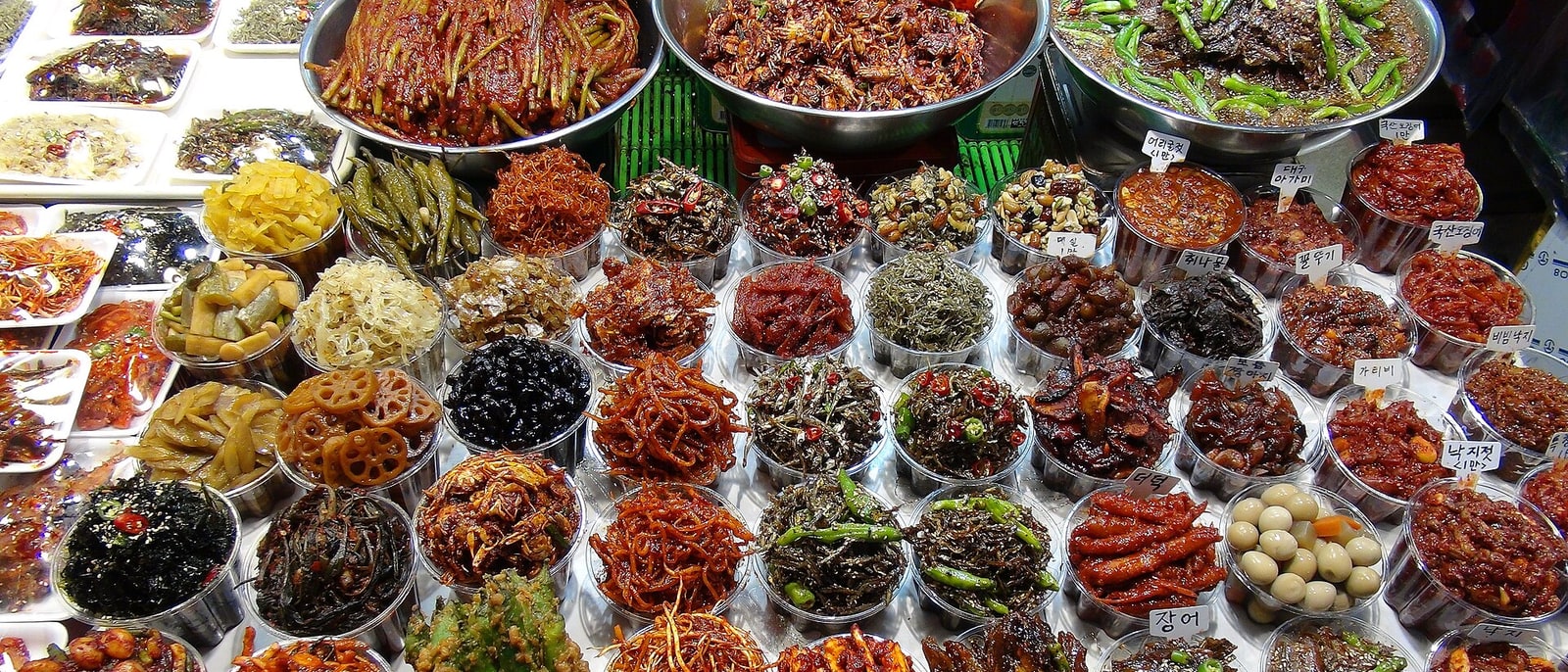
Understanding that changes how you order. A dish in Korea doesn’t come alone, it comes with an ecosystem around it, and that’s why a meal here costs what it costs and fills you so much. The other thing to know is that the table is collective: stews go in a pot in the middle and everyone puts their spoon in.
The route, stop by stop
5 STOPS- 01
The banchan
They arrive before the food and unasked: cabbage kimchi, radish kimchi, bean sprouts, spinach, omelette, seaweed, dried little fish, raw garlic, caramelised potato. There might be three in a cheap place or twelve in a good one, and in a traditional restaurant in Jeonju there might be twenty. All of them are free and all are refilled at no cost as often as you want.
This causes Europeans an embarrassment that isn’t understood here: asking for more banchan isn’t taking advantage, it’s expected, and not doing it when you’ve finished the kimchi is odd. You raise a hand and say the dish’s name, or point. In many places there’s a button on the table to call the waiter, literally, and that’s normal: here you don’t make eye contact or wait for someone to pass, you press the button.
And note: what isn’t eaten gets thrown away, so ask for what you’ll actually eat.
- 02
Kimchi, and the fridge it has
Kimchi doesn’t work as a pickle: it ferments alive, and that’s why most Korean homes have an appliance that doesn’t exist in Europe: a fridge only for kimchi. It isn’t an eccentricity. Kimchi needs a stable temperature around zero to ferment slowly and not go over, and in an ordinary fridge, opened twenty times a day, it doesn’t get it. Every major brand sells them and they’re in over ninety per cent of households.
Before that, clay jars were buried in the garden for winter. And there’s a ritual, kimjang, the collective making in November: family and neighbours gather and make hundreds of kilos at once for the whole year.
Unesco listed it as intangible heritage in 2013, and it didn’t list kimchi: it listed the act of making it together, which is a lovely and fairly precise distinction.
- 03
Chimaek
Chimaek contracts chicken and maekju, beer, and works as a national institution: Korean fried chicken (fried twice, so the skin comes out thin and crisp rather than thick like the American) with very cold beer. There are chains everywhere and it’s eaten watching football or baseball.
And here’s the part that throws any foreigner: you can order it delivered to a park. To the Han river, to a specific point on the grass, with no address, sending your location. And it arrives, by motorbike, in twenty minutes, with the beer. Thousands of people have dinner like that on the Han’s banks on summer nights, with a blanket and a box of chicken.
It isn’t a hack for the clever: it’s a normal service everyone uses and that the chains themselves advertise. It’s the best dinner you’ll have in Seoul and it costs little.
- 04
Soju, and how it’s poured
Soju tops the world’s spirit sales by volume, and not narrowly: a single Korean brand sells more bottles a year than all Scotch whisky combined. It’s clear, it has less alcohol than it seems and it costs less than water in a restaurant. It comes in a green bottle and it’s drunk in small glasses.
And it has a protocol worth learning because it genuinely matters here. You never pour your own: you pour for others and someone pours for you, and keeping an eye on your neighbour’s empty glass is part of good manners. Receiving, you hold the glass with both hands, or with your right while your left touches your forearm, if the person pouring is older. And drinking in front of someone older, you turn your face to one side.
None of this is folklore for tourists: it’s done at any work dinner and not doing it gets noticed.
- 05
The Korean convenience store
Korean convenience stores (CU, GS25, 7-Eleven) aren’t an emergency option: they’re an institution. They’re open twenty-four hours, there’s one every fifty metres, and inside there’s a microwave, a hot water boiler and a counter with stools by the window. People have dinner there, alone or together, and it carries no sad connotation.
What you buy is a gimbap, a bowl of instant noodles, filled from the hot water machine and eaten right there, or a stuffed rice triangle.
And there’s one thing to try even though it sounds wrong: the egg steamed for hours, brown and tasting of nuts, sold in a bag. It all costs small change. On a trip to Seoul you’ll end up having dinner here one night by accident and it’ll be better than you expect.
Frequently asked
Are the little dishes in Korean restaurants free?
Yes: they’re called banchan, they arrive unasked, they’re free and they’re refilled as often as you like at no cost. Asking for more isn’t taking advantage, it’s expected: you raise a hand or press the button on the table. What isn’t eaten gets thrown away, so ask for what you’ll eat.
Can you get food delivered to a park in Seoul?
Yes, and it’s normal: to a specific point on the grass by the Han river, with no address, sending your location. It arrives by motorbike in twenty minutes, with the beer. Thousands of people have dinner like that on the Han’s banks on summer nights. It’s called chimaek: fried chicken and beer.
How do you drink soju?
You never pour your own: you pour for others and someone pours for you. Receiving, you hold the glass with both hands if the person pouring is older, and drinking in front of someone older you turn your face away. It isn’t tourist folklore: it’s done at any work dinner and not doing it gets noticed.