Day trips from Tunis
4 stopsBest: March to May. In summer the ruins have no shadeUpdated July 2026
The Romans of Bulla Regia built their villas underground. Not the catacombs and not the stores: the houses, with their courtyards, their columns and their dining rooms, dug one floor below ground level to escape a heat that in summer passes forty. And since nobody has walked on them for eighteen centuries, the mosaics are still on the floor, in place, with no rope and no glass.
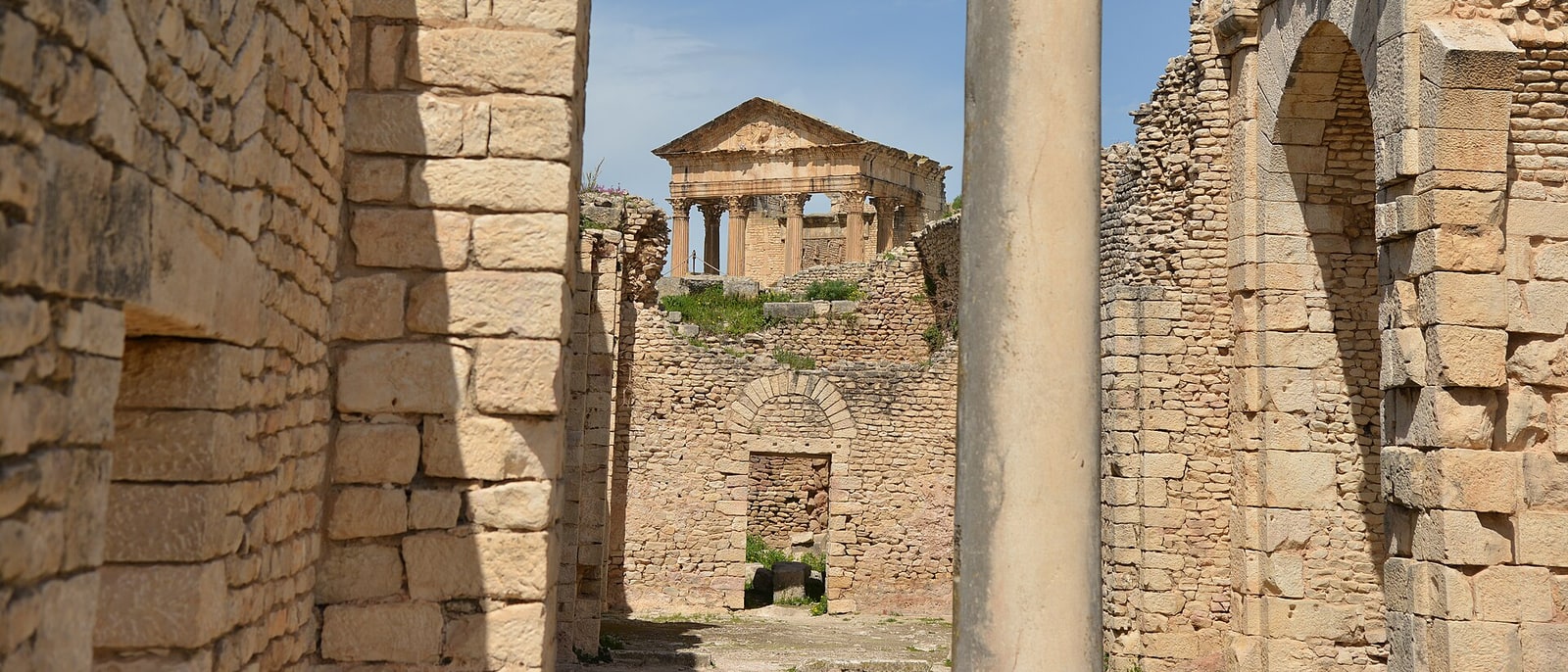
That’s two and a half hours from the capital and practically nobody goes. It’s the summary of day trips from Tunis: there are Roman ruins that in Italy would be a whole trip’s destination and that here sit empty, with a goat grazing next to them. It’s all done by car or with a driver: the train reaches some places, but the timetables leave little margin.
The route, stop by stop
4 STOPS- 01
Dougga
No Roman town in North Africa survives better, and it’s World Heritage too, and what makes it different from an ordinary site is that it isn’t half excavated: it’s all there. You can walk the streets with their cartwheel ruts, go into the houses, sit in the three-and-a-half-thousand-seat theatre and use the public latrines, which are complete, in a semicircle and with no partitions.
The Capitol, from the year 166, still stands with its columns and its pediment, and is among the best preserved in the empire. And in the middle of it all is something older: a Punic-Libyan mausoleum from the second century BC, with a bilingual inscription that was the key to deciphering the Libyan language.
The best part: there are days you’re alone. Two hours by car from Tunis to have an entire Roman town to yourself.
- 02
Bulla Regia
Here the Romans did something they did nowhere else in the empire: build the main floor of their villas underground. On this plain the summer passes forty degrees and there’s nowhere to hide, so they dug an entire storey below, with a courtyard, columns and rooms, and used the ground’s thermal mass. It’s second-century air conditioning.
And the side effect is what makes the place unique: being buried, those houses survived whole. You go down a staircase and you’re in a Roman dining room with the original mosaic on the floor, in place, under your feet. It isn’t in a museum, there’s no glass and there’s no rope: it’s where they put it.
The houses are named after what’s on the floor: the House of the Hunt, of the Peacock, of Amphitrite. It’s the best thing you can see in Tunisia and there’s nobody there.
- 03
Kairouan
Kairouan ranks fourth among Islam’s holy cities, after Mecca, Medina and Jerusalem, and its Great Mosque was founded in the year 670: it’s one of the oldest in the world and the model almost every mosque in the Maghreb and in Al-Andalus came from. Its prayer hall has a forest of four hundred columns, and they’re Roman: taken from the ruins of Carthage and other cities and reused unaltered, so they’re all different.
Non-Muslims are allowed into the courtyard, which is enormous and deliberately sloped to gather rainwater towards a central cistern, because there’s no river here.
That courtyard, with its square minaret, is the direct grandfather of the Giralda and of the mosque of Córdoba. If you’ve come from Spain, this is where that came from.
- 04
The Zaghouan aqueduct
The Romans needed water for Carthage and didn’t have it nearby, so they brought it from the spring at Zaghouan: a hundred and thirty-two kilometres of aqueduct, among the longest they ever built, with a gradient calculated so the water ran down on its own the whole way without a single pump.
There are still enormous stretches standing in open country, with twenty-metre arcades, visible from the road without paying anything or asking anyone: they’re just there, among olive trees, with goats around them. At the spring there’s a Temple of the Waters, from the second century, in a semicircle.
It’s a short trip that combines well with Dougga, and it’s the kind of place that in Europe would have a car park, a café and a queue.
Frequently asked
What is Bulla Regia?
A Roman town two and a half hours from Tunis where they built the main floor of the villas underground, to escape the heat. Being buried, they survived whole: you go down a staircase and you’re in a Roman dining room with the original mosaic on the floor, in place, no glass and no rope.
Is Dougga worth it?
It’s the best-preserved Roman town in North Africa, World Heritage, and it isn’t half-done: it’s complete, with its streets, its 3,500-seat theatre, its houses and its intact public latrines. It’s two hours from the capital and there are days when you’re alone.
Can you enter the Great Mosque of Kairouan?
Non-Muslims are allowed into the courtyard, not the prayer hall. It’s worth it anyway: the mosque is from the year 670, it’s one of the oldest in the world, and its four hundred columns are Roman, reused from Carthage. Its square minaret is the direct grandfather of the Giralda.