Tunis in a day
9 h route5 stopsBest: March to May or October. In August the medina is an ovenUpdated July 2026
The medina was founded in the year 698 and is still ordered exactly as it was then, by a logic nobody explains to you and that changes everything: the trades are placed by distance from the Great Mosque according to how clean they are. Pressed against it, the perfumers and the booksellers. A bit further out, textiles. And on the outer edge, the tanners and the blacksmiths, who smell and make noise.
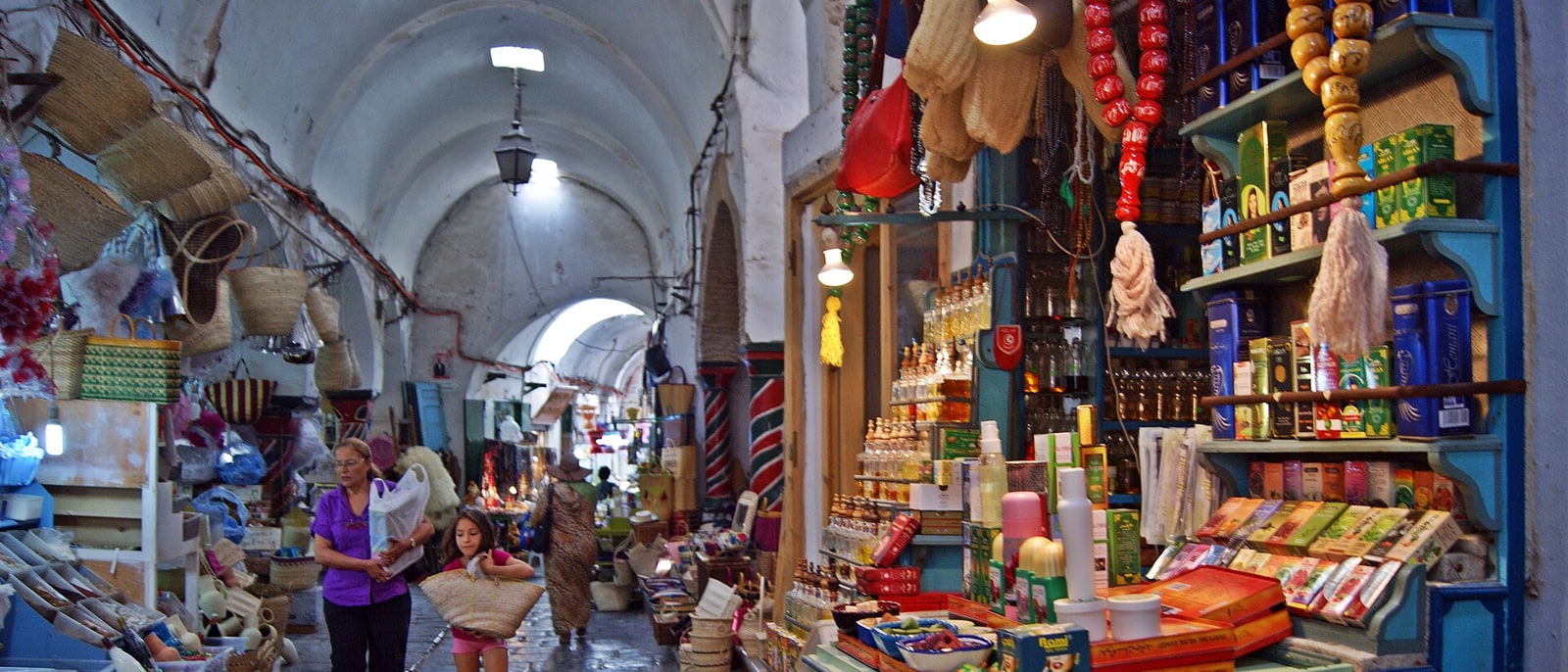
With that in your head, the medina stops being a maze and becomes a map: if you can smell leather, you’re on the edge. If you can smell jasmine, you’re in the middle. And the day sorts itself out, because the rest of Tunis is in a straight line: the French city begins where the medina ends, and from there a train from 1872 takes you to Carthage in half an hour.
The route, stop by stop
5 STOPS- 01
The Zitouna mosque and the order of the souks
The Zitouna opened before any other mosque in Tunis, and the whole medina radiates from it. Its university was among the first in the Islamic world and taught for over a thousand years. Non-Muslims are allowed into the courtyard, which alone justifies the stop: the columns are Roman, taken from the ruins of Carthage and reused without any attempt at disguise.
And around it is the system. Souk El Attarine is the perfumers’ and it presses against the mosque, because the smell was considered appropriate to the house of God. Next to it, the booksellers. Textiles, a bit further. And the tanners, right at the far edge, because tanning genuinely stinks.
It’s town planning by nose, it’s thirteen hundred years old and it still works exactly the same way: it wasn’t decreed, it ordered itself and nobody has changed it.
- 02
The chéchia souk
An entire souk works on a single object: the chéchia, the red felt cap. It has been there since the seventeenth century and craftsmen still make them by hand, in a dozen-step process that includes weaving, shrinking in hot water, carding with a teasel brush and dyeing. One cap can take weeks.
And the origin is what makes stopping worthwhile: it came with the Andalusi Muslims expelled from Spain from 1609 onwards. They arrived in Tunis with the trade in their hands, set up the guild, and here it still is, four centuries later, one of the oldest corporations in the country. If you’ve come from Spain, you’re looking at a craft that left there and didn’t get lost here.
- 03
Avenue Bourguiba
You cross the Porte de France and change century and continent in ten metres: the medina ends and the ville nouvelle begins, which the French built from 1881 on what had been a lagoon. Avenue Bourguiba is an avowed copy of the Champs-Élysées, with its tree-lined central walk, its terrace cafés and its art nouveau and art deco buildings.
The detail that tells the whole story is halfway along: the Catholic cathedral of St Vincent de Paul, from 1897, is planted directly opposite what was the French governor’s residence. Facing each other, the cross and the administration, in the middle of a Muslim country. Nobody picked those two plots by accident.
Today the avenue is the city’s living room, and at six in the evening the whole of it is out on the street.
- 04
Carthage, on the 1872 train
The TGM has run as a commuter line since 1872, one of the oldest in Africa, that drops you at Carthage in half an hour for small change. It leaves from Tunis Marine, at the end of the avenue. It’s the best way to get there and it’s half an excursion in itself.
And now the important part: the Romans sowing Carthage with salt so nothing would grow again didn’t happen. There isn’t a single ancient source for it. The story first appears in the nineteenth century and got repeated until it became true. What the Romans did do was level it in 146 BC and then, a century later, rebuild it and make it the second city of the western empire. That’s where the Baths of Antoninus come from, the largest outside Rome. Careful what you’re looking at: only the basement survives, because the upper floors fell.
What looks enormous to you was the boiler room.
- 05
Sidi Bou Saïd, blue by decree
Two stops beyond Carthage, on top of a cliff above the gulf, is the village of white houses with blue doors and blue lattices. It’s one of the most photographed images in the Mediterranean and everyone assumes it’s ancient.
It isn’t. One man imposed the blue and white: Rodolphe d’Erlanger, a painter baron of Franco-British family who settled here in the early twentieth century, fell in love with the place and got the palette made compulsory for the whole village by decree in 1915. Before that, Sidi Bou Saïd was whatever colours it happened to be. So the most “authentic” postcard in Tunisia is the aesthetic decision of a European a century ago, enforced to the letter ever since.
His house, the Ennejma Ezzahra palace, can be visited and holds his collection of musical instruments.
Frequently asked
What to see in Tunis in a day?
The medina and its souks in the morning, Avenue Bourguiba in the French city, then the TGM, a train from 1872, out to Carthage and Sidi Bou Saïd, half an hour away. It’s all in a straight line and the train costs small change.
Did the Romans really sow Carthage with salt?
No. There isn’t a single ancient source for it: the story first appears in the nineteenth century and got repeated until it was taken as fact. What they did do was level it in 146 BC and rebuild it a century later, until it became the second city of the western empire.
Why is Sidi Bou Saïd blue and white?
Because of a 1915 decree obtained by Rodolphe d’Erlanger, a Franco-British painter baron living there, who made the palette compulsory for the whole village. Before that it was whatever colours it happened to be. Tunisia’s most “authentic” postcard is a European aesthetic decision from a century ago.