What to see in Tunis
5 stopsUpdated July 2026
Salting Carthage didn’t happen. No ancient source mentions it: the story appears in the nineteenth century, got repeated in textbooks, and today gets told as fact. And the blue and white of Sidi Bou Saïd, which everyone takes for millennial tradition, was imposed by decree by a French baron in 1915.
That’s the pattern of this city: almost nothing is what you were told, and what’s actually there is better. A medina ordered by the smell of its trades for thirteen hundred years. The largest collection of Roman mosaics in the world. The only portrait of Virgil in existence. And a whole continent called Africa because the Romans gave this province that name.
The route, stop by stop
5 STOPS- 01
The medina
Founded in 698 around the Zitouna mosque, it has been World Heritage since 1979 and holds around seven hundred listed monuments: palaces, medersas, mausoleums, fountains. It survives whole because when the French arrived in 1881 they didn’t touch it: they built their city next door, on a filled-in lagoon, instead of knocking this one down. It was colonialism with one fortunate consequence.
And its internal order is the best town-planning lesson you’ll get: the trades were placed by distance from the mosque according to their smell and their noise. Perfumers and booksellers pressed against it, textiles in the next ring, tanners and blacksmiths on the outer edge. Nobody decreed it, it ordered itself, and it has worked for thirteen hundred years.
It’s a city organised by nose before the word zoning existed.
- 02
Carthage
The real story beats the salt legend. Rome levelled Carthage in 146 BC after three wars and a century of fear, and for a hundred years the site sat cursed and empty. And then Julius Caesar and Augustus rebuilt it from nothing, because the location was too good to waste: it ended up the second city of the western empire, after Rome.
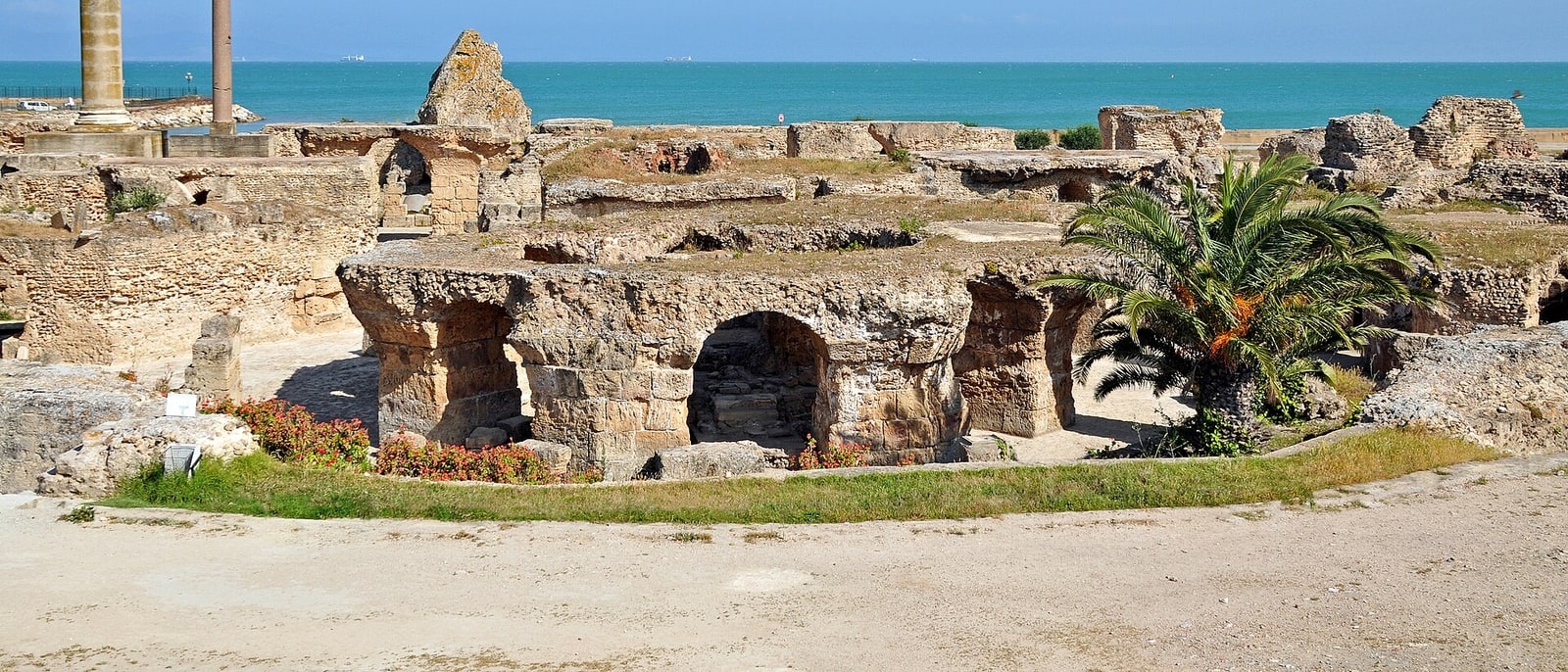
That’s why what you visit is almost all Roman and not Punic: the Baths of Antoninus, the largest outside Rome, of which only the basement survives, the theatre, the cisterns. Very little of Hannibal’s Carthage is left, because the Roman one was built on top of it and out of its stones.
And Carthage’s Roman columns ended up, centuries later, in the courtyard of the Zitouna mosque. This city has spent two thousand years recycling itself.
- 03
The Bardo
The largest collection of Roman mosaics in the world, and the reason is economic: North Africa was Rome’s granary for centuries, fortunes were made here in oil and wheat, and the provincial nouveaux riches paved their villas with enormous figurative mosaics to prove it. The result is that Tunisia today has more Roman flooring than Italy.
The unique piece is the Virgil mosaic, from Sousse: the poet seated with a scroll, flanked by two muses. It’s the only portrait of Virgil in existence anywhere, and it was on the floor of somebody’s dining room. It’s housed in a nineteenth-century bey’s palace, so you see Roman mosaics under Ottoman stucco ceilings, a combination that exists nowhere else.
Check opening times before going.
- 04
Sidi Bou Saïd
Rodolphe d’Erlanger, a banker’s son, painter, musicologist and fairly rich, settled here in the early twentieth century. He liked the village so much that in 1915 he got a decree making whitewash compulsory for every house, along with one specific blue for doors, windows and lattices. And it was obeyed. It still is.
Knowing that takes nothing away: it’s still beautiful, hanging off a cliff above the gulf, with bougainvillea and the sea behind. It only changes what you’re looking at: it isn’t an ancestral folk tradition, it’s a total work of art imposed by a European in love with the place.
His house, the Ennejma Ezzahra palace, can be visited and holds his collection of Arab musical instruments, which is what actually mattered to him: he spent his life studying and saving Arab music when nobody else was.
- 05
The ville nouvelle
The French arrived in 1881 and instead of knocking down the medina, which is what they did elsewhere, they filled in the lagoon to the east and built their city next to it. The result is that Tunis has two centres side by side from different centuries, separated by a gate: you cross the Porte de France and go from 698 to 1900 in one step.
Avenue Bourguiba is a tracing of the Champs-Élysées with a tree-lined central walk, and along its sides are art nouveau and art deco buildings that in Europe would be listed and here are half forgotten: look up, above the shop signs, and you’ll see unrestored 1920s façades.
It’s one of the best-preserved French colonial ensembles left, precisely because nobody has had the money to modernise it.
Frequently asked
What should you see in Tunis?
The medina, World Heritage with around seven hundred monuments and a thirteen-hundred-year-old ordering of souks by trade, the Bardo, with the world’s largest Roman mosaic collection, Carthage, Sidi Bou Saïd, and Avenue Bourguiba in the French city.
Why is the continent called Africa?
Because of Tunisia. The Romans called this area the province of Africa, after the Afri tribe who lived here, and the name spread southwards along with geographical knowledge until it covered the whole continent. Africa starts out as Tunisia.
Is anything left of Hannibal’s Carthage?
Very little. Rome levelled it in 146 BC and a century later built its own Carthage on top, using the stones of the old one. Almost everything you visit is Roman: the Baths of Antoninus, the theatre, the cisterns. Of the circular Punic harbour, the shape survives, now a lagoon.