A weekend in Tunis
18 h route4 stopsBest: Spring or autumn. And check whether you land in RamadanUpdated July 2026
The TGM has run since 1872, it’s one of the oldest railways in Africa and it still does the same job: getting people out of the capital towards the coast for small change. It leaves from the end of Avenue Bourguiba and drops you at Carthage and Sidi Bou Saïd in half an hour. That train is what organises a weekend here.
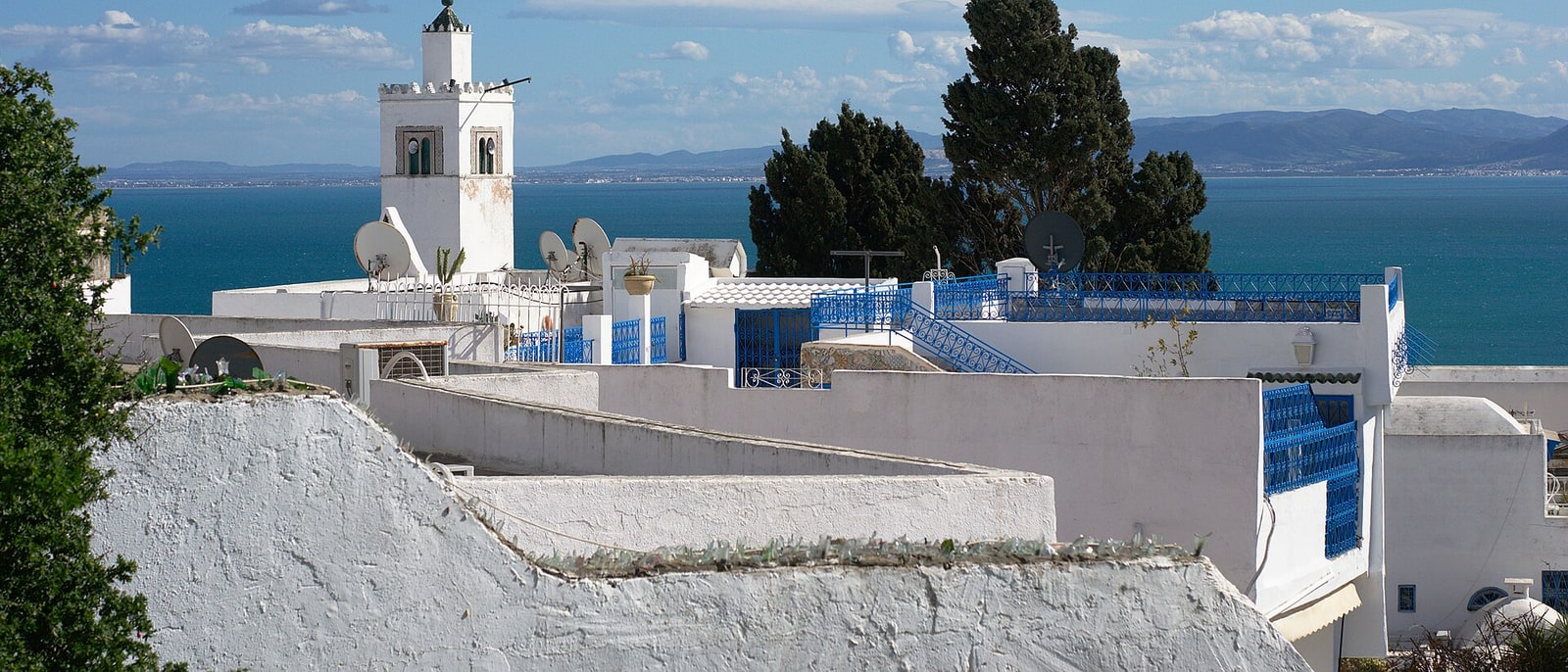
So the split makes itself: one day inside the city, between the medina of 698 and the avenue the French copied from the Champs-Élysées, and one day out along the coast. And if you have hours to spare there’s a third option almost nobody takes: the Bardo, which holds the largest collection of Roman mosaics in the world, in a palace.
The route, stop by stop
4 STOPS- 01
Saturday: the whole medina
World Heritage since 1979, with around seven hundred listed monuments inside an oval you could cross on foot in twenty minutes if you knew the way, which you won’t. And that’s fine: getting lost here is the plan, because the ordering of the souks by trade relocates you automatically. If it smells of leather, you’re on the edge. If it smells of jasmine, you’re near the mosque.
Give it the whole morning and go into a couple of medersas, the Koranic schools, which are open and empty, and into the Dar Ben Abdallah or the Dar Othman, seventeenth-century rich families’ palaces turned into museums.
The logic of the Arab house is clear there: outside, a blind wall with no windows and a small door. Inside, a marble courtyard with fountains. All the wealth faces inward and the street is shown nothing.
- 02
Saturday: the Bardo
It holds the largest collection of Roman mosaics on the planet, and not narrowly: when North Africa was Rome’s granary, the villas of this province’s rich were paved with enormous figurative mosaics, and here they are. They aren’t geometric borders: they’re scenes of hunting, of ships, of farming, with faces, and with dogs whose names are written beside them.
The piece to look for is the Virgil mosaic, found at Sousse: it’s the only known portrait of the poet, seated between two muses with a scroll in his hand. Think about that for a moment: the only face we have of Virgil is in Tunisia, on the floor of somebody’s house.
And the whole continent is named after this place: the Romans called this province Africa, after the Afri tribe who lived in this area, and the name spread southwards until it covered everything. Africa starts out as Tunisia.
- 03
Sunday: Carthage
Carthage doesn’t fit in one site: it’s several scattered through an expensive residential suburb, so you move between TGM stops. The Baths of Antoninus are the most spectacular, with the caveat that only the basement survives, the Byrsa hill has the museum and the view, and there’s a circular Punic harbour that today is a lagoon with ducks and that was the naval base which terrified Rome.
The founding legend is worth carrying with you: Elissa, or Dido, fled Tyre and asked the local king for as much land as an oxhide could cover. He agreed, expecting a laugh. She cut the hide into the thinnest possible strips, tied them together and encircled the entire hill.
Byrsa, the hill’s name, means oxhide in Greek. The etymology preserves the joke three thousand years later.
- 04
Sunday: La Marsa and the sea
The TGM ends at La Marsa, where people from the capital go swimming and where those who can afford it keep a house. There’s a real beach, there’s a seafront promenade, and there are cafés full of families on Sundays. It isn’t a tourist place and that’s why it works.
It’s the natural close of the weekend: you come down from Sidi Bou Saïd, on top of the cliff, and two stops later you’re at sea level with your feet in the water.
Order a mint tea with pine nuts floating in it, which is how it’s taken here and which surprises everyone the first time, and a bambalouni, the doughnut fried in front of you and dusted with sugar. You eat it in the street and it costs what it costs.
Frequently asked
What is the TGM in Tunis?
A commuter railway running since 1872, one of the oldest in Africa, linking the capital’s centre with Carthage, Sidi Bou Saïd and La Marsa for small change. It leaves from Tunis Marine, at the end of Avenue Bourguiba, and it’s what makes a weekend here work.
What’s in the Bardo Museum?
The largest collection of Roman mosaics in the world, in the bey’s palace. And one unique piece: the Virgil mosaic, found at Sousse, the only known portrait of the poet. Check opening times before going.
Why is the Carthage hill called Byrsa?
Because it means “oxhide” in Greek, and it comes from the founding legend: Dido asked for as much land as an oxhide could cover, cut the hide into the thinnest strips and encircled the whole hill with them. The etymology preserves the joke three thousand years later.