OZU /AUSTRALIA /MELBOURNE /GUIDE
Melbourne in a day
9 h route4 stopsBest: Any time of year, but bring layers: the weather here turns in an hourUpdated July 2026
Melbourne’s laneways, which are today the city’s monument and appear in every photo, were designed for none of this. They’re a nineteenth-century planning accident: when the centre’s grid was laid out in 1837, narrow service streets were left behind the main ones (the ones still called Little Collins, Little Bourke, Little Lonsdale) for carts, rubbish and access to the stables. They were the ugly part.
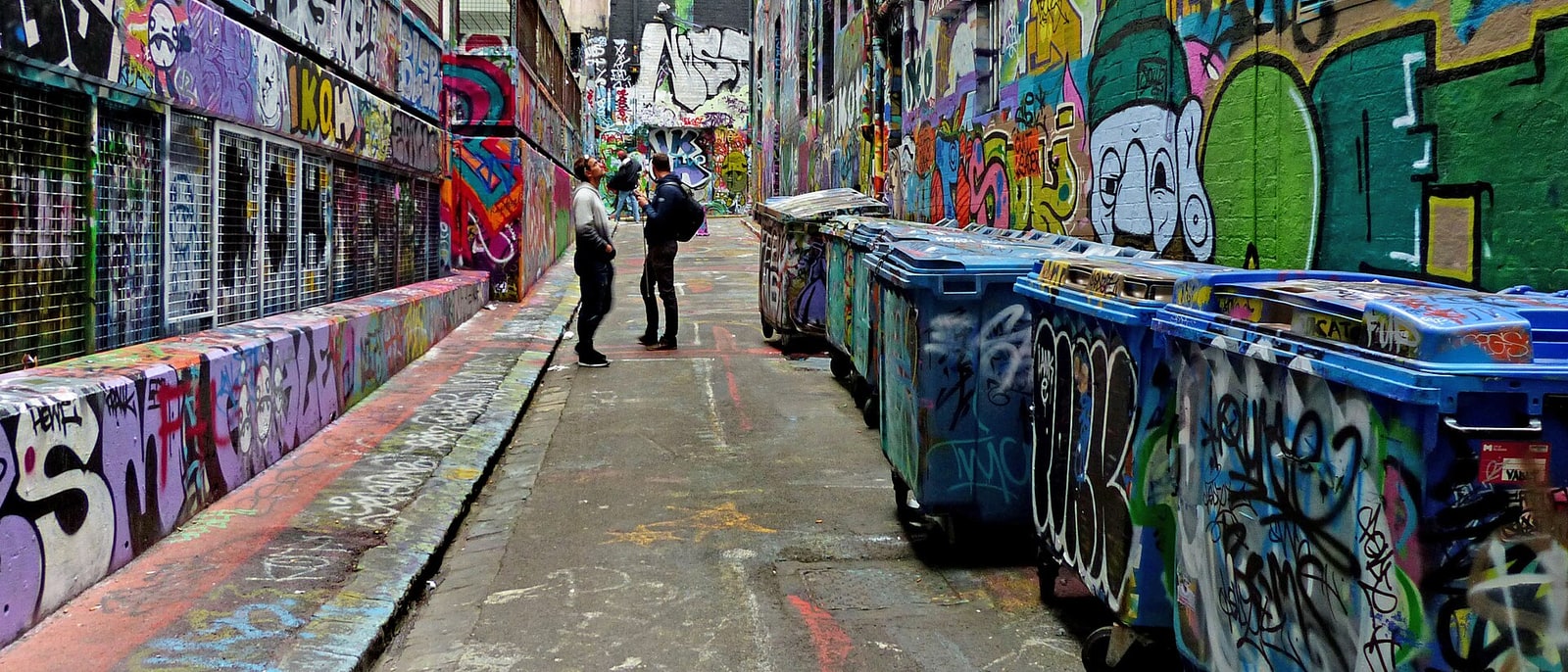
That the city’s back end should have ended up as its face is a story of the last thirty years, and it’s what makes Melbourne unlike any other Australian city. There’s no Opera House here and no bridge: there’s an urban grid you can walk end to end that rewards anyone who turns down what looks like a dead end. A day here is about that, and about coffee, which is the other local religion.
The route, stop by stop
4 STOPS- 01
The laneways
Hosier Lane takes the fame: a cobbled alley covered in street art from the ground to the first floor, changing constantly because whatever’s painted gets painted over. What almost nobody knows is that it’s legal there: the council set up a permit regime for that specific lane, so what would be a fine in the next street is the intended activity here. That’s why the paint is centimetres thick.
The others are as good or better. AC/DC Lane is named after the band, which formed in this city. Degraves Street and Centre Place are the café ones, with tables wedged into a metre and a half of width. And the Block Arcade and Royal Arcade are the luxury version of the same invention: covered nineteenth-century passages with mosaic floors and iron skylights.
The instruction is simple and it works: every time you see a gap between two buildings, go down it. Melbourne keeps the good stuff where you can’t see it from the pavement.
- 02
Coffee, which here is an institution
Melbourne takes coffee the way other cities take opera, and there’s a specific historical reason behind it: postwar Italian and Greek immigration. In the fifties tens of thousands of southern Europeans arrived in this city, and with them came the espresso machines and the habit of drinking it standing at the bar. Seventy years later, that habit is the most recognisable local trait.
The practical part: learn the vocabulary or you won’t order properly. Flat white is espresso with textured milk and barely any foam, long black is espresso lengthened by pouring it over the water, never the other way round, short black is a plain espresso. Ordering “a coffee” means nothing.
And the best way to do it is the local way: walk into a tiny place down a lane, order at the bar and drink it there. This is the country where Starbucks arrived in 2000 and closed nearly everything by 2008, and Melbourne is the main reason.
- 03
The Royal Exhibition Building
An 1880 exhibition palace, domed, surrounded by gardens, that looks transplanted from Europe. It’s the first building in Australia listed as World Heritage, and not for being pretty: it’s one of the very few nineteenth-century world’s fair palaces still standing and in use anywhere. Most were pulled down when the fair they were built for ended.
And it has a political role that surprises people: Australia’s first federal parliament met here, in 1901, when the country was founded as such.
Melbourne was the seat of federal government for the first quarter of the twentieth century, until Canberra was built. That fact explains half the city: what you see around you (the big buildings, the wide avenues, the money) is from when this was the de facto capital and one of the richest cities in the world.
- 04
The tram, and the free ring
Melbourne has the largest tram network in the world, and that isn’t a brochure headline: it’s hundreds of kilometres of track crossing the city in every direction, working as the main transport and not as a heritage attraction. The trams share the road with cars, which is why driving here has rules of its own.
What to know on day one: inside the city centre perimeter, the tram is free. There’s nothing to tap and nothing to buy, you get on and that’s it. It’s called the Free Tram Zone and it covers the whole grid and the docklands.
Outside that zone you do need the local card, and there’s the trap: if you board inside and get off outside, you must have tapped on. With that settled, the best way to see the centre is to let it carry you: get on, look, get off wherever something catches your eye.
Frequently asked
What to see in Melbourne in a day?
The laneways (Hosier Lane, where painting is legal under a council permit, Degraves and Centre Place, the café ones, and the nineteenth-century arcades, Block and Royal) a coffee standing at the bar, the 1880 Royal Exhibition Building, where the country’s first parliament met in 1901, and letting the tram carry you, which inside the centre is free.
Why are Melbourne’s laneways famous?
Because the back of the city ended up as its face. They were narrow service streets laid out in the nineteenth century behind the main ones (hence the names Little Collins, Little Bourke) for carts and rubbish. In recent decades they filled with cafés, bars and street art. In Hosier Lane painting is legal thanks to a permit regime: that’s why the paint is centimetres thick.