OZU /AUSTRALIA /MELBOURNE /GUIDE
What to see in Melbourne
7 h route4 stopsBest: The museums on a weekday. The lanes, wheneverUpdated July 2026
In 1880 Melbourne was one of the richest cities on the planet, and that sentence is the key to everything you’ll see. In 1851 gold was found in Victoria and one of the biggest gold rushes in history followed: the state’s population multiplied within a decade and an amount of money that’s hard to picture poured in. With it a huge, vain, stone Victorian city was built, on a site that fifteen years earlier had been four huts.
They called it Marvellous Melbourne, and they meant it. Almost everything you visit today comes from that: the exhibition palace, the domed library, the shopping arcades, the stadium, the wide streets. And the laneways too, which were the back rooms of that rich city and which today are what most people come to see. Melbourne’s sights aren’t spectacular one by one. What impresses is the ensemble and knowing where it came from.
The route, stop by stop
4 STOPS- 01
The library reading room
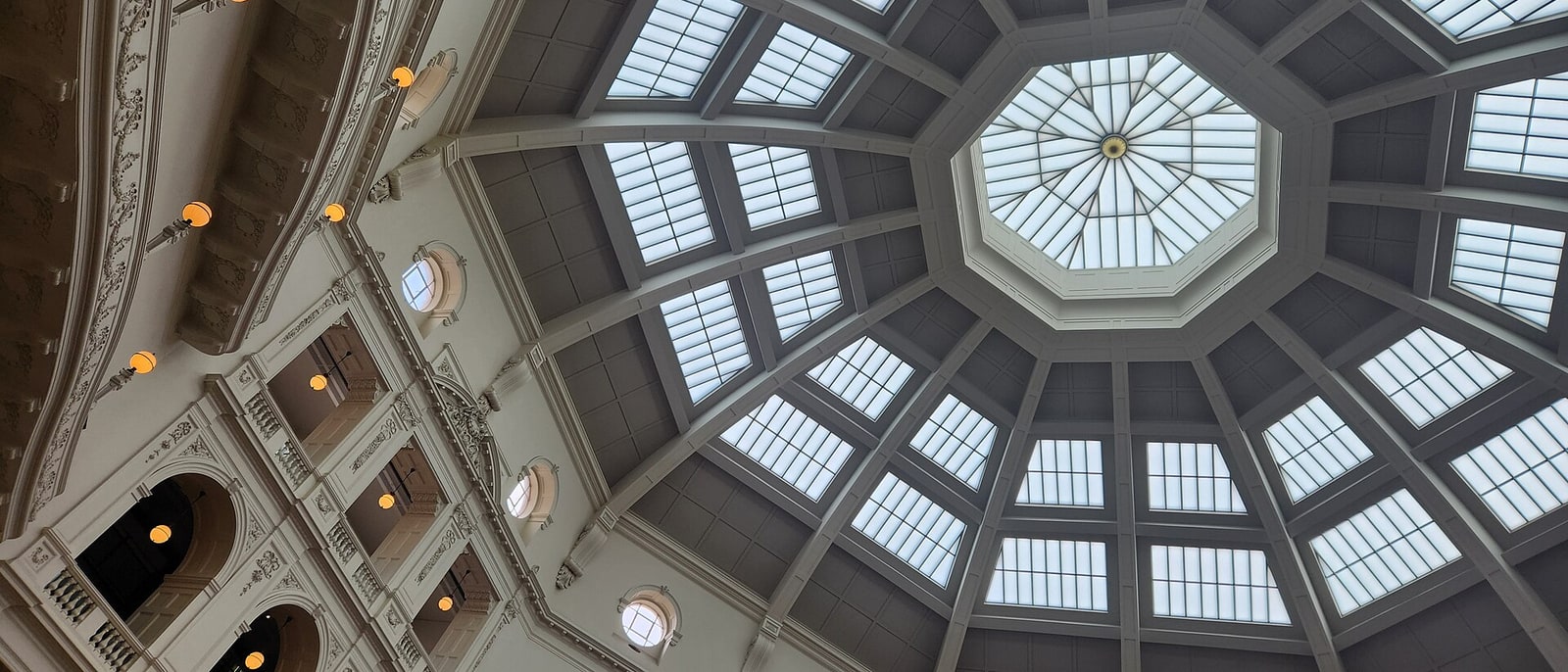
The State Library of Victoria has an octagonal reading room with an enormous dome and a gallery of balconies around it, finished in 1913, which when built was one of the largest reinforced concrete domes in the world. You walk in free, no ticket and no queue, and you can go up to the balconies and look down at it.
It’s probably the most beautiful interior in Australia and it’s still a real library: there are people studying underneath. That’s half the charm.
The other half is what it holds: Ned Kelly’s armour is here, the Irish-Australian bushranger who faced the police in 1880 in a suit of steel plates made from plough mouldboards. It’s the most famous object in the country and it’s in a case, in a library, free.
- 02
The National Gallery of Victoria
The oldest art museum in Australia, founded in 1861 with gold rush money, and today the most visited in the country. You enter through a water wall, a sheet of glass with water running constantly down it that everyone touches as they pass. And the permanent collection is free, all of it: that’s what you need to know.
Inside there’s European, Asian and Australian painting, but what to look for is the part you won’t see in any museum at home: Aboriginal art, both old and contemporary, one of the longest living artistic traditions in the world and one that in recent decades has become first-rank contemporary art.
Give it the time you’d give the Europeans. The central desert paintings, with that dot technique, aren’t craft: they’re contemporary painting made by people painting their country and their law.
- 03
The MCG
A stadium for around a hundred thousand people, in the middle of the city, which is the most sacred site in Australia and that isn’t an exaggeration. The first international cricket match in history was played here, in 1877, the 1956 Olympics were here, and every September the Australian football grand final is played here, the country’s biggest occasion.
That sport, Australian rules football, was invented in this city in the mid-nineteenth century and is played seriously almost nowhere else on earth. It’s a game on an oval field, with no offside, where the ball is punched or kicked and where people climb on each other to take it in the air.
Here it isn’t a sport: it’s the identity of the suburbs, each with its club for over a century. If a match coincides with your trip, go. And if not, the stadium tour explains the country better than a museum.
- 04
The city that was here before 1835
Melbourne was founded in 1835 and there’s an episode at that date worth knowing, because it’s unique in Australia. A settler called John Batman signed a document with Wurundjeri elders by which he claimed to have bought hundreds of thousands of hectares in exchange for blankets, knives and flour. It was the only attempt in Australian colonial history to acknowledge the land had owners.
And the government voided it that same year. The official reason was that the land belonged to the Crown and nobody could buy it from anybody, because legally there was nobody: it was the principle of terra nullius, which stood until 1992. Melbourne is on Kulin nation country, Wurundjeri and Boonwurrung, and that acknowledgement is read aloud at the start of public events in this city, including matches at the stadium.
There’s no monument to visit, but there is an Aboriginal cultural centre by the river and a date, 26 January, which here is the national holiday and Invasion Day at once.
Frequently asked
What must you see in Melbourne?
The laneways, which are the local monument, the State Library reading room, with its 1913 dome and Ned Kelly’s armour, free, the National Gallery of Victoria, with its free permanent collection and an Aboriginal art collection you won’t see in Europe, the 1880 Royal Exhibition Building, and the MCG, the hundred-thousand-seat stadium where the sport invented here is played.
Why does Melbourne have so many Victorian buildings?
Gold. In 1851 gold was found in Victoria and one of the biggest rushes in history followed: the state’s population multiplied within a decade and an enormous amount of money came in. With it a stone Victorian city went up on a site that fifteen years earlier was four huts. In 1880 Melbourne was one of the richest cities in the world, and they called it Marvellous Melbourne.