OZU /AUSTRALIA /MELBOURNE /GUIDE
A weekend in Melbourne
20 h route4 stopsBest: March or November. And check the sports calendar before bookingUpdated July 2026
Some two hundred and fifty kilometres of track make this the largest tram network in the world, and that fact is what you use to build a weekend. Melbourne is flat, it’s a grid and it’s stitched together with rails: you don’t think in distances, you think in lines. You get on, you get off, you get on again, and inside the centre you don’t even pay.
What decides a weekend here isn’t the map, it’s the calendar. This is the country’s sporting capital and it has dates that turn it upside down: the tennis in January, Formula 1 in March, the Australian football grand final in September and the November horse race, which is an official public holiday in the city. Coinciding with one of those is a different experience: better, but with the city full. Check the calendar before booking and decide whether you’re going for it or dodging it.
The route, stop by stop
4 STOPS- 01
Saturday morning: the market
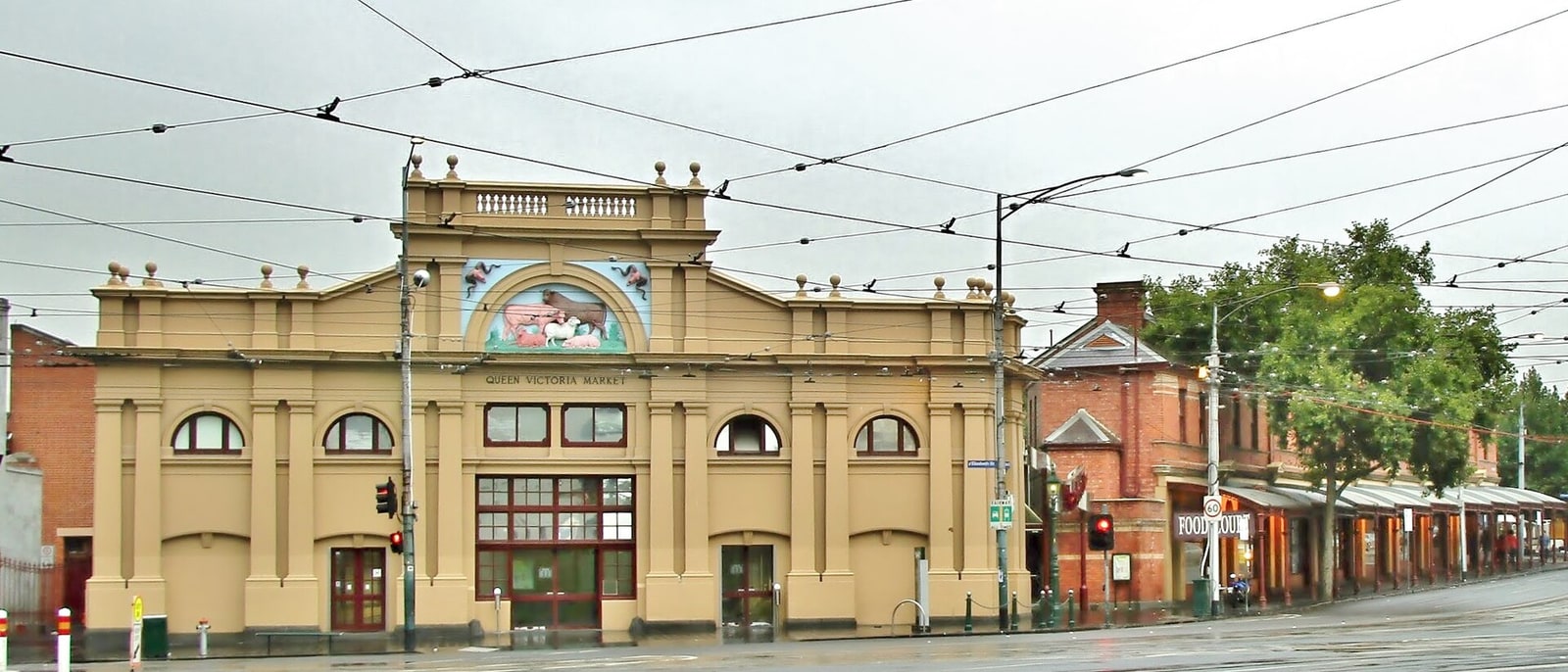
The Queen Victoria Market has been running since the nineteenth century and covers several blocks: open sheds of fruit and vegetables, a meat and fish hall, delis and stalls of everything else. It’s enormous, it’s cheap and it’s where locals shop, not just visitors.
And it has a story that isn’t on the signs: part of the market is built on top of Melbourne’s old cemetery. When it was expanded, not all the bodies were moved: thousands of burials are reckoned to still be under the ground, a good share of them under what is now the car park. It’s one of those things the city doesn’t hide but doesn’t advertise either.
Go first thing, have breakfast there and then walk into the centre: it’s up against the grid.
- 02
Saturday: the lanes and the gallery
Saturday afternoon goes to the grid: the lanes one after another, turning down every gap that appears between two buildings. Hosier Lane with its legal street art, Degraves and Centre Place with cafés wedged into a metre and a half, the covered nineteenth-century arcades with mosaic floors. You don’t need a route: you need to turn where it looks like you can’t.
And at the end, across the river, the National Gallery of Victoria, the oldest art museum in Australia and the most visited. The important part: the permanent collection is free, all of it, no catch. The first thing you see on entering is the water wall, a sheet of glass with water running down it that people touch as they pass. Inside there’s everything, from European art to contemporary Aboriginal art, which is the part you won’t find anywhere else in the world.
- 03
Saturday night: the north
Fitzroy and Collingwood sit ten minutes by tram from the centre and form the heart of the night: small bars, live music rooms, restaurants, Victorian brick terraces and two parallel streets, Brunswick and Smith, that hold almost all of it. Melbourne has one of the densest live music scenes anywhere, and this is where it is.
That this isn’t rhetoric is proved by a date: in 2010, when a historic rock pub had to close over a licensing problem, twenty thousand people marched through the city’s streets. Twenty thousand, over a pub. The state government rewrote the rule. It’s hard to find anywhere else where live music carries that political weight.
So the night here isn’t about clubs: it’s about walking into any pub and finding a band playing in the back room.
- 04
Sunday: St Kilda and the bay
Half an hour by tram drops you at the beach, and expectations need adjusting: this is the bay, not the open ocean, so the water is still and there’s no surf. What there is is a long promenade, a pier, people skating and a Sunday atmosphere that resembles nothing in the centre.
Two specific things. One: Luna Park, a 1912 amusement park entered through a giant grinning mouth, with one of the oldest wooden roller coasters still operating in the world, its brakeman riding the cars. Two: Acland Street, the cake street, a legacy of postwar central European Jewish immigration, where the windows are still full of eastern European pastries.
And at the end of the pier there’s a colony of wild little penguins that comes back at dusk. Free, in the city.
Frequently asked
What to do on a weekend in Melbourne?
Saturday at the market (the Queen Victoria, built partly over the old cemetery) lanes in the afternoon and the National Gallery of Victoria, whose permanent collection is free. The night in Fitzroy and Collingwood, where the live music is. And Sunday by tram to St Kilda: Luna Park, from 1912, the cake shops of Acland Street and the penguins on the pier.
Are there penguins in Melbourne?
Yes, and you don’t need to leave the city: there’s a colony of wild little penguins on the rocks of St Kilda pier, half an hour by tram from the centre, coming back at dusk. It’s free. The big famous colony is on Phillip Island, an hour and a half away, and that one is ticketed with grandstands.