OZU /AUSTRALIA /MELBOURNE /GUIDE
Day trips from Melbourne
11 h route4 stopsBest: The coast in afternoon light. The penguins at duskUpdated July 2026
The Great Ocean Road wasn’t built for you to drive along. It was built between 1919 and 1932 by some three thousand soldiers returning from the First World War, with picks and shovels, no machinery, and it was done for two reasons at once: to give them work on their return and to raise a monument to the ones who didn’t come back. It is, officially, the largest war memorial in the world, and it runs over two hundred kilometres.
Knowing that changes the whole trip. What you drive isn’t a scenic route: it’s a job done by hand by men just out of the trenches, cut into a cliff, dedicated to their dead. And around Melbourne there’s more of the same kind, close and reachable: penguins coming out of the sea every night, an entire gold rush town and a forest with a steam train. The city is flat and dull at its edges, but an hour out something else begins.
The route, stop by stop
4 STOPS- 01
The Great Ocean Road
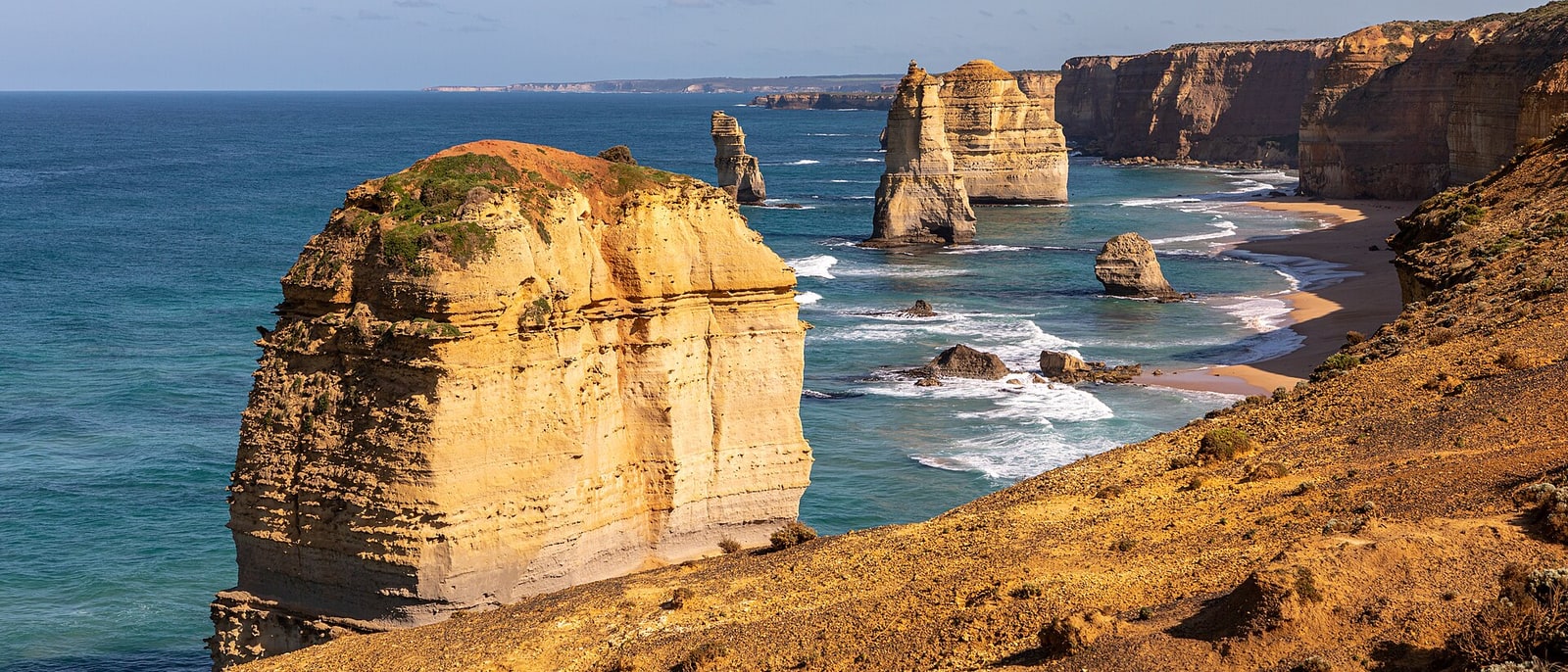
Two hundred-odd kilometres of cliff with the Southern Ocean breaking below, made by hand by soldiers back from the First World War between 1919 and 1932. You pass through eucalypt forest with actual koalas in the branches, surf towns and lookouts hung over the water. The famous site is the Twelve Apostles, limestone stacks standing in the sea.
And here’s the dismantling: they were never twelve. When they were given that name, in the twenties and for purely touristic reasons, there were nine. Before that they were called the Sow and Piglets, which sells rather less. And they keep falling: one collapsed in 2005 in front of the tourists, and another after. The limestone erodes and the sea eats them, so the number drops.
Doing it in a day from Melbourne is a hammering in the car: leave early, and if you can, sleep a night along the way.
- 02
Phillip Island
An hour and a half southeast there’s an island where every dusk, without missing a single day of the year, hundreds of little penguins come out of the sea and walk across the beach to their burrows. They’re the smallest penguin species in the world, they spend the day fishing and come back when night falls because in the dark predators can’t see them.
The visit is heavily organised (grandstands, timings and tickets) and that can put people off, but it’s justified: it’s a wild protected colony, and without control it would be wrecked in a season. They go about their business, very close, paying no attention to anyone. The time depends on sunset, so in winter it’s early and in summer very late.
And note: no flash photography, and they enforce it, because it dazzles them. If you’re travelling with children, this is the trip.
- 03
Ballarat and the gold
An hour and a half by train and you’re at the epicentre of the gold rush that made Melbourne rich. Ballarat preserves an entire nineteenth-century town and an open-air museum where you can pan real gold in the river, with costumed staff who take it seriously. It sounds like a theme park and works better than it sounds.
But the real reason to come is political: here, in 1854, the miners rebelled against the licence tax the colonial government charged them, threw up a stockade, swore an oath under their own flag and the army stormed it before dawn. About thirty died. It’s called the Eureka Stockade and in Australia it’s considered the founding episode of the country’s democracy: shortly after, the miners got the vote and the tax went. The Southern Cross flag they raised is still a live political symbol, and a contested one, today.
- 04
The Yarra Valley and the hills
An hour east there are two different and complementary things. One is the Yarra Valley, a cool-climate wine region making good sparkling and pinot noir, with cellars to visit and the usual warning: either someone who isn’t drinking drives, or you go with hired transport.
The other is the Dandenong Ranges, a forest of giant eucalypts and tree ferns reached by the suburban train. There you’ll find Puffing Billy, a narrow-gauge steam railway over a century old, saved from the scrapyard because volunteers set about fixing it, and which has a custom that exists on no other train in the world: you ride sitting on the window sills with your legs hanging outside.
Children do it and so do adults. It’s forest, steam and legs out: an hour from the city.
Frequently asked
Can you do the Great Ocean Road in a day from Melbourne?
You can, but it’s a hammering: the Twelve Apostles are about four hours out and you have to come back. Leave early, and if you can, sleep a night along the way. The road was built with picks and shovels by some three thousand soldiers back from the First World War between 1919 and 1932, as a memorial to the fallen: it’s the largest war memorial in the world.
How many are the Twelve Apostles?
They were never twelve. When they were given that name, in the twenties and for touristic reasons, there were nine: before that they were called the Sow and Piglets. And they keep falling, one collapsed in 2005 in front of the tourists and another after, because the limestone erodes and the sea eats them. The number drops over the years.