Sydney in a day
9 h route4 stopsBest: March-May or September-November. Remember summer here falls at ChristmasUpdated July 2026
The architect of the Sydney Opera House left Australia in 1966, with the job half done, and never came back. Jørn Utzon was Danish, had won the competition in 1957 with a drawing that was nearly thrown out, and ended up resigning after years of fighting the state government over money and control. He left the country and died in 2008 having never seen his building finished.
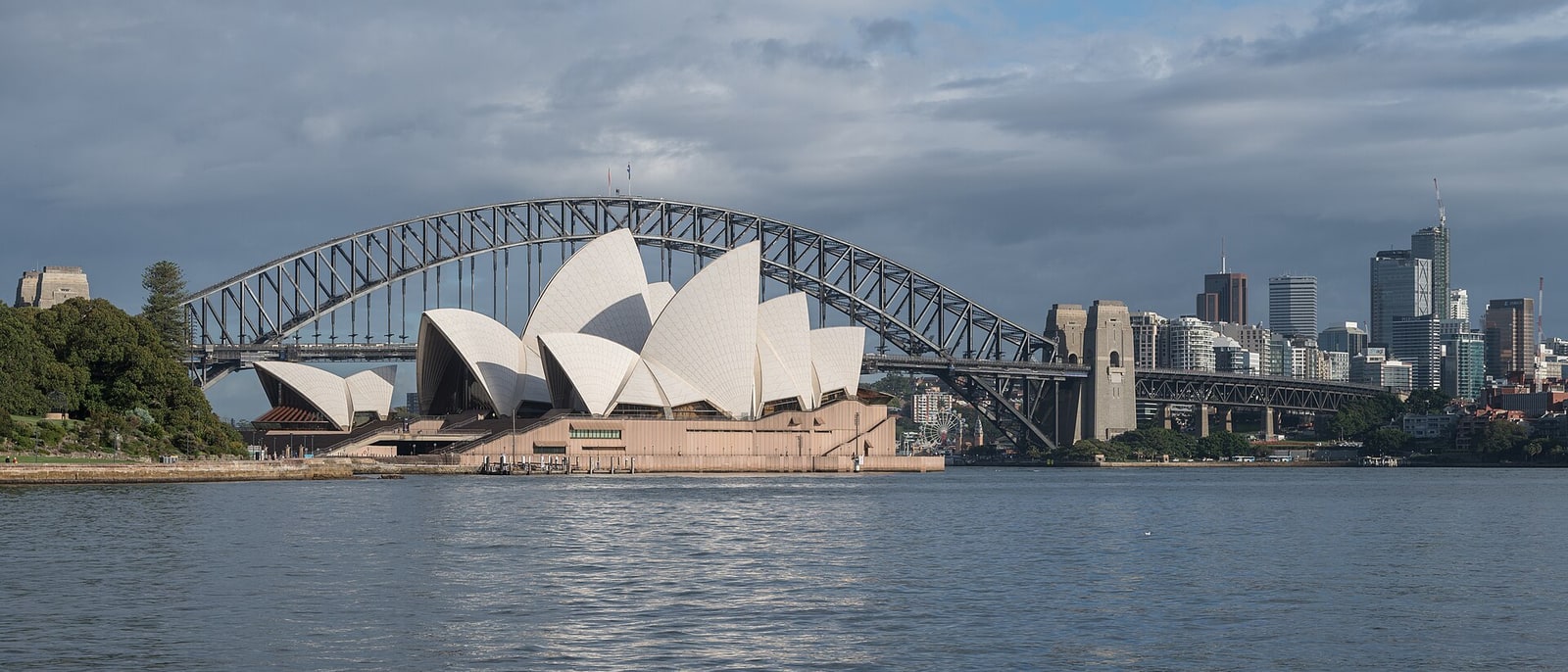
That story isn’t background colour: it’s the whole city. The job was going to cost seven million and cost over a hundred, was going to take four years and took fourteen, and was paid for with a lottery because nobody would put up the money. Sydney organises itself around the harbour and around that impossible building that almost wasn’t built. A day here is done by water, not by land, and it starts by looking closely at what was a twenty-year political war.
The route, stop by stop
4 STOPS- 01
The Opera House, up close
From a distance it looks like a postcard you’ve seen a thousand times, up close it’s another thing, for a specific reason: it isn’t white and it isn’t smooth. It’s covered in over a million ceramic tiles made in Sweden, laid in two finishes, glossy and matte, forming a chevron pattern. That’s why the colour shifts with the light all day instead of staying flat.
The technical story is better still. Utzon drew shells nobody knew how to calculate: they weren’t any known geometric form and for years the building was literally unbuildable. He found the solution himself, and it has a rare elegance: make every shell a segment of one single sphere, like the pieces of a peeled orange. With that they could be mass-produced and assembled.
Walk around and touch them: this is where you see it wasn’t a whim of shape, it was a maths problem that cost fourteen years.
- 02
The Manly ferry
The best view in Sydney isn’t priced like an attraction: you pay for it with your transport card, the same as the metro. The Manly ferry leaves Circular Quay, takes about half an hour and crosses the whole harbour, passing in front of the Opera House and under the bridge’s silhouette. Beside it, tourist cruises do exactly the same thing for several times the price.
That’s the whole tip: don’t buy a harbour cruise, take the ferry. Stand on the outside deck, at the stern, and look back as the boat pulls off the wharf, because that’s where the Opera House and the bridge line up.
On arrival, Manly has a surf beach and a walk out to the headland. And an honest warning: the heads are open to the ocean, so if the sea is up, that last stretch genuinely moves.
- 03
The bridge and The Rocks
The bridge opened in 1932 and here they call it the coathanger, for the shape. You can walk across the pedestrian path for free, and you can climb the arch with the company that runs it, clipped to a cable. What you need to know is what happened on opening day, because it’s one of the finest episodes in Australian history.
As the state premier prepared to cut the ribbon, one Francis de Groot, a member of a right-wing paramilitary group, rode up on a horse, pushed forward and slashed the ribbon with his sword, declaring the bridge open in the name of the people. He was arrested, the ribbon was tied back together and the ceremony was repeated.
Under the bridge is The Rocks, where the First Fleet landed in 1788 and where the penal colony began: sandstone lanes, old pubs and the country’s oldest quarter, which came close to being demolished entirely in the seventies.
- 04
Bondi, and the walk to Coogee
Half an hour from the centre drops you on a kilometre of surf beach with the city behind it. Bondi is famous for obvious reasons, and in summer it’s packed, but what saves it starts at its southern end: the coastal walk to Coogee, some six kilometres along the clifftop, past Tamarama and Bronte, with coves, rock pools and open ocean the whole way. It’s the best urban walk in Australia and it costs nothing.
Before you get in the water, one thing that’s taken seriously here: swim between the red and yellow flags. Lifesavers plant them to mark the stretch clear of rips, and outside them Bondi has known rips that drag people out to sea every year. It isn’t excessive caution, it’s how an ocean beach works.
And at the southern end is the Icebergs pool, a rectangle of saltwater cut into the rock with waves breaking over the top.
Frequently asked
What to see in Sydney in a day?
The Opera House up close, to see the million Swedish tiles and the geometry of the shells, the Manly ferry, public transport with the best harbour view at the price of an ordinary ticket, the bridge and The Rocks, the First Fleet quarter from 1788, and Bondi with the coastal walk to Coogee, six kilometres along the cliff.
Is a Sydney harbour cruise worth it?
You don’t need one: the public Manly ferry crosses the whole harbour, passing the Opera House and going under the bridge, takes half an hour and is paid for with your transport card, the same as a bus. Tourist cruises do virtually the same route for several times the price. Stand on the stern deck and look back as you leave Circular Quay.