What to see in Sydney
8 h route4 stopsBest: Early: the Opera House and the bridge without crowds are another thingUpdated July 2026
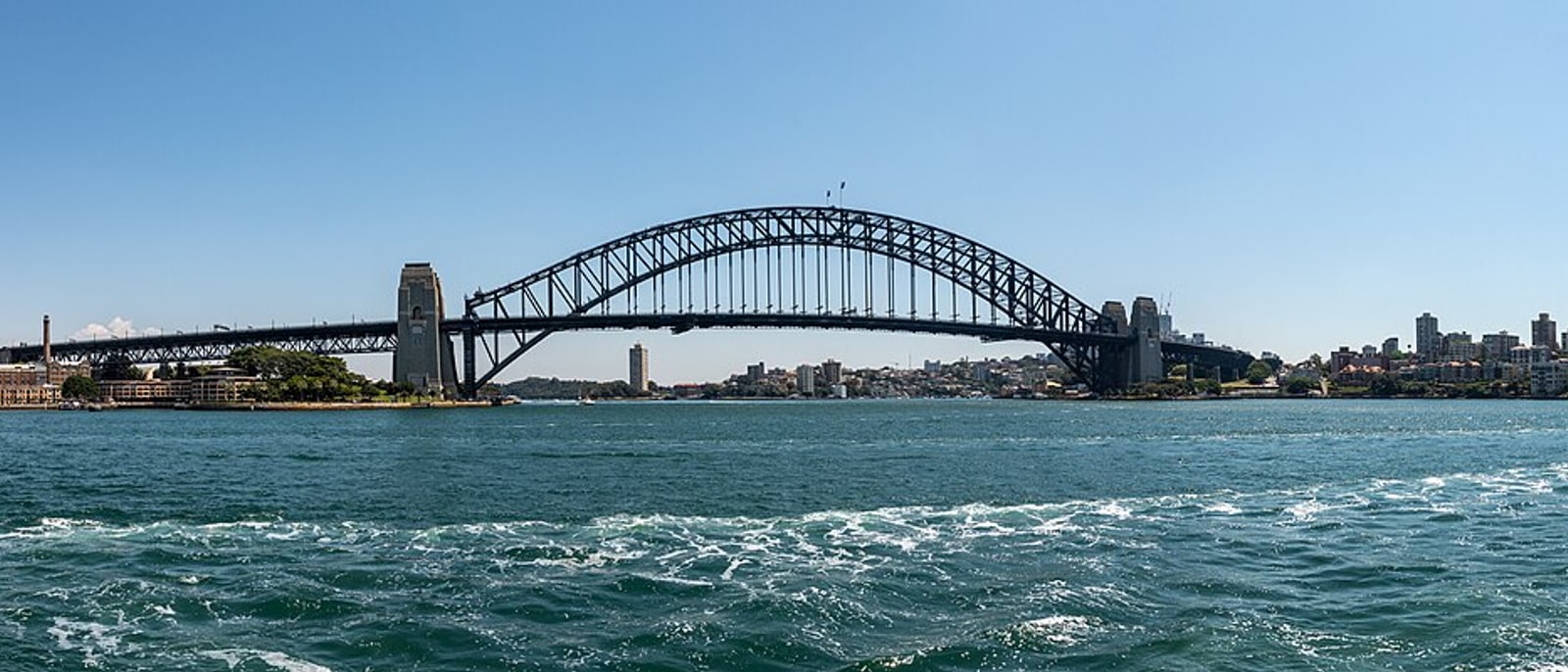
A million Swedish tiles, a bridge that has been painted almost non-stop for a century and the exact spot where a fleet of convicts landed in 1788. Sydney’s monuments are few and they’re all on the water’s edge, which makes things much easier: you see them on foot, in a line, with the harbour always to one side.
What isn’t so easily seen is what lies beneath. This is a young city, under two hundred and fifty years old as a European settlement, built on land inhabited for tens of thousands of years by the Gadigal people. Both layers are there, though one has buildings and the other doesn’t. It’s worth walking the same four places knowing what you’re actually looking at.
The route, stop by stop
4 STOPS- 01
The Opera House
The Opera House stands on Bennelong Point, and before Utzon drew anything there was a tram depot here. It’s hard to picture and it’s true: the most famous building in the southern hemisphere went up where the trams were parked.
You can see it from outside, which is free and is ninety per cent of the thing, or go in on a guided tour. Outside there are two things to do: walk right around to the back, where almost nobody goes and where the shells are seen from below, and get close enough to touch the tiles and confirm there are two different finishes, glossy and matte, forming a pattern.
Inside, what you see is that the interior isn’t Utzon’s: when he resigned in 1966, others finished it to different criteria, and that seam between outside and inside is the building’s wound.
- 02
The Harbour Bridge
It opened in 1932, in the depths of the Depression, and it’s a steel arch of the grand kind: you cross it on a pedestrian path, free, and that walk is one of the best things you can do here without paying. From the middle you see the Opera House framed by the structure, which is the photo everyone attempts.
Two things worth telling. One: painting it is a continuous job (you start at one end, reach the other and start again) to the point that in Australia “painting the Harbour Bridge” means a task that never finishes.
Two: on opening day a far-right paramilitary named Francis de Groot rode forward on a horse and slashed the ribbon with his sword before the state premier could. They had to tie the ribbon back and repeat the ceremony. If you have budget spare and heights don’t scare you, you can climb the arch clipped to a cable.
- 03
The Rocks
The First Fleet landed here in 1788 and the penal colony began here: it’s Australia’s oldest quarter as a European settlement, a handful of sandstone lanes with pubs open for a century and a half, wedged between the harbour and the bridge. You cover it in an hour and it’s heavily polished for visitors, but the place is the place.
And it has a story that deserves more attention than the pubs: in the seventies the whole quarter was going to be demolished for office towers.
What stopped it was the construction union refusing to do the work, in what was called here a green ban: the workers who were meant to knock it down said no. That’s why it’s still standing. It’s one of the few cases in the world where a historic quarter was saved by the builders rather than the architects.
- 04
The country that was here first
Sydney sits on Gadigal country, of the Eora nation, inhabited for tens of thousands of years, and that layer has no monuments to visit in the centre because it wasn’t a culture that built in stone. But it’s there, and there are ways of seeing it that almost no visitor looks for.
The most direct: the rock engravings. In the sandstone parks north and south of the city there are figures carved into open rock (animals, fish, human figures) made by the same peoples who lived here when the fleet arrived. There are no tickets and no queues. They’re on the ground, in the bush, and you reach them by public transport in under an hour.
The other layer is in the date: 26 January 1788 is when the First Fleet landed, it’s the national holiday, and for Aboriginal peoples it’s Invasion Day. Both things are true at once and in Australia that’s an open argument, not a settled matter.
Frequently asked
Can you go into the Sydney Opera House for free?
Seeing it from outside is free and is nearly the whole thing: walk around to the back, where nobody goes and the shells are seen from below, and get close enough to touch the tiles. Over a million of them, Swedish, in two different finishes forming a pattern. Going in requires a tour or a performance ticket. The interior, besides, isn’t Utzon’s: others finished it after he resigned in 1966.
Can you walk across the Harbour Bridge?
Yes, there’s a pedestrian path and it’s free: from the middle of the bridge you see the Opera House framed by the structure. That’s different from climbing the arch, which is done clipped to a cable with the company that runs it and costs a fair bit. The walk across the path is one of the best things you can do in Sydney without paying anything.