OZU /BOSNIA AND HERZEGOVINA /SARAJEVO /GUIDE
Where to stay in Sarajevo
2 h route3 stopsBest: Stable year-roundUpdated July 2026
Almost every visitor stays in the same place, and rightly so: Sarajevo is a long narrow valley, the city stretches along the river, and practically everything of interest sits at the eastern end, in the old town and around it.
The decision, then, isn’t about neighbourhood but about how far from that end you’re willing to be in exchange for price or quiet. The tram runs the whole axis, so moving away doesn’t cost you much.
The route, stop by stop
3 STOPS- 01
Baščaršija and the streets above it
Where most people stay, and it makes sense: you step out of the door into the bazaar, with the restaurants, the mosques and the foot of the cable car. Climbing the lanes behind, there are houses with views over the roofs and the cemetery, an image very much of this place.
The drawback: in summer the bazaar terraces are noisy until late, and the streets above have serious gradients.
Worth checking the altitude on the map before booking if you have a suitcase.
- 02
The Austro-Hungarian centre
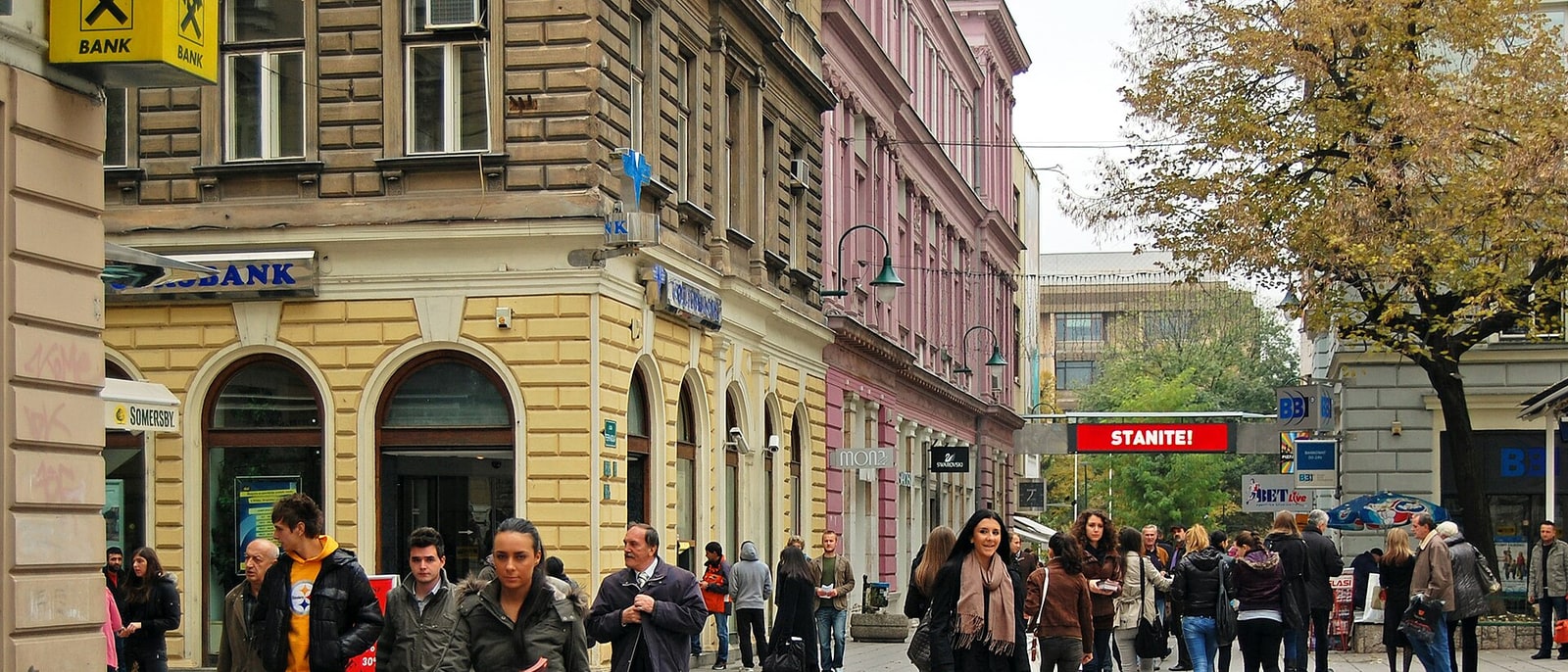
Just west of the meeting-of-cultures line is the city the Austro-Hungarians built: straight streets, four-storey buildings, cafés and the shops. It’s quieter at night, flatter, and still a short walk from the old town. It suits a stay of several days or if noise matters to you. It’s also where most mid-size hotels are, as against the apartments and guesthouses that dominate the bazaar.
- 03
Ilidža
Ilidža is about twelve kilometres from the centre, at the western end, and it’s where the airport is. It has a large park with a chestnut avenue leading to the springs of the river Bosna, and it costs considerably less than the centre.
A good option with an early flight or if you’re driving, because parking there is easy and in the old town it isn’t.
The trade-off is obvious: every trip into town is twenty or thirty minutes of tram, and that tram is slow.
Frequently asked
How does the Sarajevo tram work?
It runs the valley end to end, from Ilidža to Baščaršija, and it’s the backbone of city transport. It’s one of Europe’s oldest tram systems: running since 1885, and the city was used as a test line before it was installed in Vienna.