OZU /BOSNIA AND HERZEGOVINA /SARAJEVO /GUIDE
Sarajevo in a day
8 h route4 stopsBest: May to October. In December and January the valley fills with smogUpdated July 2026
Sarajevo fits into a walking day, and that’s part of what makes it singular: the Ottoman old town, the Austro-Hungarian city, and the places where two of the twentieth century’s defining events happened are all within twenty minutes on foot of one another.
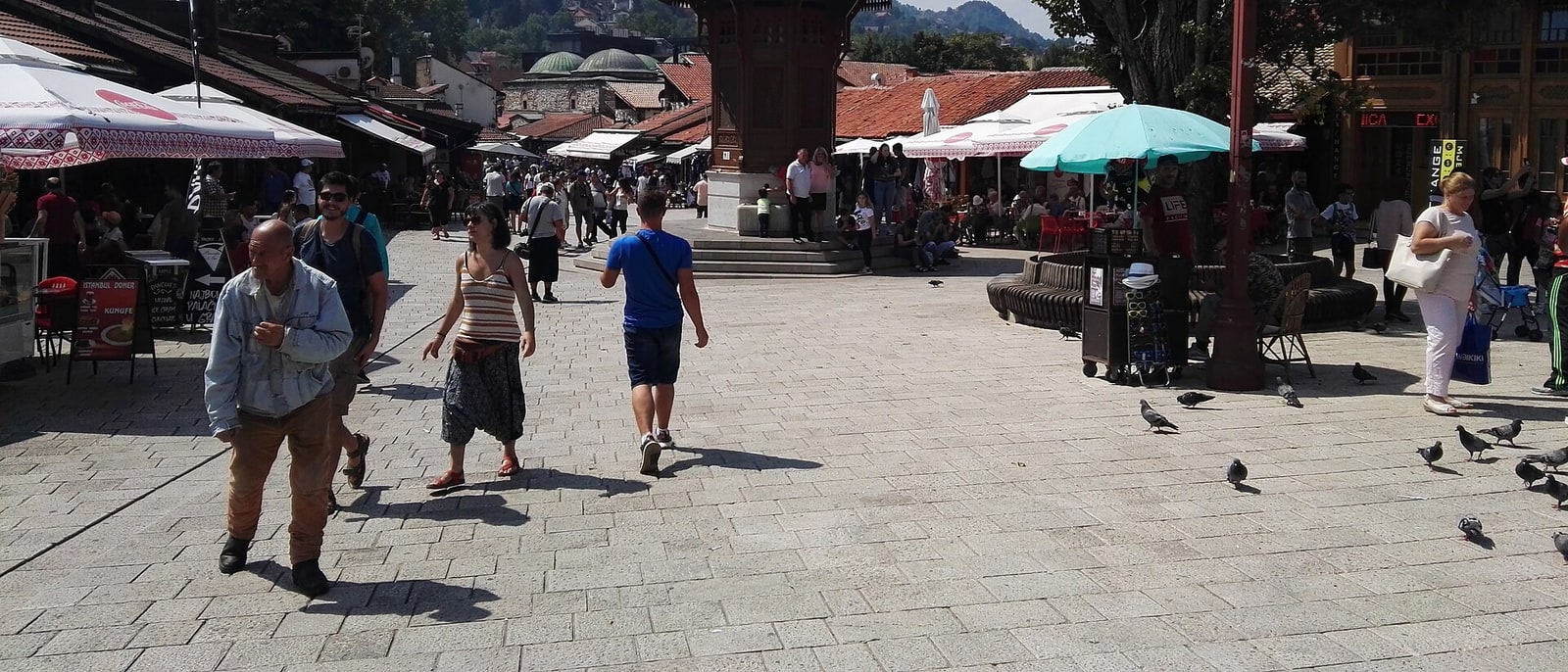
The route runs east to west, which is how the city reads: you start in the fifteenth-century bazaar and finish among Viennese façades, crossing on the way a line marked in the pavement that separates the two.
The route, stop by stop
4 STOPS- 01
Baščaršija
The heart of the city since the Ottomans founded it in the fifteenth century: streets of low buildings organised by guild (coppersmiths on one side, jewellers on another) and you can still hear copper being hammered in some workshops. In the middle stands the Sebilj, a wooden kiosk-shaped fountain that is everybody’s meeting point.
This is where you drink Bosnian coffee, which is not Turkish coffee though it resembles it: it arrives in a little copper pot called a džezva, with a handleless cup, a sugar cube and a piece of rahat lokum.
The sugar doesn’t go in: you dip it in the coffee and bite it.
- 02
The meeting-of-cultures line
On Ferhadija street a line runs across the pavement with an inscription: “Sarajevo, meeting of cultures”. It isn’t tourist decoration, it’s a real architectural border.
On one side, low Ottoman houses of wood and stone, on the other, four-storey Austro-Hungarian buildings with balconies and stucco.
The change came from 1878, when Austria-Hungary occupied Bosnia and set about building its city exactly where the other one ended, without demolishing it. Few people look at it, and yet it’s where the city’s history explains itself: turn a hundred and eighty degrees and you’ve changed empire.
- 03
The Latin Bridge
Beside this Ottoman bridge, on the pavement, Gavrilo Princip shot Archduke Franz Ferdinand and his wife Sophie. Five weeks later Europe was at war. There’s a discreet plaque and a small museum on the corner, and the first thing that strikes you is how narrow it all is: the car passed within a metre.
The detail that makes it stranger is that the attempt had already failed that same morning, a bomb thrown hours earlier missed, and that the archduke went out again by car to visit the wounded.
The driver took a wrong turn and had to reverse right in front of Princip.
- 04
Vijećnica
The city’s most striking building: the Austro-Hungarians raised it in 1896 in neo-Moorish style. That is, Central European occupiers building in an “oriental” style they imagined for the occasion. It later became the National Library.
In August 1992, during the siege, it was shelled with incendiary rounds and burned: close to two million books and manuscripts were lost, much of it irreplaceable. Neighbours and librarians formed human chains under fire to save what they could.
It reopened restored in 2014, and there’s an exhibition inside about what happened.
Frequently asked
What are the Sarajevo roses?
They are the scars left in the asphalt by mortar shells during the siege, later filled with red resin. The splash pattern resembles a flower. You see them across the city, on pavements and roadways, and they mark places where people were killed.
Is Sarajevo safe to visit?
Yes. The war ended in 1995 and the city is safe and calm for visitors. The one genuine precaution is to stay on marked paths in rural areas of the country, because there are still signposted mined areas off the usual routes.