A weekend in Toronto
20 h route5 stopsBest: September and October: good weather and the maples turningUpdated July 2026
Two days covers the city and covers Niagara, ninety minutes away, which earns the trip even if the cliché puts you off. The split makes itself: one city day, with the tower, the market and the neighbourhoods, and one falls day, which takes the whole thing because the town next to them is a funfair and you have to get out of it.
And something throws people who arrive expecting little: the food here is very good. Half of Toronto’s residents were born outside Canada and brought their cooking, so in two days you can eat Ethiopian, Tamil, Korean, Portuguese and Jamaican inside a five-kilometre radius without paying European capital prices.
The route, stop by stop
5 STOPS- 01
Saturday: the Distillery District
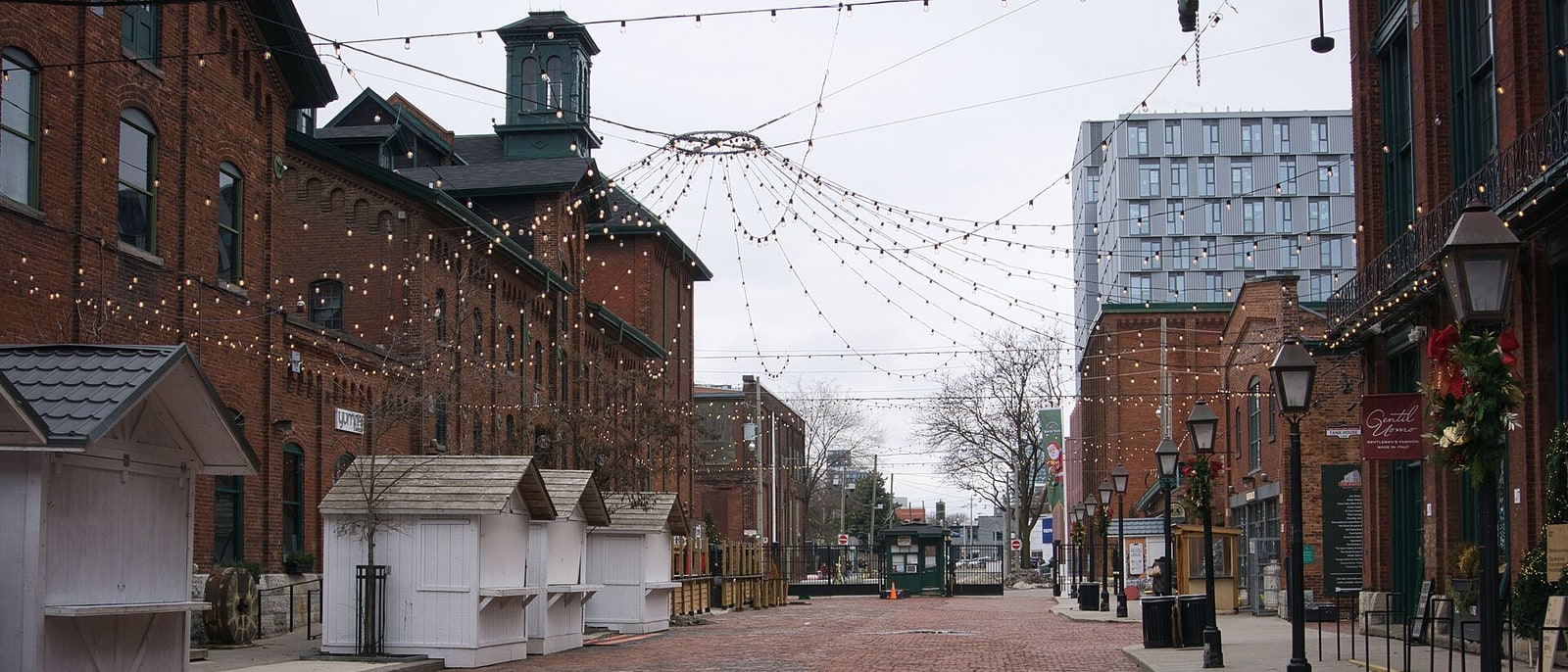
Forty-odd red-brick Victorian industrial buildings, cobbled streets, no cars: it’s the best-preserved industrial ensemble of its period in North America. It was the Gooderham & Worts distillery, which by the end of the nineteenth century was the largest in the world and produced more whisky than anywhere else.
It closed in 1990 and sat abandoned, serving as a film set (over eight hundred films and series were shot here, which is what happens when you have an empty, cheap Victorian district) until it was converted into galleries, shops and breweries.
It’s a bit of a shop window and it’s still worth it: the buildings are real, the scale is real, and in December it hosts the prettiest Christmas market in Canada.
- 02
Saturday: the ROM and the crystal
The Royal Ontario Museum, Canada’s largest, has everything: dinosaurs, mummies, Chinese art, minerals. But what people argue about is the building: in 2007 the Michael Lee-Chin Crystal, by Daniel Libeskind, was driven into its front. Five volumes of aluminium and glass bursting out of the Victorian façade as though an iceberg had landed on it.
The city has spent twenty years failing to agree. Some say it’s the best thing that ever happened to Toronto’s architecture and others that it’s an expensive monstrosity which also has a practical problem: the walls slope, so hanging paintings inside is a nuisance. Both positions are right. Go, look at the collision between 1914 and 2007 from the opposite pavement, and decide for yourself, which is more fun than agreeing.
- 03
Saturday night: eating in a different country
Toronto has the highest share of foreign-born population of any city on the planet: around half. There are over two hundred ethnic origins in the census and more than a hundred and sixty languages spoken. That isn’t a brochure statistic, it’s what makes the food here what it is.
And the neighbourhoods aren’t themed: they’re real, with people living in them. Little India, on Gerrard Street, has genuine Tamil and Bengali. The Danforth is Greek and in August it closes the street for an enormous festival. Little Portugal smells of grilled chicken. And out in Scarborough, on the edge, is probably the best Chinese and Sri Lankan food in North America, in ugly strip malls with not one photograph in them.
Pick one and go, instead of looking for “the best restaurant in Toronto”, which means nothing here.
- 04
Sunday: Niagara
Niagara Falls doesn’t win on height, fifty-seven metres, but on volume it ranks among the world’s biggest, and that’s the point: the drop doesn’t impress you, the volume and the noise do. The Horseshoe, the big one, is on the Canadian side, so the good view is this one and not the American.
And here’s the fact almost nobody knows: the flow you see is regulated. A treaty between Canada and the United States allows a good share of the water to be diverted to hydroelectric stations, and at night and in low season more of it is: the falls are literally turned down when nobody is watching. In daytime in summer the agreed maximum runs.
You aren’t watching a pure natural phenomenon: you’re watching the setting two countries negotiated.
- 05
Sunday: Niagara-on-the-Lake
It has to be said plainly: the town beside the falls is a funfair with haunted houses, wax museums and neon, and it disappoints a lot of people who expected nature. The solution is simple and almost nobody applies it: see the falls and get twenty minutes north.
Niagara-on-the-Lake is a village of early nineteenth-century timber houses that escaped all of it, with a main street, a theatre and, around it, the best wine region in Canada.
This is where ice wine is made: the grapes are left on the vine until they freeze at minus eight, and pressed frozen, so the water stays behind as ice and what comes out is a hugely concentrated must. It’s ruinously expensive for a physical reason, not a marketing one: a whole vine yields a few drops.
Frequently asked
Is Niagara Falls worth it?
Yes, on one condition: see the falls and leave the town beside them, which is a funfair with wax museums and haunted houses. Twenty minutes north is Niagara-on-the-Lake, with nineteenth-century timber houses and Canada’s best wine region. It’s ninety minutes from Toronto.
Do they really control Niagara’s flow?
Yes. A treaty between Canada and the United States allows a good share of the water to be diverted to hydro stations, and at night and in low season more is diverted. The falls get turned down when nobody is watching. The agreed maximum runs in daytime in summer.
What is ice wine?
Wine made from grapes left on the vine until they freeze at minus eight and pressed frozen: the water stays behind as ice and what comes out is a hugely concentrated must. It’s ruinously expensive for reasons of physics, not marketing, because a whole vine yields a few drops. The region is Niagara-on-the-Lake.