Vancouver in a day
9 h route4 stopsBest: June to September. The rest of the year it rains, a lotUpdated July 2026
Stanley Park isn’t a designed park. Central Park was drawn onto a site, every tree planted and every hill built. This is the opposite: it was a military reserve, the city asked for it in 1886, and they basically left the forest that was already there. There are centuries-old cedars and Douglas firs standing, and in places it’s genuine temperate rainforest, with ferns at head height, ten minutes from the financial district.
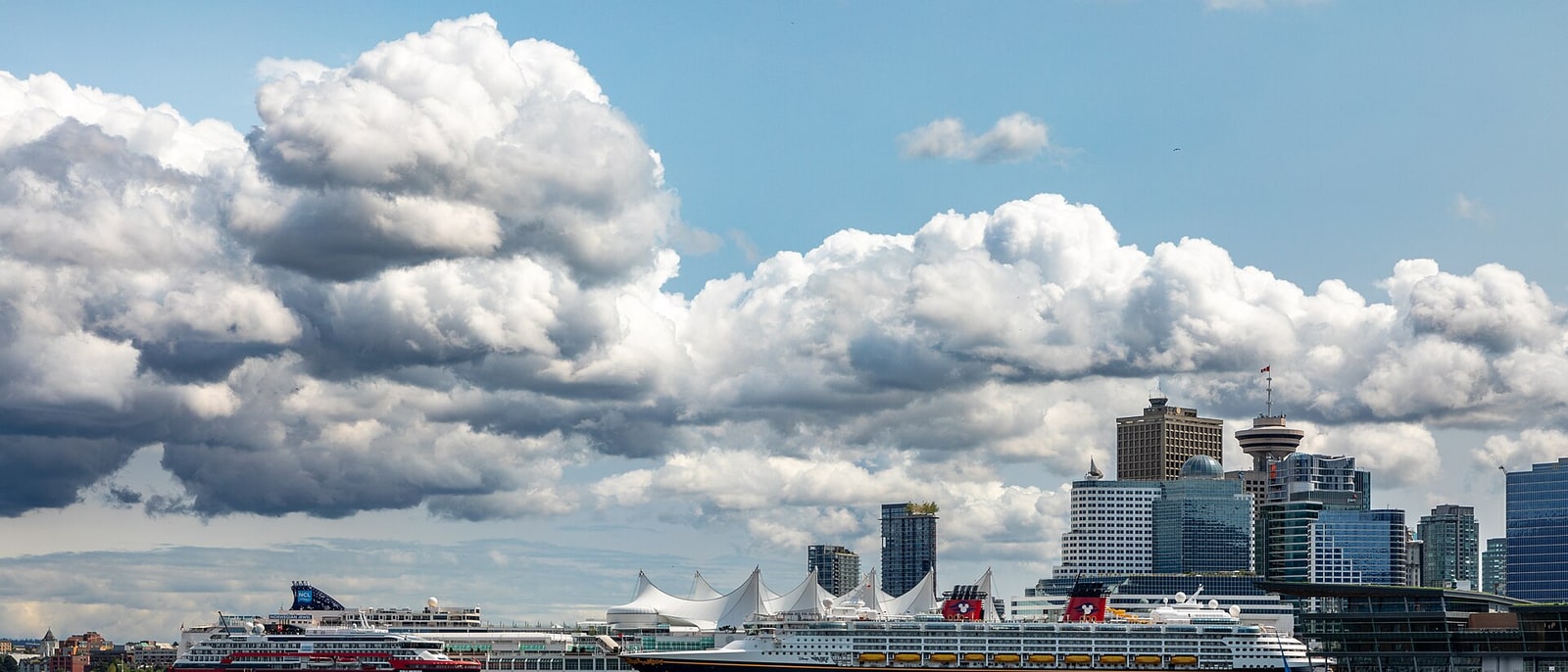
That’s the whole proposition of Vancouver and it isn’t brochure copy: it’s a glass city wedged between a forest, an ocean and a mountain range, and in one day you can touch all three. The other thing to know is that almost nothing that looks old here is: the city is a hundred and forty years old and the “Victorian” clock in every photograph is from 1977.
The route, stop by stop
4 STOPS- 01
The seawall
The seawall runs twenty-eight kilometres hard against the water without a single road crossing, and it’s the longest uninterrupted waterfront path in the world: walked or cycled with the ocean on one side and the city on the other. The Stanley Park stretch is nine kilometres and takes a long hour by bike, one-way and anticlockwise, which is compulsory.
And it has an almost single author: James Cunningham, a Scottish master stonemason who worked on the wall for thirty-two years, until he retired in 1955, and who afterwards kept turning up at the works on weekends to supervise. It took sixty years to finish the ring.
There’s a plaque to him on the northern stretch and an annual race named after him. It’s one of those pieces of infrastructure that wasn’t built by a company: it was built by a man, bit by bit.
- 02
Inside Stanley Park
Four hundred and five hectares, more than Central Park, and the important difference isn’t the size: it’s that nothing was planted here. Get onto the interior trails, away from the seawall, and in five minutes you’re in wet forest with enormous red cedars, hanging moss and an odd silence. It’s genuine temperate rainforest, the same kind as the Pacific coast’s, and you’re inside a city.
At Brockton Point are the totem poles, the most visited attraction in the whole of British Columbia. And it’s worth knowing what they are: they aren’t from here. They were brought from other parts of the coast from the twenties onwards, and they’re from different peoples: Haida, Kwakwaka’wakw, Nuu-chah-nulth.
Several of the originals are now in museums and what you see are replicas carved by artists from those same nations. It isn’t a stage set: it’s a relocation with a history, and the signs beside them explain it without hiding it.
- 03
Granville Island
Of island it has nothing, and of old even less: it was a sandbar at the river mouth filled in in 1916 to put factories on, and for decades it was a dirty, polluted industrial estate under a bridge. In the seventies it was decided not to demolish it but to convert it, keeping the corrugated sheds and the cement silos, which are still there and still working.
Today it’s a public market with fish, fruit and cheese stalls, plus craft workshops, a theatre, and a working cement plant in the middle of it all, because it never left.
You get there on tiny ferries that cross the water in five minutes and look like toys. It’s one of the best industrial conversions anywhere precisely because they didn’t clean it up entirely.
- 04
Gastown and the 1977 clock
The Gastown steam clock appears in more photographs than anything else in Vancouver, and everyone takes it for Victorian: it’s bronze, it whistles, it puffs steam and it chimes the hour with a tune. It’s from 1977.
A local clockmaker, Raymond Saunders, designed it, and it was built for a thoroughly prosaic purpose: there was a district-heating steam vent on that corner, homeless people slept on it because it was the only warm spot, and the city wanted to cover it with something that would also draw tourists. It worked too well: today there are groups waiting for it to strike.
And one detail completes the irony: for years it ran more on electricity than on steam, because steam alone wasn’t enough to drive the mechanism. Gastown is Vancouver’s “old” quarter, with cobbles and lamp posts, and it’s from 1886, so here the antiquities are your great-grandfather’s age.
Frequently asked
What to see in Vancouver in a day?
The seawall by bike (28 km, the longest uninterrupted waterfront path in the world) the inside of Stanley Park, which is genuine temperate rainforest, Granville Island by ferry, and Gastown. It’s all close and in one day you touch forest, ocean and city.
Is Stanley Park like Central Park?
No, and that’s the important difference: Central Park was designed and planted tree by tree, and Stanley Park is the forest that was already there and was left when the city asked for the military reserve in 1886. It’s 405 hectares, more than Central Park, and in places it’s genuine temperate rainforest.
Is the Gastown steam clock old?
No: it’s from 1977. A local clockmaker designed it and it was built to cover a district-heating steam vent that homeless people slept on, and incidentally to draw tourists. It worked too well. For years it also ran more on electricity than on steam.