What to see in Vancouver
4 stopsUpdated July 2026
Vancouver is the only major North American city with no freeway through downtown, and that isn’t a geographic accident: in the sixties and seventies there was a plan to drive one through, as everywhere else did, and residents organised and killed it. The route would have flattened Chinatown and Gastown. The engineers lost and the city won.
Everything else follows from that. With no freeway, downtown didn’t empty out or turn into car parks, not having emptied, it filled with residential towers instead of offices, and because people live downtown, you can walk. They even gave it a name, “Vancouverism”, and today it’s studied and copied abroad. What you see here is what happens when someone says no in time.
The route, stop by stop
4 STOPS- 01
Stanley Park
Four hundred and five hectares surrounded by water on three sides, larger than Central Park, with a difference of origin that explains everything: it wasn’t designed. It was a government military reserve, the city asked for it in 1886, the same year it was founded, and instead of landscaping it they left the forest that was already standing. That’s why there are centuries-old red cedars and why, inside, it’s genuine temperate rainforest.
What almost nobody mentions is that people lived here. There were several communities, Indigenous and not, at various points in the park, one of them at Brockton Point, and they were evicted through the courts over decades, into the thirties.
The “pristine” park wasn’t empty. Today’s signs mention it, which is more than they did twenty years ago.
- 02
The seawall
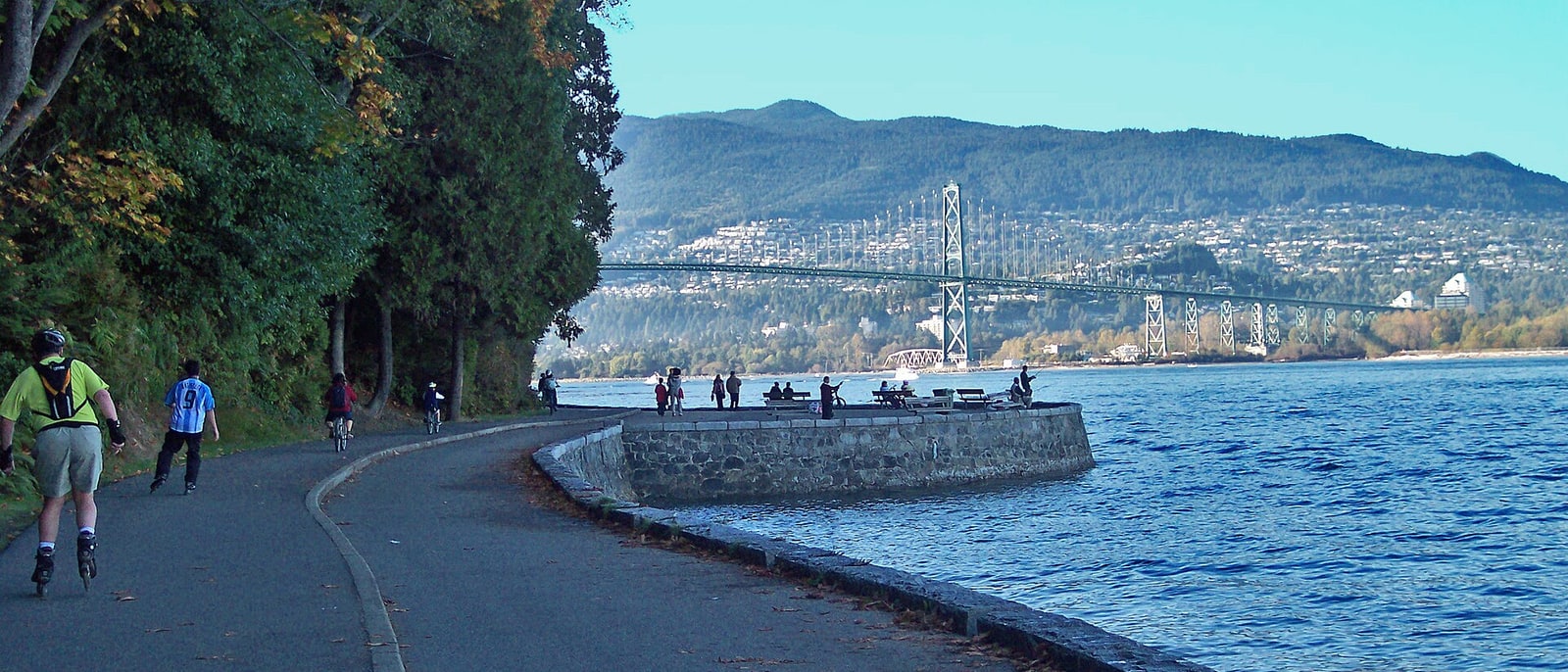
Twenty-eight kilometres of path hard against the water without a single road crossing: the longest of its kind in the world. It was begun in 1917 for a practical rather than an aesthetic reason, erosion was eating the park’s shoreline, and it took sixty years to close the ring.
And it has a protagonist: James Cunningham, master stonemason, who spent thirty-two years on the works until he retired in 1955 and then kept coming on weekends to supervise how the others were doing it. He’s said to have known every stone. There’s a plaque to him and an annual race in his name.
Cycling the whole thing takes about three hours. The Stanley Park stretch, nine kilometres, takes a long hour and is one-way, anticlockwise, and that’s observed.
- 03
The city with no freeway
In the late sixties, Vancouver had the same plan on the table as every North American city: an elevated freeway driven into downtown. The route ran over Chinatown and Gastown and would have demolished them. Residents, with Chinatown leading, organised, filled the council meetings and got the project buried in 1972.
The consequence is everything you see. Without a freeway, downtown never emptied of people or filled with car parks, so housing could be built upwards instead of offices: slim towers on low podiums, with street at pavement level.
That model has its own name, “Vancouverism”, and it gets copied from Melbourne to Dubai. Downtown here is the densest residential neighbourhood in North America, and that’s why at nine in the evening there are people in the street.
- 04
The Museum of Anthropology
The museum sits on the university campus, half an hour from downtown, and you should see it if you want to understand where you are. It holds one of the best collections of Northwest Coast art: totem poles, canoes, masks, bentwood boxes. The building, by Arthur Erickson, is a concrete hall with a glass end wall, so the totems stand against real forest and sea rather than a wall.
Inside is Bill Reid’s The Raven and the First Men, by the Haida sculptor: a carved yellow cedar in which a raven opens a clamshell out of which the first humans emerge, which is the Haida origin myth. It took him three years.
And the museum does something almost none do: much of the collection is shown in open cases and drawers you can pull out, and the originating communities have a say over what is shown and how. Several pieces have been returned.
Frequently asked
Why is there no freeway in downtown Vancouver?
Because residents stopped it. In the late sixties there was an elevated freeway plan that would have demolished Chinatown and Gastown, and neighbourhood opposition got it buried in 1972. It’s the only major North American city without one, and that’s why downtown is residential, dense and walkable.
What is Vancouverism?
The urban model that came out of having no freeway: slim residential towers on low podiums, with shops at street level and residential density downtown instead of offices. Downtown Vancouver is the densest residential neighbourhood in North America, and the model gets copied from Melbourne to Dubai.