OZU /COSTA RICA /SAN JOSÉ /GUIDE
Day trips from San José
10 h route4 stopsBest: Leave at dawn. And May to November, be back before the rainUpdated July 2026
Nowhere in Costa Rica is more than a day from San José, and that’s the first thing: the country is a little over fifty thousand square kilometres and the capital sits right in the middle, in a high valley. From here it’s an hour and a half to a steaming crater, three to cloud forest, four to the Caribbean. It’s a country that fits into day trips, which is why the capital works so well as a base.
And there’s a story behind everything you’re about to see that’s worth telling because it changes the trip. In 1940 this country was over seventy per cent forest. By the eighties, cattle and timber had left it around twenty: it was one of the fastest deforestation rates in the world. And then it turned around. Today forest is back above half the territory. Costa Rica is one of the very few countries to have reversed its deforestation, and it did it by paying landowners to leave the forest standing, with money from a fuel tax. What you’re about to see isn’t forest that survived: in good part it’s forest that came back.
The route, stop by stop
4 STOPS- 01
The valley volcanoes
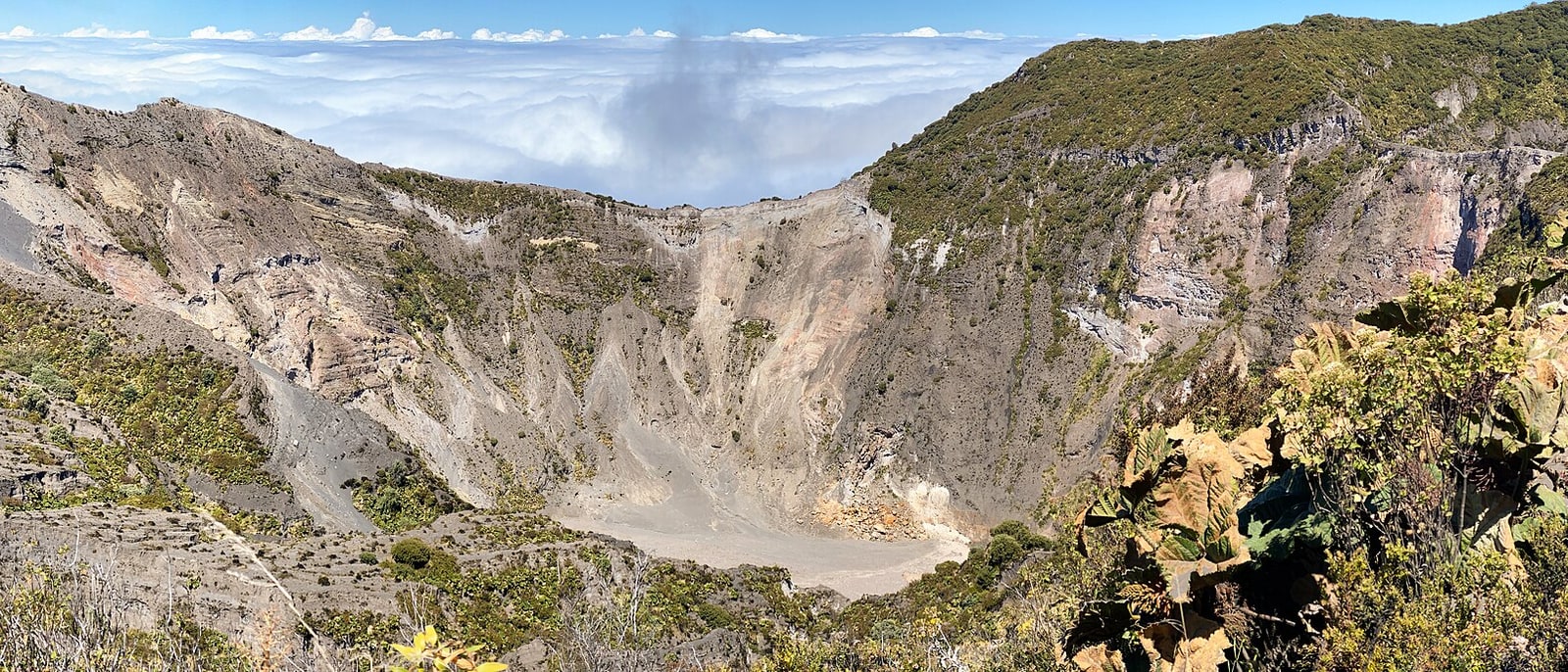
An hour and a half from the capital there are two volcanoes where you park practically on the crater rim and walk a hundred metres. That’s very rare: almost everywhere else, seeing an active crater means a serious hike. Poás has a turquoise acid lake steaming below, one of the largest of its kind on the planet. Irazú, over three thousand metres, is a lunar landscape of grey ash, and on an exceptionally clear day you can see the Pacific and the Caribbean at once from the top.
Two warnings worth the trip. One: leave at dawn, genuinely. By mid-morning cloud climbs the slope and covers the crater, and you’ll be looking at a white wall after two hours in a car. At seven it’s usually clear.
Two: Poás is a genuinely active volcano, it has closed to the public at various times because of its activity, and when open there’s usually timed entry with booking. Check the park’s site the day before rather than just turning up.
And take a jacket: on Irazú, at three thousand metres, it’s cold even when San José is warm.
- 02
Arenal, and what it no longer does
Arenal has taken over the image of the volcano in Costa Rica: a near-perfect seventeen-hundred-metre cone beside a lake, with forest around it and hot springs heated by its own magma. It’s beautiful and it deserves the trip. And there’s something the agencies don’t highlight: it no longer throws lava.
Between 1968 and 2010 Arenal was in continuous eruption and it was famous for exactly that: at night you could see rivers of orange lava running down the slope, and that image is what still circulates in the photos. In 2010 it entered a resting phase and since then there’s been no visible lava. Plenty of people drive three hours expecting the night show and find a dark mountain.
Knowing that, the place is still worth it for the rest: the cone is spectacular when it isn’t clouded over, the surrounding forest has real wildlife and the natural hot springs in the river, free and at thirty-odd degrees, are among the best things in the country.
- 03
The cloud forest
Monteverde sits on the ridge of the range, over fifteen hundred metres up, where the wind rising off the Caribbean condenses on hitting the mountain and forms permanent fog. That’s the cloud forest: trees covered in moss, giant ferns, orchids and bromeliads growing on other plants, and a humidity that soaks everything.
Adjust your expectations before going, because that’s where people go wrong: there’s fog and drizzle here almost always, and that isn’t bad luck with the weather. It’s the ecosystem. Without that fog there’d be no cloud forest. If you go expecting panoramic views and sun, you’ll be frustrated. If you go to look closely, it’s one of the most extraordinary places on the planet. The quetzal lives here, the bird everyone wants to see and which you should look for with a guide and first thing.
And there’s a good story: part of this reserve was founded by American Quakers who moved here in the fifties fleeing military service, precisely because this country had abolished its army.
- 04
The animals, and how to look at them
Costa Rica holds an absurdly high share of global biodiversity for its size, and the wildlife is the real reason most people come: sloths, monkeys, toucans, red frogs, coatis. You genuinely see them, with no special luck, in any decent national park and above all with a local guide, which is the best investment of your whole trip: they see things you won’t see even knowing where to look.
And now the part that has to be said. There are places offering to let you hold sloths for a photo. Don’t. Sloths are animals of extreme stress that don’t show it (that face isn’t a smile, it’s their face) and handling causes them real damage you can’t see. The same goes for feeding monkeys, which changes their behaviour and ends in aggressive, sick animals.
The rules are simple: don’t touch, don’t feed, no flash, and if a centre offers you contact with the animals, not that one. A serious sanctuary shows you the animals at a distance and explains why.
Frequently asked
What day trips can you do from San José?
Practically the whole country: the Poás and Irazú volcanoes are an hour and a half away and you drive to the crater rim. Leave at dawn or cloud covers it, Arenal is three hours, the Monteverde cloud forest three or four, and the Caribbean four. Costa Rica is a little over fifty thousand square kilometres and the capital is in the middle.
Does Arenal volcano still erupt?
No. It was in continuous eruption between 1968 and 2010, and at night you could see rivers of orange lava running down the slope, that’s the photo still circulating, but in 2010 it entered a resting phase and since then there’s been no visible lava. Plenty of people drive three hours expecting the night show and find a dark mountain. It’s still worth it for the cone, the forest and the natural hot springs in the river.