OZU /COSTA RICA /SAN JOSÉ /GUIDE
What to see in San José
6 h route4 stopsBest: In the morning. May to November it rains in the afternoon, punctuallyUpdated July 2026
The National Theatre ceiling is the most reproduced image of Costa Rica: an allegory of the coffee and banana harvest that was printed on the banknotes for decades. It was painted by an Italian artist who had never been here, working from Italy with descriptions that reached him by letter. That’s why the details are wrong: the posture in which they carry the coffee has never been used by anyone in this country, and the banana bunch is held upside down.
That painting sums up what visiting San José is: there are few things, they’re concentrated and they’re far more interesting than they look at first glance, provided you know what you’re looking at. This isn’t a city of architecture or of great views. It’s a city of three very good museums, a theatre, a market and a couple of stories that explain a whole country. With that, a long morning is worth it. Without it, no.
The route, stop by stop
4 STOPS- 01
The Pre-Columbian Gold Museum
The museum hides underground: three floors below the Plaza de la Cultura, in the middle of town, and down there are thousands of pieces of pre-Columbian gold. Frogs, eagles with open wings, crocodiles, shamans in trance, bells. Almost all made with the lost-wax technique and with a level of detail you have to see up close.
What’s interesting isn’t the quantity, it’s what it means. These pieces aren’t from an empire: there were no Aztecs or Incas here, but smaller, decentralised societies, and even so they worked gold to this level and traded across half a continent. Costa Rica sits exactly on the passage between the two great cultural zones of the Americas, the Mesoamerican and the Andean, and you can see it in the pieces: there are influences from above and below. The museum explains it well and without frills.
And being underground, it’s the perfect plan for when it starts raining, which here is every day in mid-afternoon.
- 02
The Jade Museum
The largest collection of pre-Columbian jade in the Americas is here, in a modern five-storey building beside the Plaza de la Democracia. There are thousands of pieces: pendants, ceremonial axes, figures, all worked in an extremely hard stone and without metal tools, which is already hard to absorb.
And on top of that is the puzzle the museum poses openly instead of hiding: Costa Rica has no known jade deposits that would explain this quantity. The stone came from outside, probably from Guatemala, over a thousand kilometres away, along trade routes we know very little about. Which means there was long-distance trade, sustained for centuries, moving a heavy stone with no practical value, only symbolic.
A country with no jade that accumulated more jade than anyone. That museum is the best visit in San José and almost nobody mentions it.
- 03
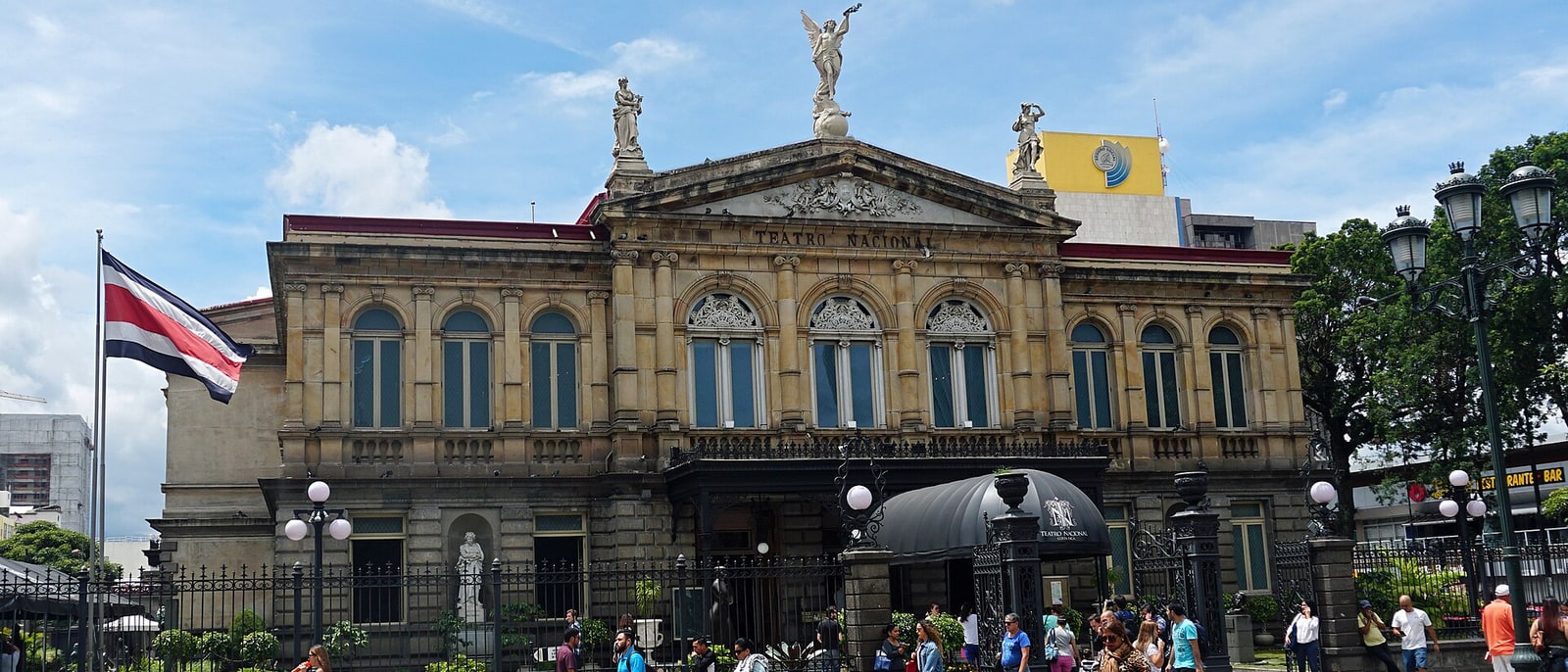
The National Theatre
A miniature opera house finished in 1897, with marble brought from Italy, gilded mouldings, red velvet and a staircase that splits in two. It was made with coffee money, through an export tax on the bean, and that detail isn’t minor: here culture was literally paid for by agriculture.
You can take the daytime guided tour, which lasts half an hour and is worth it for the foyer ceiling and its second-hand Italian story alone. But the better thing is the other one: it’s still a working theatre, with a programme, and a concert ticket costs considerably less than it would in Europe.
Sitting in that hall listening to music is infinitely better than seeing it with a guide.
And in the theatre’s own café, occupying a corner of the building, you can have a decent coffee in a room from 1897.
- 04
The city that isn’t there
It’s worth explaining why San José doesn’t have the colonial centre other capitals in the region have, because the answer isn’t that it never had one: it fell down. This city sits on a very active seismic zone and earthquakes, above all the 1910 one that flattened neighbouring Cartago, shaped how people build here: low, light, without great stone vaults.
From that comes something you can go looking for and which is very much of this place: the metal houses. In Barrio Amón and around there are mansions of the nineteenth- and early twentieth-century coffee barons built with structures and walls of metal sheeting imported from Belgium, painted in colours, because metal took the tremors better than adobe. There’s even an entire school made that way, which arrived flat-packed by ship.
An hour’s walk through Barrio Amón, looking at those façades, is the only architecture in this city that genuinely deserves the walk.
Frequently asked
What must you see in San José?
The Jade Museum, with the largest pre-Columbian collection in the Americas of a stone that doesn’t exist in Costa Rica, the Gold Museum, three floors underground, the National Theatre, paid for by a coffee tax and with a ceiling painted by an Italian who never came, the National Museum, barracks of the army abolished in 1948, and the metal-sheet mansions of Barrio Amón.
Why has San José no colonial old town?
Because it fell down. The city sits on a very active seismic zone and earthquakes (above all the 1910 one, which flattened neighbouring Cartago) shaped how people build here: low and light. Hence the mansions of Belgian metal sheeting you see in Barrio Amón: metal took tremors better than adobe. There’s even a school that arrived flat-packed by ship.