What to see in Munich
6 stopsUpdated July 2026
Munich’s problem is abundance, not scarcity: two royal palaces, three picture galleries in a row, the largest science museum in the world and a whole old town, and four days won’t cover it. The reason is that the Wittelsbachs ruled here for seven hundred and thirty-eight years and spent all of it buying things.
And there’s a part of the catalogue the city took seventy years to show. Munich was the Hauptstadt der Bewegung, the capital of the Nazi movement: the party was founded here and the 1923 putsch failed here. The documentation centre that tells it opened in 2015, on the exact plot where the headquarters stood. It isn’t a pleasant visit and it’s the one that best explains this city.
The route, stop by stop
6 STOPS- 01
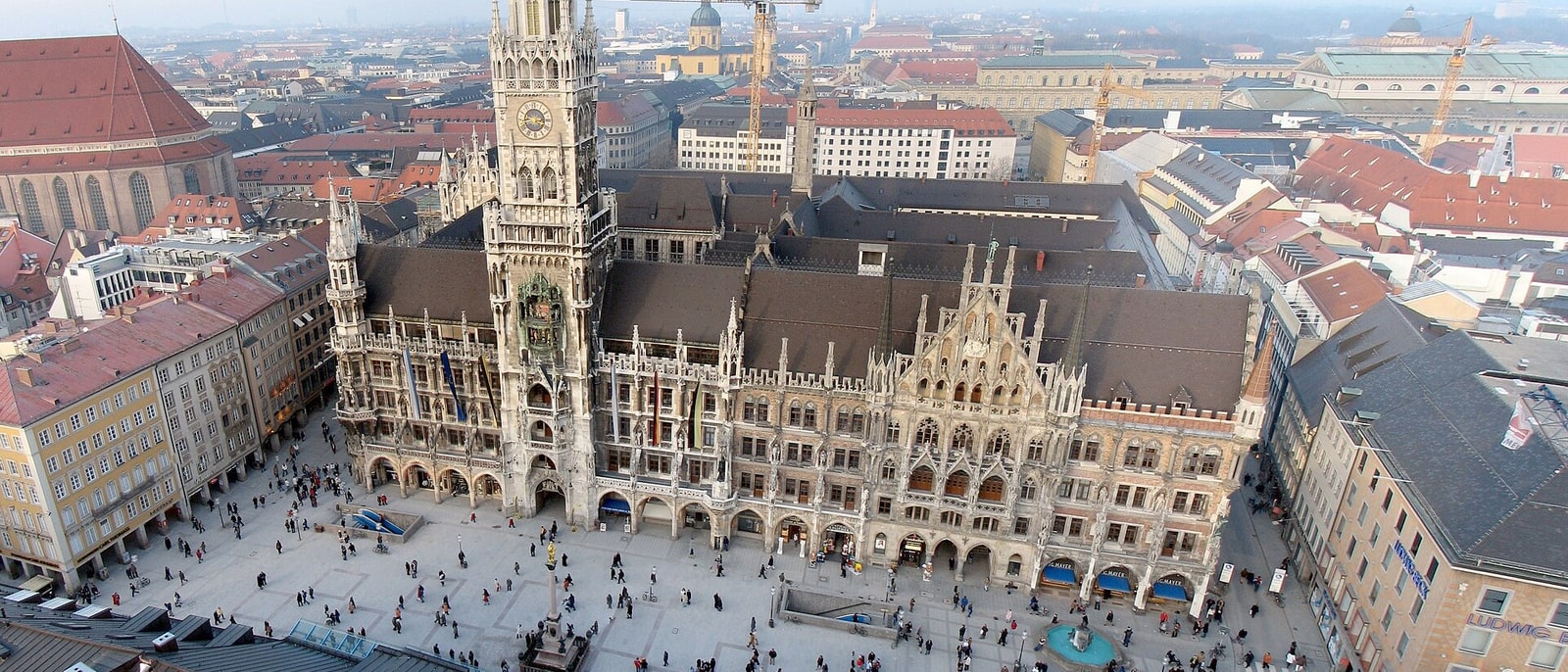
The Neues Rathaus
It takes up a whole side of Marienplatz, has a hundred metres of frontage, gargoyles, pinnacles and an eighty-five-metre tower, and it dates from between 1867 and 1908. Which is to say: while this was being finished, Paris had had the Eiffel Tower for twenty years. It’s neo-Gothic, the fashion of the day for making newly rich cities look old.
It’s worth it for two things. One: you go up the tower by lift, and from the top you see the whole old town and, on clear days, the Alps behind it, which is the image that explains why Munich is the way it is.
Two: the inner courtyard is free, almost nobody goes in, and in December it holds one of the prettiest Christmas markets in the city.
- 02
The Frauenkirche
Red brick, enormous and sober inside to the point of dull, and it’s still the city’s symbol. It went up in twenty years, between 1468 and 1488, which for a Gothic church is indecently fast. The onion domes that make it recognisable weren’t in the plan: the design called for Gothic spires and the money ran out, so in 1525 they capped it with those domes as a temporary fix.
Five hundred years later they’re still there.
Its towers are ninety-nine metres and that number governs the whole city: in a 2004 referendum Munich voted that no new building in the centre may exceed them. It’s the only place in Europe where a fifteenth-century church sets the ceiling for property developers, and it’s why there are no glass towers here.
- 03
The Residenz
The largest city palace in Germany hides in plain sight: from outside it’s a long grey frontage people walk past without looking. Inside are a hundred and thirty rooms of seven centuries of accumulation, Renaissance to nineteenth century, because each generation of Wittelsbachs added a wing without pulling down the last.
The room that justifies the ticket is the Antiquarium: sixty-six metres of sixteenth-century vault built to hold Roman busts, and the largest Renaissance hall north of the Alps. Almost everything you see was rebuilt after 1945 from photographs, because little survived.
On the front, the bronze lions have shields worn shiny by hands: you touch them for luck, and it’s one of the few things done here for no reason at all.
- 04
The Kunstareal
Four blocks north of the centre hold the Alte Pinakothek (to the eighteenth century), the Neue (nineteenth), the Pinakothek der Moderne and the Sammlung Brandhorst, plus the antiquities museums. It’s one of the densest concentrations of art in Europe and it was designed that way from Ludwig I, who wanted to make Munich an Athens of the north and took the idea rather seriously.
Everyone’s mistake is trying two in a day, and it doesn’t work: you come out saturated and remembering nothing. The Alte has the world’s largest Rubens holding and the Dürer, the Moderne has industrial design, which is the German strength, the Brandhorst has Twombly and a building sheathed in thirty-six thousand coloured rods.
One, then outside.
- 05
The Deutsches Museum
The largest science and technology museum in the world takes up an entire island in the Isar and was founded in 1903 on an idea that wasn’t obvious then: that you could touch it. No ropes. Lids open, levers pull, and there are demonstrations at set times, including one throwing lightning at hundreds of thousands of volts that makes the room jump.
There’s a real U-boat opened down the middle, a reconstructed mine under the floor you walk through, aircraft hanging from the ceiling and a musical instrument section nobody expects.
The warning is about size: it doesn’t fit in a day, not remotely, and anyone who tries ends up hating science. Two floors, then out.
- 06
The Nazi documentation centre
Munich is where the Nazi party was founded, where the 1923 putsch failed, and the city Hitler gave the official title “capital of the movement”. For seventy years none of this was told anywhere: the plot where the Brown House, the party headquarters, had stood was left as a car park and everyone looked away.
In 2015 a white, cubic, deliberately cold building opened there documenting what happened, who did it and why in this city rather than another. There are no objects and no staging: there are documents, photographs and names, including those of local families who did well out of it.
It’s the most uncomfortable visit in Munich and the one that does the city most credit, precisely because it came so late.
Frequently asked
What should you see in Munich?
Marienplatz and the Frauenkirche, the Residenz or Nymphenburg for a palace, one of the Kunstareal’s three galleries, and the Deutsches Museum if technology interests you. Plus the Nazi documentation centre, the most uncomfortable stop and the one that best explains the city.
Why are there no skyscrapers in Munich?
Because residents voted against it. A 2004 referendum decided no new building in the centre may exceed a hundred metres: the height of the Frauenkirche towers. That’s why Munich has no skyline and Frankfurt does.
What is Munich’s connection to Nazism?
The party was founded here, the 1923 putsch failed here, and the city was given the official title “capital of the movement”. The documentation centre telling that story opened in 2015 on the exact plot of the party headquarters, which for seventy years had been a car park.