Munich in a day
9 h route5 stopsBest: Be on Marienplatz before eleven, for the carillonUpdated July 2026
Everything here is literally measured from Marienplatz: it’s the city’s zero point, and the whole old town fits inside a ring you cross in twenty minutes. So that’s where the day organises itself from. The surprise comes from the most photographed building on the square, that enormous Gothic city hall, which is younger than the Eiffel Tower.
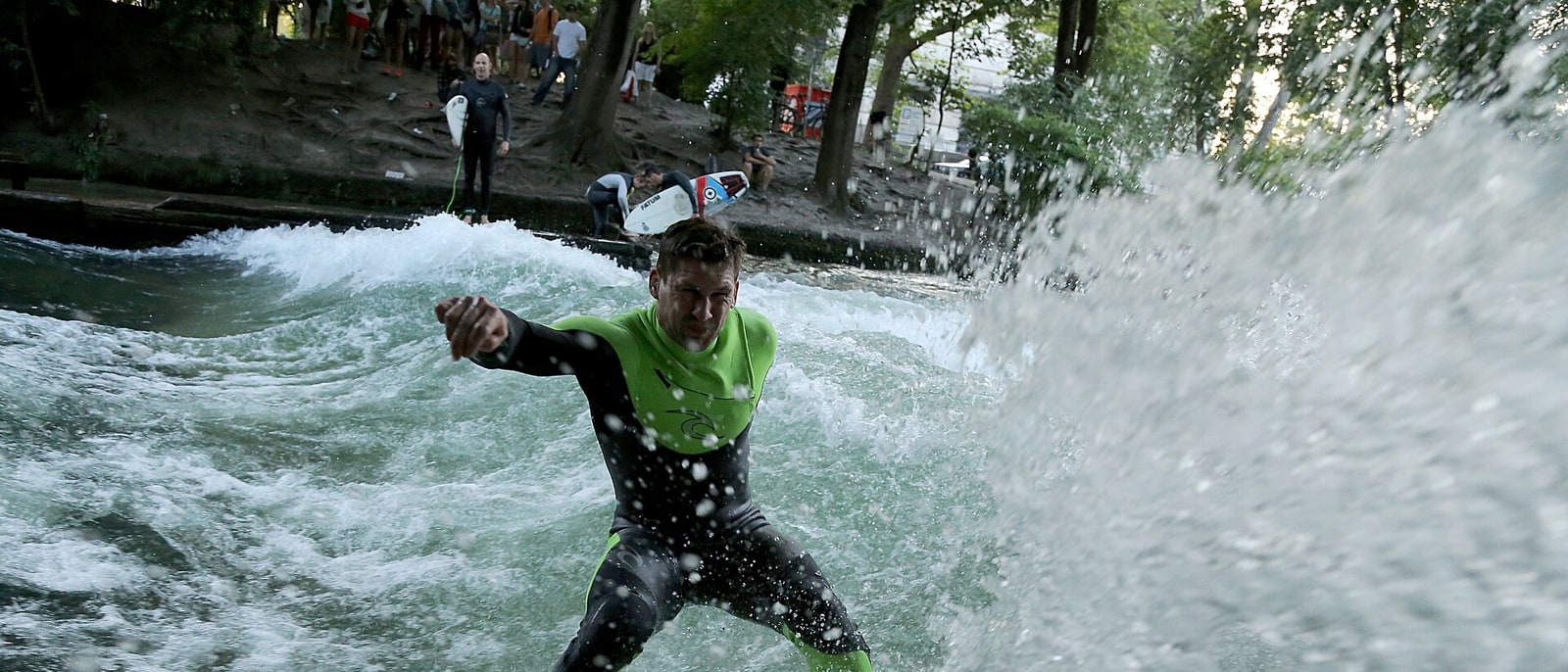
The shape of the day: morning on the square and at the market, midday at the Frauenkirche, afternoon in the English Garden watching people surf a river a kilometre from the centre, evening in a beer hall at a shared table. And one rule that spares you the disappointment: the white sausage is eaten before noon. Here that isn’t folklore, it’s the only way to eat it.
The route, stop by stop
5 STOPS- 01
Marienplatz, and the carillon that disappoints everybody
The square marks Munich’s zero point: the city’s distances are counted from here. The building filling the whole of it, the Neues Rathaus, looks medieval and dates from between 1867 and 1908: contemporary with Jules Verne’s novels. It was deliberately built to look older than it is, and it works: almost nobody questions it.
On top is the Glockenspiel, forty-three bells and thirty-two figures that at eleven and twelve act out a wedding from 1568 and the coopers’ dance marking the end of a plague in 1517. It lasts fifteen minutes and is, in all likelihood, the most overrated attraction in Europe: you watch it once, you understand it’s a large mechanical clock, and you move on.
I’m saying it beforehand so you don’t get cross afterwards.
- 02
The Viktualienmarkt
The market has been here since 1807, when the king ordered it out of Marienplatz because it no longer fitted, and it remains a real market despite the prices: cheesemongers, butchers, spices, flowers, pickles. It’s where you buy Obatzda, the paprika cheese spread invented by a landlady in a beer garden in the twenties to use up over-ripe camembert.
In the middle there’s a Biergarten under chestnut trees with a quirk that tells you everything about this city: the beer it serves rotates between Munich’s six breweries through the year, so as not to favour any of them.
And there you can do what Bavarian law allows: buy your food at the stalls, sit down with it, and pay only for the drink.
- 03
The Frauenkirche and the hundred-metre rule
The two onion-domed towers are Munich’s symbol and they stand ninety-nine metres. That number isn’t an accident and it still rules: in 2004 Munich voted in a referendum that no new building inside the inner ring may exceed a hundred metres. The height of its own towers. Yes won, and that’s why Munich has no skyline and Frankfurt does.
Inside, at the entrance, there’s a black footprint on the floor: the Teufelstritt, the devil’s step. The legend says the devil laughed that the church had no windows, planted himself on that exact spot, the only one from which the columns hide every window, and on spotting the trick kicked the floor.
It’s a story invented to explain a real optical effect, and you can check the optical effect by standing where the footprint is.
- 04
The Eisbach wave
A kilometre from Marienplatz, where the Eisbach canal enters the English Garden, there’s a one-metre standing wave formed by rocks on the bed that has been surfed since the seventies. It isn’t a staged attraction: it’s an urban canal with people queuing on the bank in wetsuits, taking thirty-second turns, in January too.
It was illegal or tolerated for decades and the city finally legalised it in 2010, conceding the obvious. Watching is free and it’s the best show in Munich: five minutes on the bridge and you understand this city better than at the Glockenspiel.
What you don’t do is get in: the water is cold all year, the current is strong, the bed is rock and that wave isn’t one to learn on. There are signs saying so and there’s a reason they’re there.
- 05
The English Garden, founded by an American
It covers three and a half square kilometres, more than Central Park, and it starts a step from the centre. It was founded in 1789 by Benjamin Thompson, a man born in Massachusetts who took the British side in the American Revolution, had to run for it, and ended up a minister in Bavaria with the title of count. His idea was to give beggars work. What came out was the largest urban park in Europe.
Two things to know before going in. One: the Chinesischer Turm beer garden is one of the biggest in the world and runs on the Bavarian rule, so you can bring your own picnic.
Two: nudity has been permitted in designated areas since the eighties and they aren’t tucked away, they’re on the lawn you walk past. Nobody notices except the people who just arrived.
Frequently asked
What to see in Munich in a day?
Marienplatz and the Viktualienmarkt in the morning, the Frauenkirche at midday, the Eisbach wave and the English Garden in the afternoon and a beer hall at night. The old town fits in a ring you cross on foot in twenty minutes.
Is Munich’s Glockenspiel worth it?
Not much, and it’s better to know beforehand: it plays at eleven and twelve, lasts fifteen minutes and is thirty-two figures acting out a wedding from 1568. You watch it once in passing. It’s probably Europe’s most overrated attraction and the rest of the city is nothing like it.
Can you surf in Munich?
Yes: on the Eisbach, a canal a kilometre from Marienplatz, there’s a standing wave surfed all year, legalised in 2010. Watching is free and it’s the best show in the city. Getting in, no: the water is cold, the current strong, the bed is rock and it isn’t a wave to learn on.