A weekend in Santorini
20 h route4 stopsBest: May, June or September-October. July and August are another levelUpdated July 2026
Fifteen thousand residents and millions of visitors a year, on an island of seventy-odd square kilometres with two main villages joined by one road. That arithmetic is all the information you need, and out of it comes the only question that matters here: not what to see, but when. The island isn’t big, and in high season there are too many people for it.
The practical consequence is that a well-built weekend here isn’t about routes, it’s about timings. The same place that at seven in the evening is a jam of people is empty at eight in the morning and is one of the most beautiful things in the Mediterranean. The cruise ships unload in the morning and leave at dusk. So the plan is simple: get up early, disappear at midday and go out late, and be at places when everyone else is somewhere else. It’s an island that punishes anyone who goes with the flow.
The route, stop by stop
4 STOPS- 01
Saturday at eight: the rim walk
The best thing on this island escapes plenty of people: a path running from Fira to Oia along the caldera rim, about ten kilometres with the flooded crater below on your left the whole way, passing Firostefani and Imerovigli. It takes three or four hours walking without rushing.
The first part is built up and it’s a stroll. After Imerovigli it turns into a dirt track along the lip, up and down, and that’s where it gets good, because the people vanish. The condition isn’t negotiable: you have to leave first thing. There isn’t a metre of shade on the whole route, and doing it at midday in summer is recklessness with a view.
Leave at eight, carry two litres of water and closed shoes, and you reach Oia mid-morning, while the village is still walkable. Come back by bus.
- 02
Saturday afternoon: the wine
At midday you have to disappear from the sun, and the best way to do it is to go into a winery. Santorini’s wine is a global oddity and it has two reasons, both consequences of the volcano.
The first is in the soil: it’s ash and pumice, with barely any organic matter, and in that material phylloxera, the aphid that in the nineteenth century wiped out Europe’s vineyards and forced them all to be grafted onto American rootstock, can’t live. So it never got here. These vines are ungrafted, on their own roots, and many are centuries old: the same plants, with the same root.
The second is in the shape: because a wind blows here that takes the skin off your face and it doesn’t rain, the vines are woven along the ground into a basket, with the grapes inside, sheltered from the wind and catching the night dew. They look like nests. It resembles no vineyard anywhere in the world.
- 03
Saturday at dusk: Amoudi
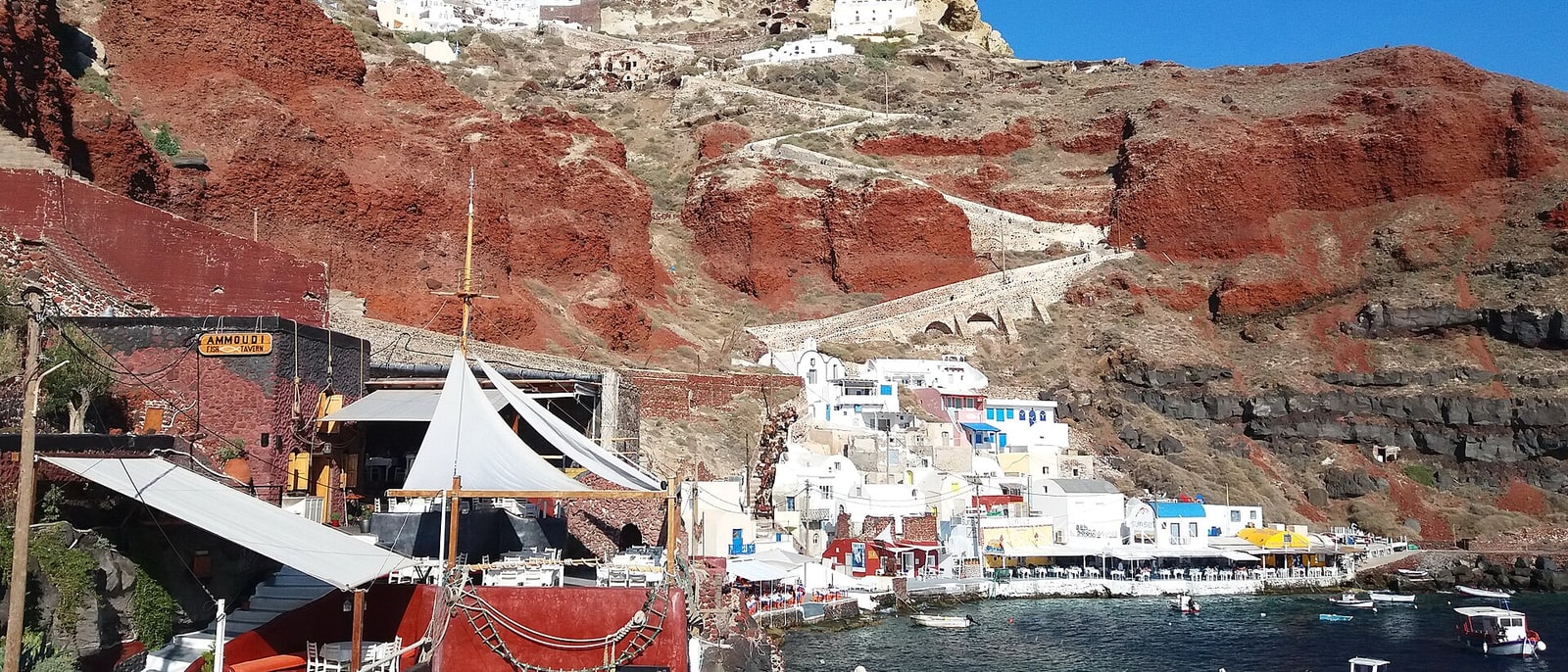
At the foot of Oia, three hundred-odd steps down the cliff, there’s a tiny port with four fish tavernas whose tables are practically in the water. It’s called Amoudi and it’s the best decision you can make on this island at dusk.
The reason is plain common sense: while thousands of people are packed together up in the village to watch the sunset, down here you’re sitting at a table, eating fish that arrived that morning, watching exactly the same sun drop into the same sea. The view is identical. Only seated.
The one thing to accept is the way back: three hundred steps uphill after dinner, or waiting for a taxi that won’t come, because there are barely any on this island. Book a table: there are four places and in season they fill.
- 04
Sunday: the island that lives
On Sunday, get off the rim. All of Santorini’s pressure is on the caldera line, and five kilometres inland there are villages where people live and where there’s practically nobody from outside. That contrast is so big it seems like a different island.
Pyrgos is the highest of them all, a medieval village of concentric lanes climbing to a Venetian castle, and from the top you see the whole island sea to sea.
Emporio has a walled old quarter, with covered streets and passages, built that way as a defence against pirates: a deliberate labyrinth. Megalochori has ship captains’ mansions. In these places you eat better and for half the price, and the grandmothers are sitting in their doorways. If you do only one different thing in Santorini, make it this.
Frequently asked
How many days do you need in Santorini?
Two or three are enough: the island is seventy-odd square kilometres. What matters isn’t how many days but what time you do things: there are around fifteen thousand residents and millions of visitors a year, so the same place that at seven in the evening is a human jam is empty at eight in the morning. Get up early, disappear at midday and go out late.
Can you walk from Fira to Oia?
Yes, and it’s the best thing on the island: about ten kilometres along the caldera rim, three or four hours, passing Firostefani and Imerovigli. But you have to leave first thing: there isn’t a metre of shade on the whole route and at midday in summer it’s reckless. Take two litres of water and closed shoes, and come back by bus.