The temples of Bali
8 h route4 stopsBest: Uluwatu at sunset, for the kecak. Tanah Lot at low tideUpdated July 2026
Bali’s oddity, and what explains everything else: Indonesia is the country with the largest Muslim population in the world, and Bali is a Hindu island. Around 87% of its people practise Balinese Hinduism, which isn’t the Indian kind: it’s its own blend of Hinduism, Buddhism and earlier animist beliefs, with its own gods and its own structure.
It survived because when Islam spread across Java in the 15th century, the elite of the Hindu Majapahit kingdom took refuge here and dug in. The result: an island with more than twenty thousand temples, where every house has its family shrine and where you’ll see flower offerings on the ground, on car dashboards and in shop doorways, three times a day, every day.
The route, stop by stop
4 STOPS- 01
Uluwatu and the kecak
A temple on the edge of a seventy-metre cliff above the sea, at the island’s southern tip, and one of the six temples the Balinese consider spiritual pillars of Bali. The sunset view is the one you’re imagining.
But what to see is the kecak, performed here as the sun goes down. It has no instruments: it’s a chorus of a hundred or so men sitting in a circle chanting “chak-chak-chak” in overlapping rhythms, creating percussion made only of voices, while an episode of the Ramayana is performed with fire. It’s hypnotic.
An honest note: in its current form it was created in the 1930s, partly for visitors, out of an older trance ritual. That doesn’t make it less impressive. And beware the monkeys at the entrance: they steal glasses with professional precision.
- 02
Tanah Lot
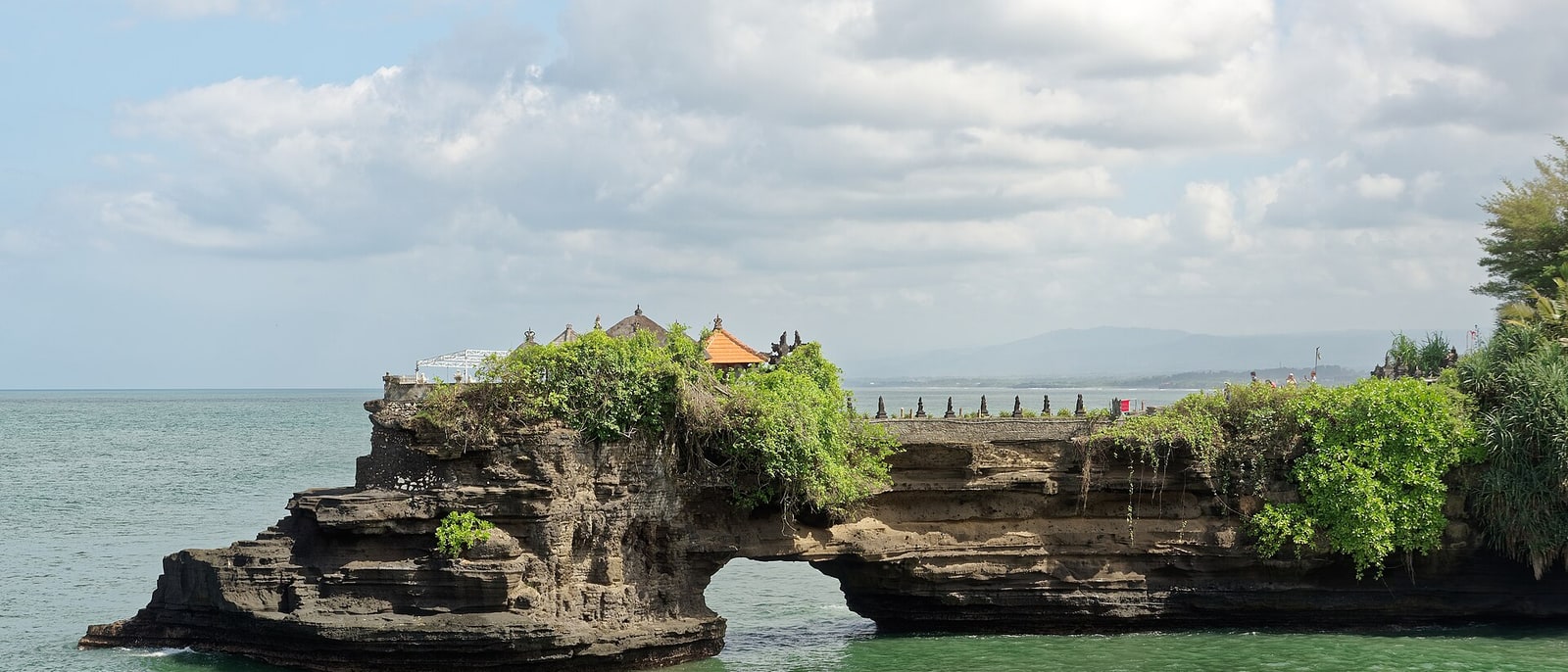
Bali’s postcard: a small temple perched on a rock in the sea, reachable on foot at low tide and stranded like an island at high tide. At sunset, with the sun behind it, it’s the photo that has sold this island for decades.
Two warnings. One: check the tide table before going, because the plan changes completely. Two: it’s one of the most crowded places in Bali and you cross a long souvenir market to reach it. It’s still worth it, because the image is the image.
Non-Hindus can’t go up to the temple itself, you see it from below, which is where it looks best anyway.
- 03
Tirta Empul
A temple built in the year 962 around a spring the Balinese consider sacred, with a long pool and a row of stone spouts pouring water. People get in fully clothed and pass under each spout in order, praying at each one: it’s a purification ritual, the melukat, and it’s done for real, today, by people who came to purify themselves and not to take a photo.
Visitors can take part, and that’s the point: if you do it, do it properly. You wear a sarong, you enter in the correct order, start on the left and skip no spouts, and there are two specific spouts used only for funeral rites that aren’t used.
And if you’re not going to do it respectfully, watch from the edge, which is fine too.
- 04
How to enter a temple
The rules come down to a few, and they’re kept. Sarong and sash tied at the waist, always, men and women: they’re lent or hired at the entrance of every touristed temple. Shoulders covered. Don’t climb on walls or structures for photos, don’t stand higher than a priest and don’t point with your foot.
And there’s one rule that surprises visitors and is worth knowing in advance because it’s written on the signs: menstruating women may not enter the temples. It’s a ritual purity rule of Balinese Hinduism, it applies equally to Balinese women, and nobody will ask you: you’re trusted to respect it.
We mention it because finding out at the door, in front of a sign, is more awkward than knowing beforehand.
Frequently asked
Why is Bali Hindu if Indonesia is Muslim?
Because when Islam spread across Java in the 15th century, the elite of the Hindu Majapahit kingdom took refuge in Bali and dug in. Today around 87% of Balinese practise Balinese Hinduism, its own blend of Hinduism, Buddhism and earlier animism, distinct from Indian Hinduism.
What is the Uluwatu kecak?
A dance without instruments: a hundred or so men sit in a circle chanting “chak-chak-chak” in overlapping rhythms, making the percussion with voices alone, while the Ramayana is performed with fire, at sunset. In its present form it was created in the 1930s from an older trance ritual.
What do you need to wear in a Balinese temple?
A sarong and sash tied at the waist, men and women, they’re lent at the entrance, and covered shoulders. Don’t climb on walls or stand higher than a priest. And one rule surprises people: menstruating women may not enter, and you’re trusted to respect it.