Ubud and the rice terraces
8 h route4 stopsBest: At dawn. By ten, Tegallalang is a queue for photographsUpdated July 2026
Everyone goes to Ubud to see the rice terraces and almost nobody knows what they’re looking at, which is a shame because the story is infinitely better than the photo.
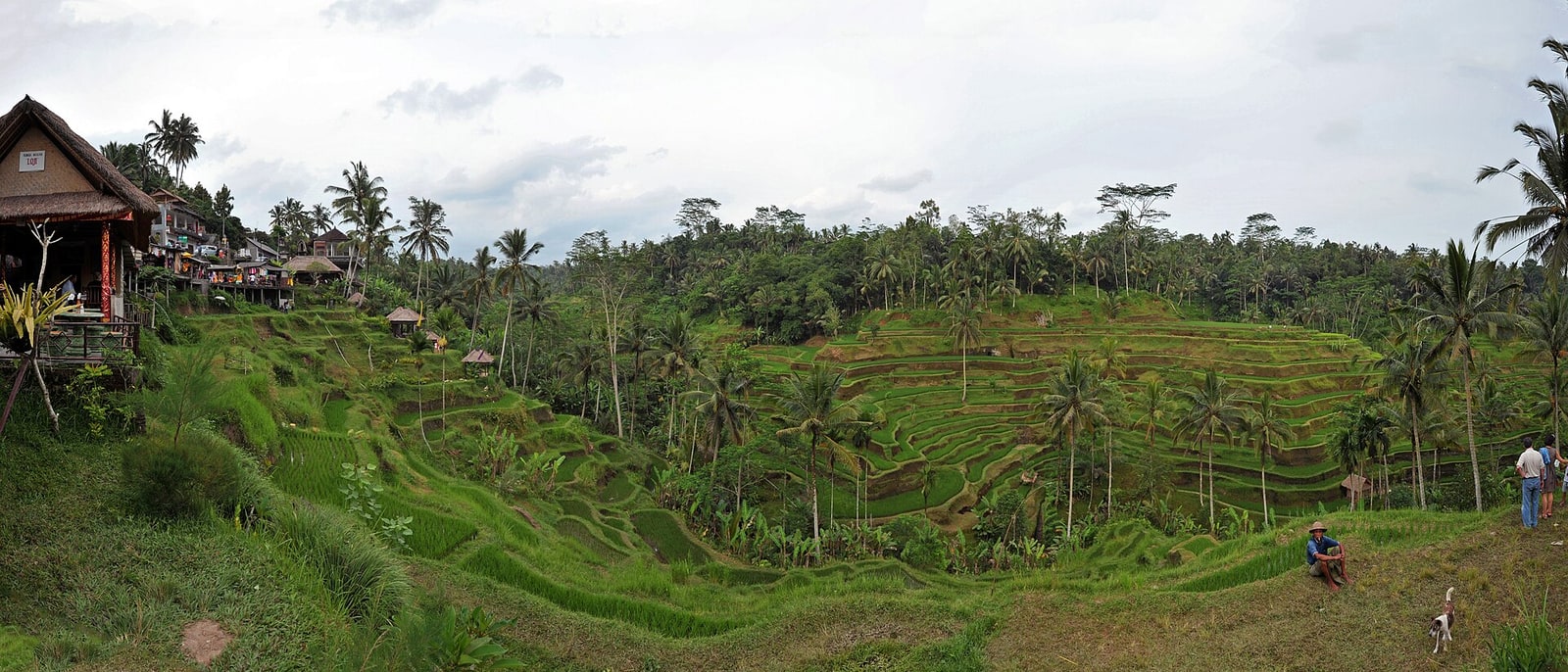
Those green terraces aren’t pretty scenery that happened by itself: they’re the visible surface of the subak, an irrigation system the Balinese have been running since the 9th century. And it isn’t run by a council or a company: it’s run by the farmers themselves, meeting in assemblies, through the water temples. UNESCO made it World Heritage in 2012, and not for how it looks: for how it works.
The route, stop by stop
4 STOPS- 01
The subak: what you’re looking at
The problem with rice on a volcanic island of steep slopes is water: whoever is upstream can take it all and leave those below dry. The Balinese solution wasn’t a king rationing it, it was a network of cooperatives, the subak, where the farmers of each stretch meet, decide irrigation turns together and plant in coordination, with the water temples as the meeting and arbitration point.
The astonishing part is that it works better than the modern alternatives. In the 1970s the Green Revolution imposed year-round planting on Bali, with fertilisers, overriding the subak calendars. Yields rose at first and then collapsed: without synchronised planting, pests ran out of control, because the traditional system synchronises the fallow periods and starves the insects.
They modelled the temple calendar on computers and it turned out to be close to the mathematical optimum. They went back to the subak.
- 02
Tegallalang, and when to go
The Tegallalang terraces show up in the photo: a whole valley stepped in green curves. They’re genuinely beautiful and they have a genuine problem: by mid-morning they’re full, you pay at several points along the path, and the edge has filled with giant swings and bamboo bird’s nests for photographs, at a price per photo.
The solution is the hour. At half past six in the morning there’s nobody, the light is low and horizontal, mist rises from the valley and the farmers are working. By ten it’s a different place.
And if you don’t want the early start, there’s a better alternative: Jatiluwih, in the west, which is larger, is the one with World Heritage status, and is far enough out that almost nobody goes.
- 03
The Monkey Forest
A nutmeg forest in the middle of Ubud with three Hindu temples inside it and around seven hundred long-tailed macaques living as they please. It isn’t a zoo: it’s a sanctuary where the monkeys are wild and at home, and you’re the one passing through.
And they steal. Sunglasses, caps, bottles, phones and above all plastic bags, which they associate with food. Rules: carry nothing loose or dangling, no food on you, don’t make eye contact with a big male, it’s a challenge, and don’t try to retrieve what they take, that’s what the staff are for. If you sit on a bench carrying nothing, it’s a lovely quiet place with moss-covered temples.
- 04
The Campuhan ridge walk
The best free plan in Ubud and it starts in the centre: a paved path running along the top of a narrow ridge, with a valley on each side and tall grass rippling. There are no cars or scooters, which in Bali is already a luxury. It’s about two kilometres out, flat, with cafés at the end. The key is the hour again: at seven in the morning it’s cool and empty. At midday it’s a walk in full sun with no shade at all. Go at dawn and have breakfast on the way back.
Frequently asked
What is Bali’s subak?
The rice terraces’ irrigation system, run since the 9th century by farmer cooperatives that meet in the water temples and decide turns and calendars together. It’s World Heritage since 2012, and not for the looks: when the Green Revolution replaced it in the 1970s, pests ran out of control and they had to go back to it.
When should you go to the Tegallalang terraces?
At dawn, around half six: there’s nobody, the light is low and the farmers are working. From ten it’s packed, you pay at several points and the edge is taken up by paid photo swings. The alternative is Jatiluwih, larger and nearly empty.
Is Ubud’s Monkey Forest dangerous?
Not dangerous, but they’re wild macaques at home and they steal: sunglasses, caps, bottles, phones and plastic bags. Carry nothing loose and no food, don’t make eye contact with a big male, and don’t try to retrieve what they take: tell the staff.