What to see in Muscat
7 h route4 stopsBest: The mosque, mornings only. The rest, at duskUpdated July 2026
Oman’s frankincense was worth more than gold for centuries. It isn’t brochure rhetoric: it was an absolute luxury commodity in Rome, in Egypt and in Persia, burned in temples by the tonne, and it grew only in a few strips of southern Arabia and the Horn of Africa. The trees that give it, in the Dhofar region, are why this stretch of coast appears on the maps of antiquity, two thousand years before oil.
That’s what you need to know to visit Muscat: this isn’t an emirate invented half a century ago. It’s an ancient state that was a maritime power, that had an empire in Africa, that fought the Portuguese and that traded with India and Zanzibar when the Gulf held nothing but fishing villages. What you see today is from the last fifty years, yes. What holds it up is three thousand years old.
The route, stop by stop
4 STOPS- 01
Frankincense, and where it comes from
Frankincense arrives as dried resin. You cut a specific tree, Boswellia sacra, which only grows well in a few arid strips of southern Arabia, and the tree exudes a sap that hardens in the air into drops called tears. They’re collected by hand, left to dry for weeks and that’s it. That’s the product that was worth more than gold.
In the Muttrah Souq it’s sold by grade and it’s worth learning to tell them apart, because the difference is enormous and almost nobody knows it: the large, pale, almost translucent tears with a greenish cast are the good ones, from the best area of Dhofar. The dark, small, opaque ones are ordinary, fit for scenting the house and little else. Smell before buying: the good ones smell of citrus and pine, not smoke. It’s burned over charcoal in a clay burner.
And a fact for your wallet: the best grades aren’t cheap even here, precisely because they’re still what they were.
- 02
The carpet and the chandelier
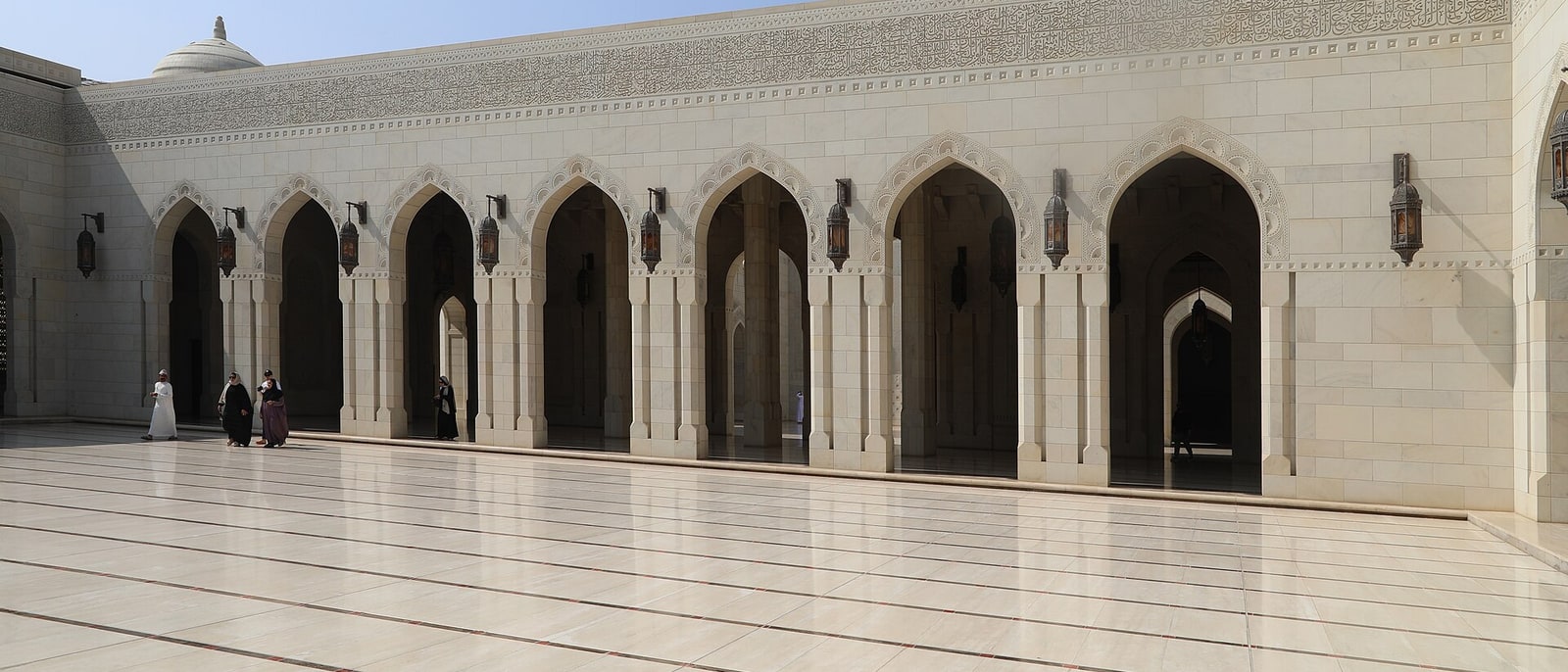
The Sultan Qaboos Grand Mosque was finished in 2001 and inside there are two objects to see up close. The main hall’s carpet was hand-woven by around six hundred women in Iran over four years, it’s a single piece and it weighs over twenty tonnes. When it was installed it was the largest carpet in the world. It isn’t any more, because the neighbour made a bigger one shortly after.
The central chandelier, fourteen metres tall, with Swarovski crystal and gold, was also the world’s largest in its day. And it too stopped being it.
That detail is more interesting than the figures: here both pieces remain what they are and nobody has gone out to build a bigger one to win the record back. It’s the difference in temperament between Oman and the rest of the Gulf, summed up in two objects.
The mosque mixes Omani, Persian and Indian architecture, and has five minarets for the five pillars. Entry is early morning only and not on Fridays.
- 03
The dhows and the port
In Muttrah bay dhows are still anchored, the wooden lateen-sailed boats that were this ocean’s merchant fleet for centuries. They’re still built in Sur, a coastal town two hours away, in yards where they’re made by hand, without plans, by eye, as they have been for generations.
Those boats explain everything. With them, using the monsoons, Omanis traded with India, with Persia and with East Africa, carrying dates and frankincense and bringing back spices, timber and slaves. A dhow left on the winter monsoon and came back on the summer one, six months later: this country’s entire calendar was set by the wind.
In the maritime museum you see how they’re built: without a single plan, with the frames sewn together with coconut fibre in the oldest ones, no nails. That a country could build an empire with that is what to take away from the port.
- 04
The real Muscat
Muscat stretches fifty kilometres today, but the original Muscat fits in a handkerchief: a cove wedged between cliffs, across the headland from Muttrah, with room for little more than a palace, two forts and a gate in the wall. You reach it through a tunnel or around, and it fits into a twenty-minute walk.
There’s the sultan’s palace, with its blue and gold columns, which isn’t open but is visible from outside, and the two Portuguese forts hung off the rock on either side of the entrance. And here’s the important part: that was all of it. That cove was the capital of a state that controlled the trade of half the Indian Ocean and that once held Zanzibar. The gates in that wall closed every night at dusk, and until 1970 anyone outside afterwards had to carry a lantern.
Seeing how small it is and knowing what it was is the best half hour in this city.
Frequently asked
Why is Oman’s frankincense famous?
Because it’s the best in the world and was worth more than gold for centuries: an absolute luxury in Rome, Egypt and Persia, and it grew only in a few strips of southern Arabia. It’s the resin of a tree, Boswellia sacra, which is cut and exudes drops called tears. In the souk it’s sold by grade: the large, pale, almost translucent ones are the good ones and smell of citrus and pine. The dark small ones are ordinary.
What time can you enter the Muscat Grand Mosque?
Early morning only, in a window of about three hours, and it doesn’t open to non-Muslims on Fridays. It’s visitors’ commonest mistake: plan the day around it. You must be covered, women with a headscarf and everyone with arms and legs covered. Inside is the carpet six hundred women hand-wove over four years, weighing over twenty tonnes.