Where to eat in Muscat
3 h route4 stopsBest: Eat late. And Omani coffee whenever it’s offeredUpdated July 2026
This country’s celebration dish gets buried. It’s called shuwa: a large piece of goat or lamb is marinated with spices, wrapped in palm leaves, put into a hole dug in the ground with embers at the bottom, covered with sand and left there for one or two whole days. It’s opened afterwards and the meat comes out falling apart and smoked. It’s made for Eid and for weddings, it’s a whole-family affair, and you don’t order it in a restaurant: you have to be invited or hunt hard.
That technique tells you where this cooking comes from: a place with no fridge where you had to cook without watching the fire, using the heat of the ground. Omani food is the kind cooked at home more than in restaurants, and what you’ll find outside is mostly the other thing: the food of India and Pakistan, which arrived across the same ocean the frankincense left by, and which has been here for centuries.
The route, stop by stop
4 STOPS- 01
Omani coffee, and the rite
Omani kahwa carries cardamom, comes in a small handleless cup, without sugar, and always arrives with dates and sometimes halwa. You’ll be offered it the moment you enter anywhere (a shop, a house, an office) and you always accept, because refusing is genuinely rude.
The protocol matters: you take it with your right hand, it will be refilled as long as you do nothing, and to say that’s enough you shake the cup slightly from side to side as you hand it back. Without that gesture, they keep pouring indefinitely.
And there’s something about Oman that has to be said here because it’s where it shows most: this country’s hospitality has no agenda. Elsewhere they offer you a tea and then show you a carpet. Not here. Here they offer you a coffee because you came in, and that’s it, and if you refuse to understand that you’ll miss the best of the trip.
- 02
Halwa
Omani halwa resembles no other sweet by that name: it’s a gelatinous paste, dense, translucent and very sweet, made with starch, sugar, rosewater, saffron, cardamom and nuts, served in a bowl and eaten with the fingers or a small spoon, always with coffee.
It’s made in enormous copper cauldrons and has to be stirred non-stop for hours, by arm, with a wooden paddle, because if you stop it sticks and it’s ruined.
It’s a trade: there are families who have been making it for generations and the difference between the good and the industrial is very noticeable. It’s this country’s social gift par excellence, you arrive at a house with a tray of halwa. Fair warning: it’s extremely sweet and heavy, and a small portion is enough. And the reason it’s eaten with bitter unsweetened coffee is exactly that: the coffee is there to cut it.
- 03
The fish and the majboos
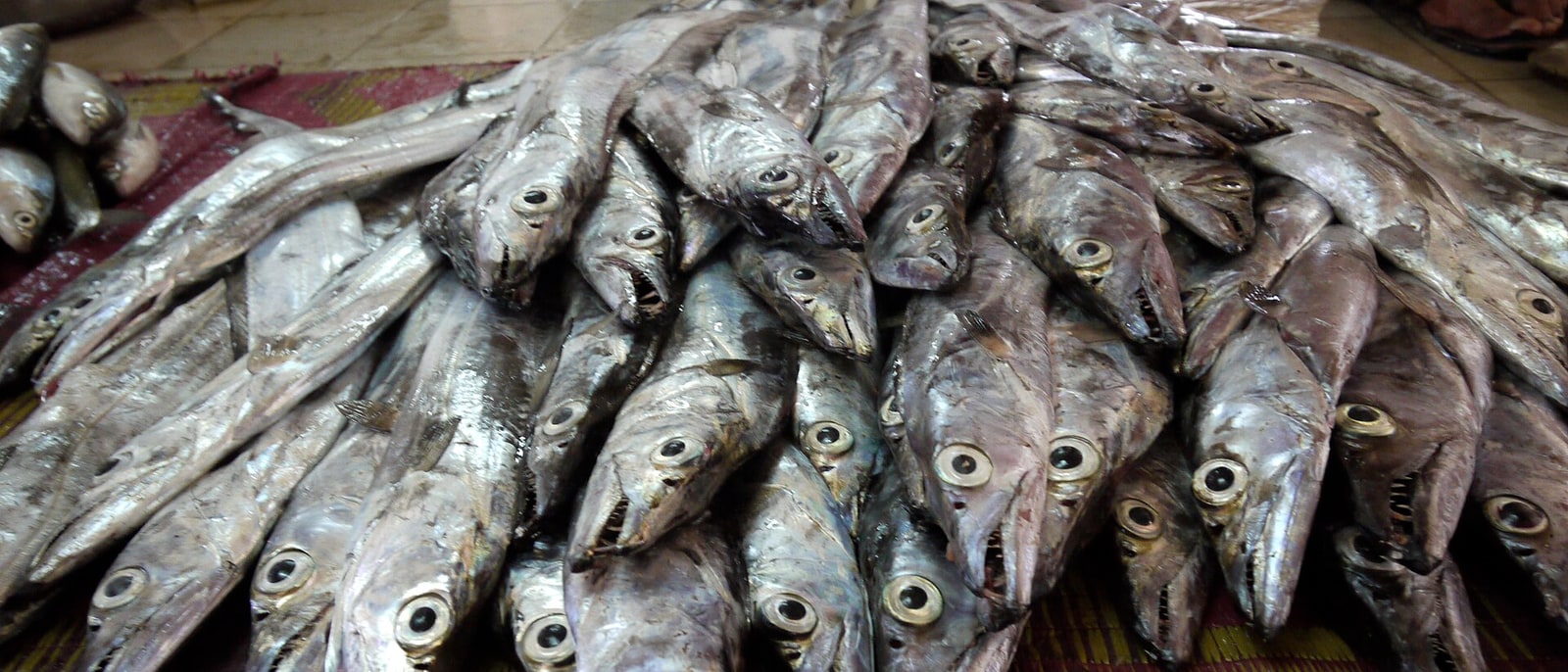
Oman has an advantage over all its neighbours and almost nobody mentions it: its coast faces the Indian Ocean, not the Gulf. That means open water, deep and cold with currents, and therefore fish of another category: tuna, swordfish, kingfish, lobster, and a fishing tradition still alive in villages all down the coast. At the Muttrah fish market, first thing, you can watch it landed.
On the table, the fish is grilled whole, with spices, or goes into majboos, which is this part of the world’s rice dish: rice cooked in the broth with spices and black lime, a cousin of Indian biryani and Saudi kabsa. Here the Omani version tends to be slightly less spiced and drier than the neighbours’.
And there’s a detail that throws people: in many places you eat sitting on the floor, on a carpet, around a communal tray, and with your right hand. If you’re invited to that, say yes without thinking.
- 04
The food the ocean brought
As across the rest of the Gulf, a good share of Oman’s population is foreign, above all from the Indian subcontinent, and that’s where the everyday food is. In Ruwi, the commercial quarter, there are dozens of Indian and Pakistani rooms where you eat dinner for very little: thali, biryani, south Indian curries, freshly made breads.
But here that food has a longer history than in the countries next door, and it’s worth telling: Oman and India have traded across this ocean for two thousand years. The dhows came and went with the monsoons, and with them came the spices, the rice, the people and the recipes, centuries before oil or aeroplanes existed.
When you eat a curry in Ruwi you aren’t eating recent immigrants’ food: you’re eating the result of a millennial maritime traffic. It’s the same route the frankincense left by heading north and the pepper came back on. That plate is trade history served on a steel tray.
Frequently asked
What do you eat in Oman?
Majboos, rice cooked in broth with spices and black lime, Indian Ocean fish, another category from Gulf fish, grilled, Omani halwa, a dense, very sweet paste stirred by arm for hours in copper cauldrons, and coffee with cardamom and dates, which you’ll be offered everywhere and always accept. The celebration dish is shuwa: meat buried in an underground oven for one or two days.
What is shuwa?
Oman’s celebration dish, and it gets buried: a large piece of goat or lamb is marinated, wrapped in palm leaves, put in a hole with embers at the bottom, covered with sand and left for one or two whole days. It comes out falling apart and smoked. It’s made for Eid and weddings, it’s a whole-family affair and you don’t order it in a restaurant: you have to hunt hard or be invited.