Muscat in a day
8 h route4 stopsBest: November to March. In summer here too you take coverUpdated July 2026
In 1970, Oman had around ten kilometres of paved road in the entire country, three schools and one hospital. The sultan of the day, Said bin Taimur, had banned sunglasses, radios and bicycles, and his personal permission was needed to build a house or to leave the country. The gates of Muscat closed at dusk and anyone on the street afterwards had to carry a lit lantern, by law.
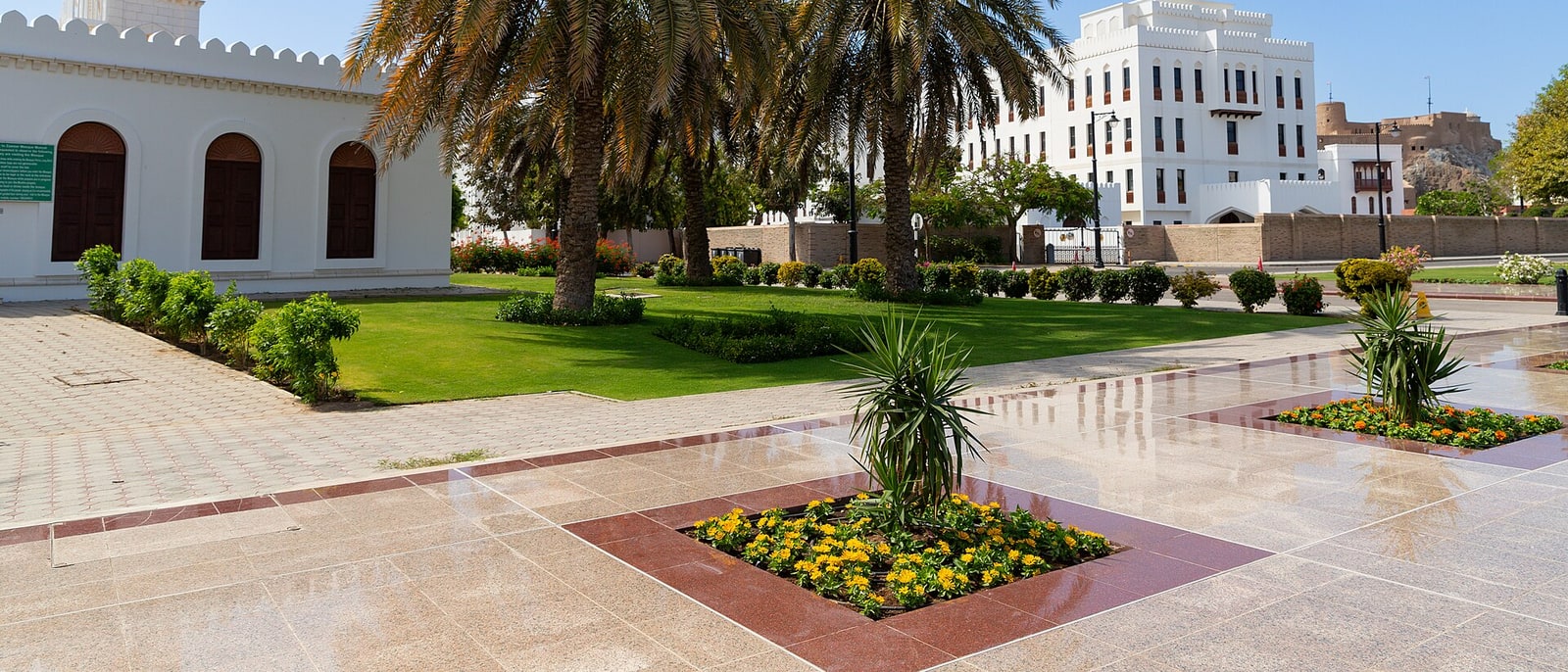
That year his son Qaboos deposed him in a palace coup and began building a country from nothing. Everything you’ll see today (the roads, the mosque, the hospital, the university, the opera house) came after that date. It’s a fifty-odd-year-old country built on top of one of the oldest states in the Arab world. And unlike its neighbours, it did it without skyscrapers: building height here is limited by law. A day in Muscat is calm, white and low, and that’s the entire argument.
The route, stop by stop
4 STOPS- 01
The Sultan Qaboos Grand Mosque
First the hours, because they ruin the visit for plenty of people: you can only enter early in the morning, in a window of about three hours, and it doesn’t open to non-Muslims on Fridays. Miss it and there’s no second chance that day. Plan the day around this rather than the other way round.
Inside, two pieces. The prayer hall carpet is a single piece hand-woven by around six hundred women in Iran over four years, and it weighs over twenty tonnes. It was the largest in the world until the neighbour made a bigger one. And the central chandelier, of Swarovski crystal and gold, was also the world’s largest in its day. That detail, having been the largest and having stopped being it without anyone here getting upset, says a good deal about the difference between this country and the ones next door.
The mosque is from 2001 and mixes Omani, Persian and Indian architecture. You must be covered: women with a headscarf and everyone with arms and legs covered. And it’s done in silence.
- 02
The Muttrah Souq
One of the oldest markets in the Arab world, beside the old port, under a wooden roof with skylights that let the light in as shafts. It’s a labyrinth rather than a corridor: you go in and get lost, which is what people do here.
What sets it apart from other souks in the region is that this one smells. The moment you go in the frankincense reaches you, because here it isn’t a tourist souvenir: it’s the national product. Oman produces the best frankincense in the world, in the Dhofar region to the south, and has been selling it for millennia. It’s bought by grade, and they differ greatly: the large white tears are the good ones, the dark small ones are ordinary. They’re sold with the clay burner and the charcoal.
Buy dates too, Omani halwa (a dense paste of sugar, egg and saffron eaten with coffee) and look at the khanjar, the curved daggers worn at the belt that are on the country’s flag. You haggle, but gently and smiling: aggressive haggling here is considered bad manners.
- 03
The corniche and the forts
Muttrah’s seafront skirts a horseshoe bay, with the white houses on one side, black rock mountains behind and the wooden dhows anchored in front. At dusk everyone comes out to walk and it’s the best hour in Muscat without argument.
At the far end, guarding the entrance to the old port, two forts are wedged into the cliff, one on each side: Al Jalali and Al Mirani. The Portuguese built them in the late sixteenth century, when they held Muscat for nearly a century and a half as a staging post on their route to India.
The Omanis threw them out in the mid-seventeenth and kept the forts, which are still there, in official use and closed to the public. You see them perfectly from the promenade.
That detail is the one to take away: this isn’t a new country that invented itself with oil. It’s a place a European power fought over four hundred years ago because it controlled the way into the Indian Ocean.
- 04
The opera house
Muscat has an opera house, of marble and wood, with a genuinely international programme, and behind it lies the best story in this city. Sultan Qaboos was an obsessive music lover: he studied in England, played the organ and was fascinated by Western classical music.
In 1985 he decided his country was going to have a symphony orchestra. The problem was that Oman had no classical musicians, no conservatoire and no tradition at all: fifteen years earlier there had been three schools in the whole country. So he did the only possible thing: he selected a group of Omani children, put them in a boarding school and trained them from nothing for years, with teachers brought from abroad, until in 1987 they gave their first concert.
The orchestra still exists and it’s entirely Omani. A country that in 1970 banned radios today has a national symphony that began as a classroom of children. The opera house is worth seeing even from the outside, and if there’s a performance, go.
Frequently asked
What to see in Muscat in a day?
The Sultan Qaboos Grand Mosque, but entry is early morning only and not on Fridays: plan the day around that. The Muttrah Souq, which genuinely smells of frankincense because it’s the national product. The corniche walk at dusk, with the two sixteenth-century Portuguese forts guarding the port. And the opera house, which exists because the sultan built a symphony orchestra from scratch with Omani children.
Why are there no skyscrapers in Muscat?
Because they’re limited by law: the regulations restrict building height and require a traditional style, white and low. It’s a deliberate decision and it’s the opposite of what the Gulf neighbours did. The result is a low white capital wedged between dark rock mountains and the sea, spreading fifty kilometres along the coast instead of growing upwards.