Cusco in a day
8 h route4 stopsBest: On your first day, slowly: you’re at 3,400 m and your body noticesUpdated July 2026
Cusco is at three thousand four hundred metres and that has to go into the plan from minute one: the first day isn’t normal sightseeing, it’s slow sightseeing. A slope you wouldn’t notice at home leaves you breathless here, and pushing on day one is the commonest way to spend day two in bed.
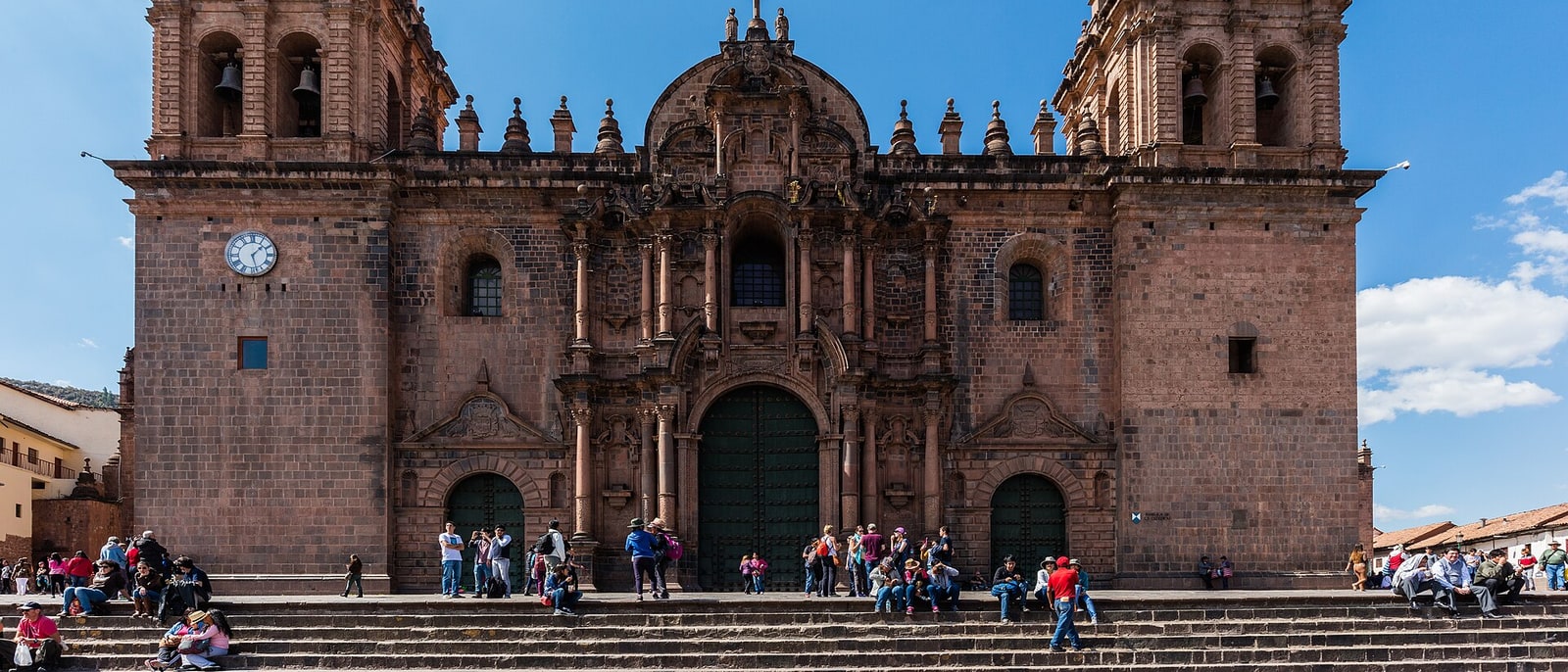
Happily the city is compact and the essentials sit around the Plaza de Armas. The route below climbs very gradually and leaves the highest point, the fortress, for the end of the day, once you have hours of acclimatisation behind you.
The route, stop by stop
4 STOPS- 01
Qorikancha
The Temple of the Sun stood on this ground and was the religious centre of Tahuantinsuyo: the chronicles say the walls were sheathed in gold plate and that there was a garden of life-size gold and silver plants and animals. The Spanish took all of it and raised the convent of Santo Domingo on top.
What to look at is how the two things meet. The earthquakes of 1650 and 1950 brought down much of the colonial building and the Inca walls didn’t shift a finger’s width.
Stone cut so precisely the joints won’t take a sheet of paper, and not a drop of mortar. The answer to why they hold is in that joint.
- 02
The Plaza de Armas and the cathedral
The square worked as the Inca Haukaypata, the ceremonial centre where the empire’s four roads met, and today the cathedral and the church of La Compañía frame it. The cathedral was built with stone brought from Sacsayhuamán: that is, by dismantling the Inca fortress to raise the church. Inside hangs the painting to see: a Last Supper of the Cusco School where the main dish is a roast guinea pig, feet in the air, and the cups hold chicha. Indigenous painters learned the European technique and put their own world inside it. That isn’t an anecdote: it’s the entire Cusco School summed up in one canvas.
- 03
Hatun Rumiyoc street and the twelve-angled stone
A narrow lane with an Inca wall on one side that was the palace of Inca Roca and is now the archbishop’s palace. The famous stone has twelve angles and fits perfectly with every stone around it, without mortar and without a gap.
It’s worth looking past that particular stone, which always has a crowd around it: the whole wall is just as good.
And note that the stones aren’t rectangular but polygonal and irregular: fitting irregular shapes is far harder than stacking ashlars, and it’s precisely what lets the wall absorb earthquakes instead of splitting.
- 04
Sacsayhuamán
Above the city stand three zigzag terraces built from cyclopean blocks: the largest weighs over a hundred tonnes and meets its neighbours with the same millimetric precision as a small wall. They were moved from quarries kilometres away, without the wheel and without draught animals. What you see today is a fraction: the Spanish used it for centuries as a quarry to build Cusco, and only the blocks too large to move survived. You can walk up, but on your first day at altitude it’s better to take a taxi up and walk down.
Frequently asked
How long does it take to acclimatise to Cusco’s altitude?
Most people feel fine from the second or third day. Take the first one gently: arrive, drop the bags, walk little and on the flat, drink plenty of water and avoid alcohol. Most people notice some headache and shortness of breath in the first hours.
Why are the Inca walls still standing and not the churches?
Technique: polygonal stones cut to interlock without mortar, with faces leaning slightly inward. In an earthquake the blocks move and settle back instead of breaking. Colonial masonry with mortar is rigid and cracks. In 1650 and 1950 the difference was plain to see.